Nimsdai: The Man Who Conquered Mountains?

There is something about successful people that we resent, especially when they have risen through the ranks. Their ascent underscores the smallness of our own existence of how we have wallowed in the bottom while these people made it to the very top through the force of their will and determination, by not following conventions, by breaking all rules and norms and in that process leaving their personal imprint. Our lives are but imprints on the sand of time, while theirs is a marker etched for ages.

We admire these souls even as we envy them. We gape at their ascent and somehow celebrate their fall. It’s the heel that we look at in every Achilles.

The story of Nirmal Purja or Nimsdai, as he was popularly known, follows the same pattern. The irony of it is that it took an avalanche to stop him.

Nims’s death on Broad Peak in Pakistan brings an untimely close to a chapter in mountaineering history: the story of a man who, in a matter of a few years, created a name and legacy that will inspire people, and that many will revile.

It was in 2019 that this man from Nepal barged his way into global news with his extraordinary feat of summiting the 14 highest mountain peaks in the world (the 8000ers) in less than seven months. The previous record had stood at seven years, and this man, with his seemingly insane bravado and chutzpah, scaled these peaks like we undertake a morning walk at Lalbagh, climbing the little hillock there.

But while his achievement stood out in the news, it was actually the documentary on Netflix “14 Peaks” that turned him into a global icon. The documentary was released in 2021, and “Nothing is Impossible” was a mantra that inspired many mountaineers.

There is one clip in particular during one of his ascents, when other climbers are in doubt about going through with the climb, he smiles to the camera cheekily and says, in a sing-song way, “Giving up is not in the blood, sir.”

One could argue that he was no Hillary, Norgay, or even Messner, and he seemed quite aware of it. Instead, he was always wanting to do better than them. There is this anecdote of Michael Phelps, the most decorated Olympian in human history, when a younger version of him was told that he had a chance to be the second Mark Spitz (another record-breaking Olympian), he scoffed at the suggestion, stating that he rather be the “first Michael Phelps.” In that sense, Nims was not a mountaineer, the kind who simply enjoyed the challenge of going up the mountain and pushing themselves against the limits. He was a competitively charged sportsman for whom limits were merely a hurdle to overcome – someone who wants to be on the podium under the arclights.

Through the times, we have witnessed how mountaineers metamorphise when they summit a peak. Astronauts who blast out into orbit undergo something similar, it is called the Overview Effect. Looking at the planet from above, their perspective undergoes a change. They don’t see boundaries, countries, or borders, but a fragile blue planet in the seemingly endless darkness of space.

Similarly, standing at the top of Everest, mountaineers realise the fragility of human life and the sturdiness of human will. Standing at a height, at which commercial planes operate, with the clouds underneath their feet – it is hard not to feel invincible. But those agonizing hours in the death zone, where every step is an achievement by itself, there is also that respect for the elements, for nature. There is a realization that sort of creeps in – the ascent and the summitting was not an act of subjugation or triumph. But rather a fortuitous benediction, a passage that was granted to them. Standing 25000 feet closer to heaven, you become aware about the power of the elements – lets call it the Overstanding Effect.

Did Nims feel the same reverence towards the mountains?

Maybe. But he didn’t really show it, if at all he felt it. For him the peaks were there to be summited, mastered to be conquered, to be vanquished.

He did grant some allowance to the forces of nature, when he underscored that he did not take the mountain for granted and asked for a safe passage. But ultimately he believed in himself. “The biggest strength I have is, I have no fear.” Like Phelps, he scoffed at conventions, when people expressed doubt at the possibility of his 14 Peaks project, he dubbed the endeavour as Project Possible, a sort of a middle finger to his naysayers.

In the documentary, there is one sequence that truly stumped me. Generally, any expedition to the Everest peak or any other starts in a sombre manner. In a sort of ritualistic way, with the climbers performing puja, beseeching the mountain gods for safe passage.

On 12th of May, 2019, he summits Dhaulagiri – the second mountain in his project. He then travels to Kathmandu for a meeting a client, who could be an important funder. He parties with the client all night drinking and dancing till 6 AM. Then, without resting he proceeds directly to Kanchenguna, the third one of his project, and reaches the summit in a single ascent from bottom to top. In the video, he seems so groggy and high that it seems absurd he was able to do it at all. You could credit the climb to his elite forces training, his endurance or even to the acclimitisation. Yet, even accounting all the possibilities, this one was an extraordinary feat. Somehow, between the rituals and the revelry, it makes you wonder if the mountain gods have truly lost their mojo. I mean, if someone could amble up an 8000er in a hangover, what’s the fuss about all that reverence and deference? Is the sublime soluble in alcohol?
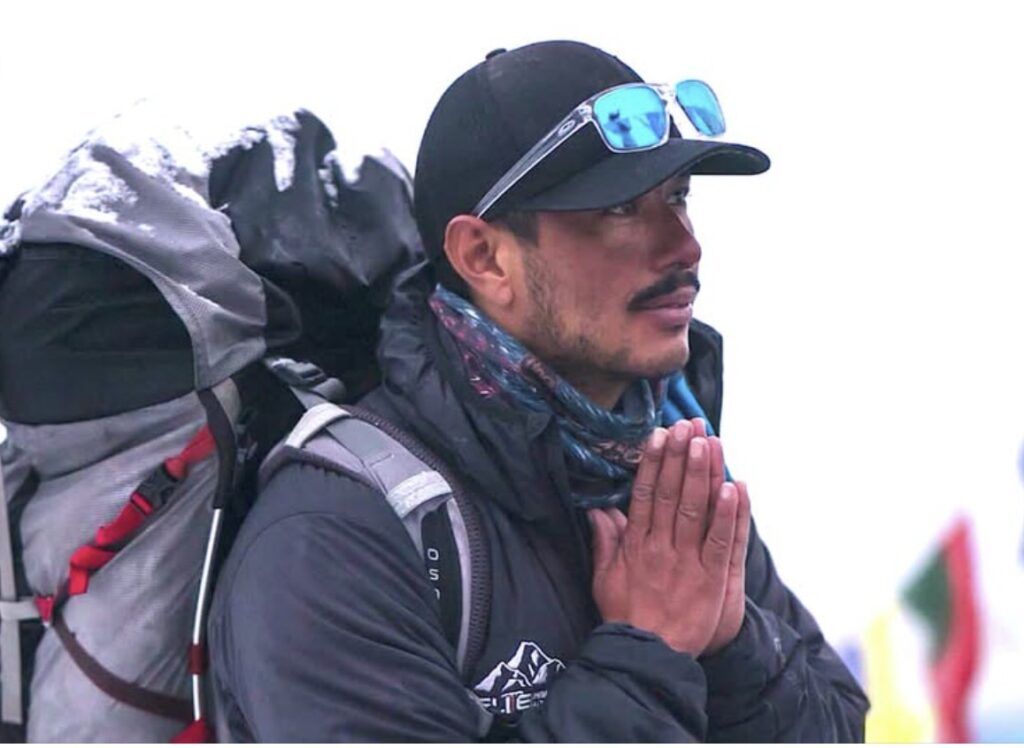
This is where Nims was different from us Middle Earth people, who are thankful to fate and the powers above for whatever little or more scraps destiny throws at us. Not Nims, he believed he deserved a lot more, and would snatch his glory from the gods if they dared stand in his way. Life became a relentless pursuit of the next summit. After tasting success and creating a record that would be hard to emulate, Nims did not sit back and start enjoying the fruits of the work by writing books and giving talks. Well, he did do all that, but he wanted to do something harder, something almost impossible to emulate: creating one mountaineering record after another. And so he did:

The first winter ascent of K2. All 14 peaks without supplemental oxygen. The first person to complete all the 8000ers and the Seven Summits. A record number of 8000ers climbed. Eighteen Guinness World Records.

When his 2019 ascent of the 14 Peaks was questioned over the use of supplemental oxygen, he climbed all 14 peaks again without oxygen support to prove his superiority. This time, it was 2+ years instead of 7 months.

His expeditions were arduous and tough, but also very organized. He ran it like a well-oiled machine, helicopter transfers, fixed ropes, hardened and dedicated set of Nepali sherpas in his team. He created a commerce-driven ecosystem with him at the very centre – with companies like Elite Exped, Nimsdai Store, Nimsdai Foundation, Skydive Nimsdai and so on.

Nims was not only hard-headed mountaineer, but also a canny businessman – smart and astute. He was well aware of the power of story-telling. He built this aura of invincibility around him. He was the brand, the icon – the living embodiment of Nothing is Impossible mantra. All his posts on social media featured him and him alone. And he had lots of followers – on Instagram he had over two million followers; on X (formerly Twitter) more than 100,000; on YouTube, 500,000.

This was the commercial engine, through which he was raking in the money.

The irony is that in 2019, during his climb to the top of Everest – he had taken and posted a picture of the traffic jam to the top – showing hundreds of people lining up in a single file on Hillary step to reach the top. The picture went viral sparking a debate on commercialization of mountaineering – especially on Everest.
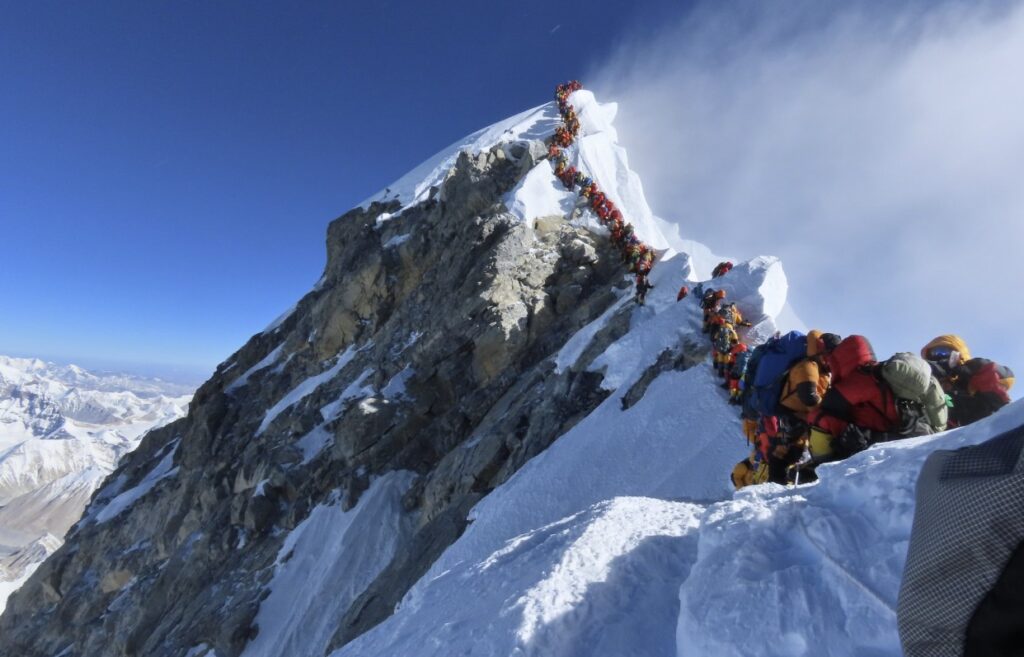
In 2019, Nims was hinting at this commercialization and by 2026, he was a prominent beneficiary of it.

Nims explained this contrast by talking about the benefit this accrued to his country and his people. Despite being a UK citizen, Nims was a proud Nepali within. Time and again he emphasised how Nepali climbers, especially the Sherpas and the porters, went unrecognized despite of them ascending the summits multiple times in their lifetimes. To right these wrongs, he set up a core team of Nepali climbers who seemed to share his passion and chutzpah.

In the Netflix documentary, when he completes the mission, he pronounces loudly that had a Westerner or a white man conquered the 14 Peaks in this record time, there would be ten times more renown and acclaim – it was a grouse of a brown man living in a world designed to deify the white man. And this was something that he railed against through his life, about being vilified, or being scorned and belittled. The only way, he could break the hallowed citadel was through the sheer will of his determinations, through the bolts of his records. He knew that because of his origins, the accented English or the colour of the skin, he will never be accepted as one. But the mountains don’t make such distinctions, they do not judge or moralise. For them a brown, a white, or even a purple is all the same. It didn’t matter if the climber was humble or arrogant.

But his irreverence and the unconventional mountaineering style made him a target – he had many detractors. While Nims focused only on the summit and the ascent, a great alpinist like Reinhold Messner emphasised: “The summit is only halfway.”
People would constantly point to the purist approach to mountaineering, called Alpine style: doing it on your own, without much support or logistics. By that measure, Nims was surely a deplorable pagan, a barbarian.

In his short lifetime of fame and glory, there were other accusations too, from financial ones to sexual abuse. But in his characteristic manner, Nims fought back, loudly and strongly. He could not be cowed, neither by the peaks nor by his detractors.

He knew that whatever the outcome, so long as he stayed ahead of the pack, he would continue to reap the rewards. His focus was singular: creating new records. And that, in some way, was also his undoing.
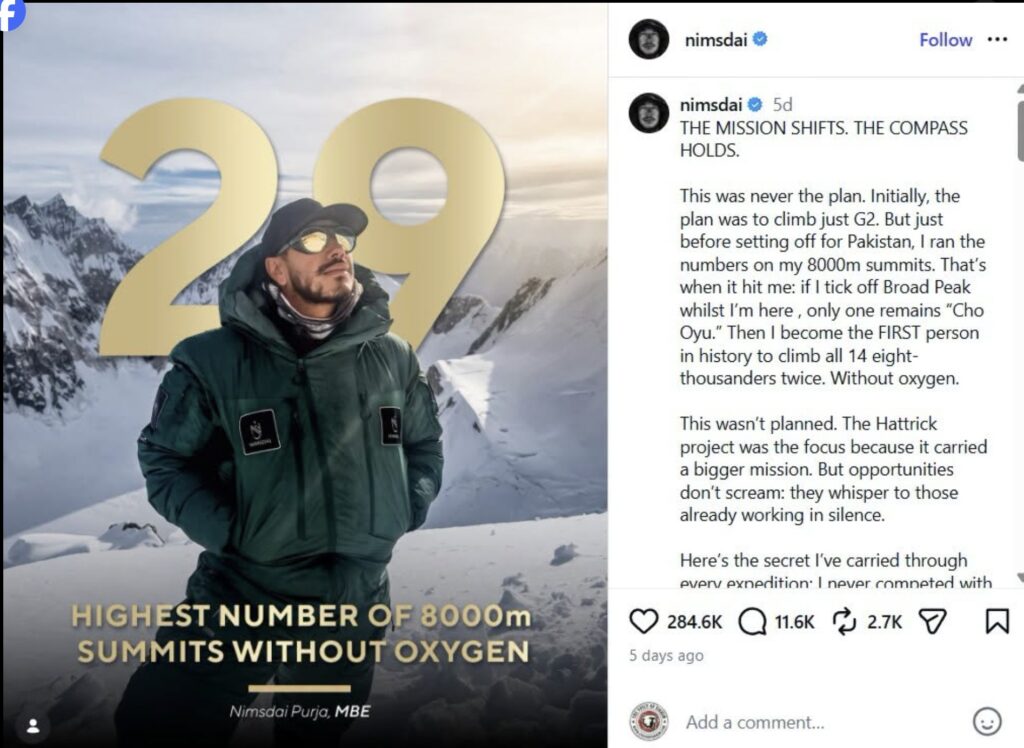
His last post on Facebook revealed that he was in Pakistan, climbing G2, and while preparing for the expedition, he did a number check: if he were to climb Broad Peak in Pakistan, it would be his 13th peak, and then only Cho Oyu would remain to be conquered, making him the first person in human history to have ascended the 14 peaks twice without oxygen. That would be his hat-trick record of climbing the 14 peaks, something, again, almost impossible to emulate.

Broad Peak had an interesting connection to Nims. During his first record-breaking attempt, after he summited Everest, Lhotse, and Makalu in 48 hours – becoming the first person to do so – he headed to Pakistan to climb the five treacherous mountains there: G1, G2, K2, Nanga Parbat, and Broad Peak, all the five 8000ers.

Nims ascended the five peaks in a record time of 26 days, a record that has been unsurpassed and is likely to stay that way for a long time to come. The last peak he conquered was Broad Peak. It was here that he created the record, etched his legacy.

It is also here that the Nims story comes to a sad end.

Perhaps the mountain gods, incensed by the irreverence and nonchalance of this mortal, were waiting for their chance, biding their time. They enticed Nims with a record-breaking feat, and then, when they had him vulnerable and in a spot, they crushed him under the weight of snow and ice.
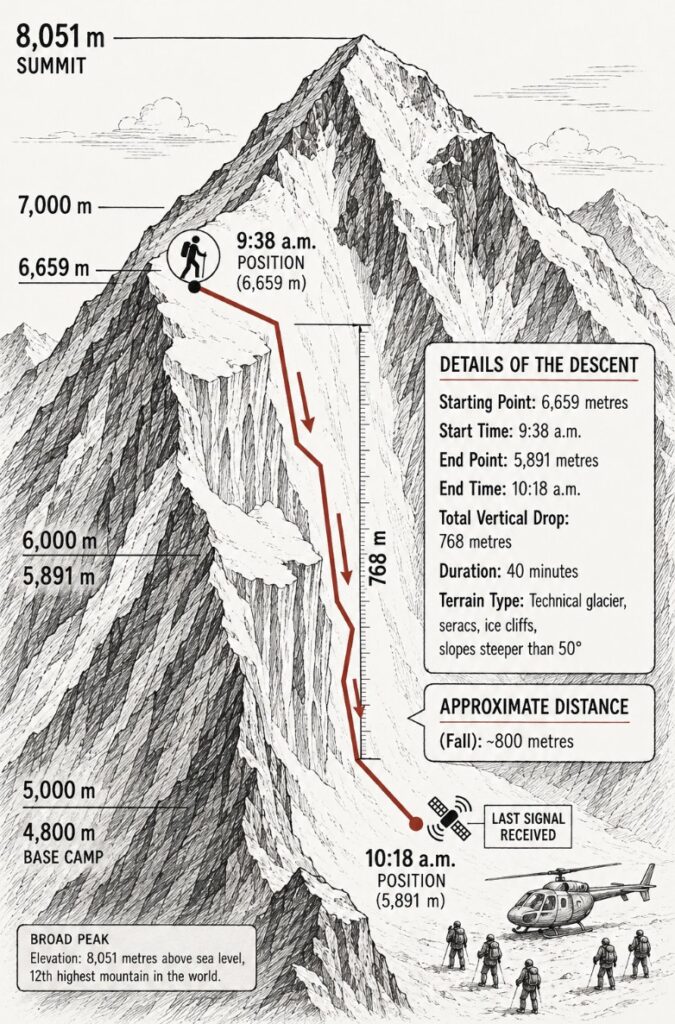
Through his short mountaineering life, Nims was famous for his rapid ascent. The quick strides whereby he would climb metres in minutes – reflecting on his superior physicality. The avalanche that extinguished his life took him on a rapid descent.

There is aphorism that goes something like – there are old climbers and there are bold climbers, but there are never old, bold climbers.

Nims was definitely a bold one. He now is part of an extraordinary league of legendary climbers who lost their lives in the very mountains they loved, starting from George Mallory, to Anatoli Boukreev, Alex Lowe, Ueli Steck to David Lama. The list is long and illustrious. Nims will be among the rarified stars.

In his brief life, Nims burnt through the stratosphere like a rocket. His life will become a folktale, people will retell, emphasising how dreams come true and how impossible becomes possible if you really believe hard enough. Destiny can be manifested.

Others will warn that ambition and arrogance are a heady concoction, that it will almost always result in tragedy. Don’t upset the fates, they will love to rip you out, they will warn.

That is quite understandable. After all, people who live and die in the safety of terra firma will never really know what it is to soar over the clouds, to be closer to heaven, to live and to breathe deeply, to drink heavenly ambrosia standing on the top of the world.

We will focus on the heels. But then, Achilles would never have it any other way. Rest a bit, Nimsdai, you finally can.

Continue reading
आग जलनी चाहिए — The Fire Must Burn

A post from a friend about a Malayalam movie, Amma Ariyan, forced me to confront what I had been trying to avoid for quite some time.

Like so many of us who live for the simple रोटी, कपड़ा, मकान and don’t want to be न किसी की तीन, न तेरह — ignorance, at times feigned, is an amazing cloak. It wraps you into a stupefaction, a sense of disbelief that even if “all izz not well,” it might just eventually be — and that when it does end well, all will automatically be well.

It is this meekness within you that covers your vision — rendering you unable to see things the way they are, or to come to terms with reality as it is.

Over time we tend to become so much like the courtiers in the Emperor’s New Clothes — muffling our conscience for a little bit of peace.

And then, when the curtain over our eyes is jerked out suddenly, you are ashamed of your wretchedness, of your own weakness. The world suddenly seems so raw and unvarnished — you now have to confront the sheer wantonness that is so ubiquitous, the squalor, the putrefaction of values, the sheer morbidness.

It is suffocating — how could one buy peace in such conditions? How can one come to terms with it?

It is disgusting, infuriating — you hate what’s around you, and also what you have become, buying scraps of peace with conscience as the currency. But now the price seems just too high.

And just when you are sort of drowning in this slough of despondency, Dushyant Kumar appears like an apparition — speaking words of revolution, of change. His words give warmth, they give hope, and most importantly, they give you a roadmap of how things could shift.

हो गई है पीर पर्वत-सी पिघलनी चाहिए,
इस हिमालय से कोई गंगा निकलनी चाहिए।

His short poem — ho gayi hai peer parvat-si… — is an anthem of revolution, of courage, of standing up, of not giving up.

आज यह दीवार, परदों की तरह हिलने लगी,
शर्त लेकिन थी कि ये बुनियाद हिलनी चाहिए।

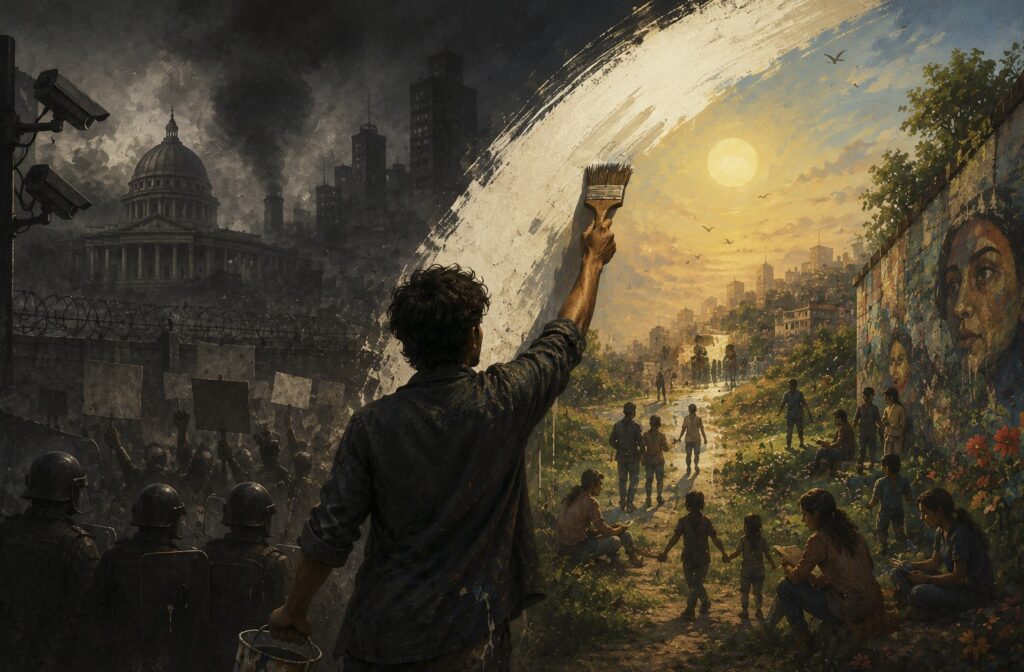
This does not imply making a compromise with either the system or its stooges — maggots that have grown fat feeding off the lard of corruption, even as they dress up nobly and act saintly. The system needs to be dismantled. It needs to be overhauled.

हर सड़क पर, हर गली में, हर नगर, हर गाँव में,
हाथ लहराते हुए हर लाश चलनी चाहिए।

We need deep-seated change — a shift away from all the encumbrances that bind us down: caste, creed, language, religion. These compartmentalizations must be eviscerated. A system plagued by rampant inequity and steeped in corruption cannot, and must not, be allowed to beguile or misguide us any longer.

सिर्फ़ हंगामा खड़ा करना मेरा मक़सद नहीं,
मेरी कोशिश है कि ये सूरत बदलनी चाहिए।

Many times in the past there have been moments when people rose, only to retreat when confronted by the state. Silence is the price the system demands. And ironically, disquiet is the only way the system can be jolted. Whether it will change or shift, one can’t say — but that should not deter us from the objective.

मेरे सीने में नहीं तो तेरे सीने में सही,
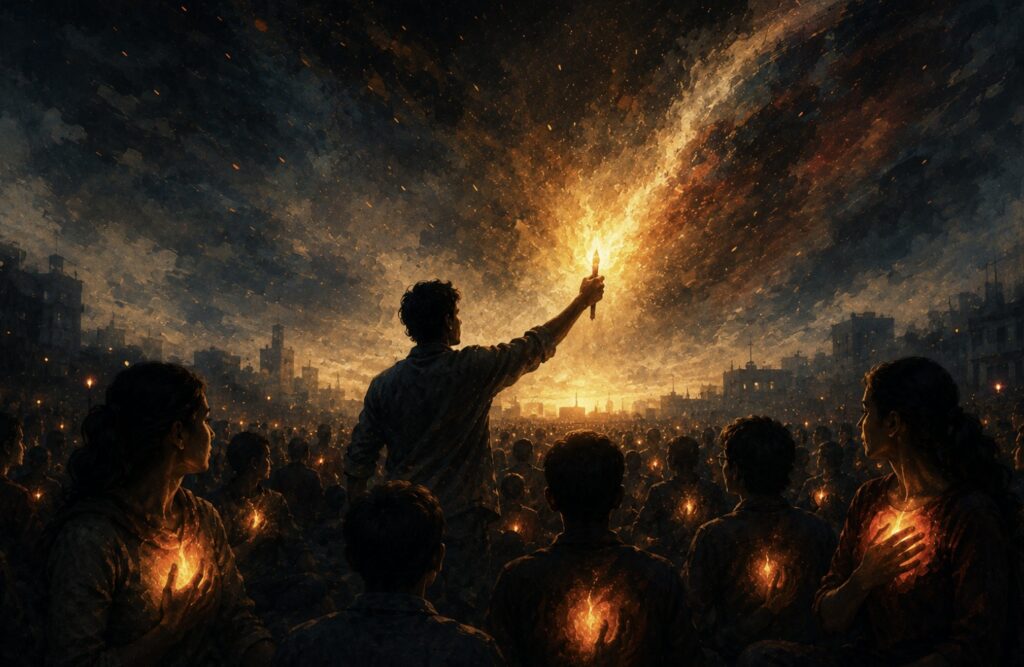
हो कहीं भी आग, लेकिन आग जलनी चाहिए।

The only regret is that the bravado that comes with youth is often amiss elsewhere. Experience is a lousy teacher — it teaches only profit, ROI, benefit, survival. It does not concern itself with society, nation, or state; it prioritizes only self-preservation.

Little wonder, then, that it is the young who are at the front, leading the call for change — getting whacked, getting beaten, and yet persisting. It is they who give us hope of a possible breakthrough.

हो कहीं भी आग, लेकिन आग जलनी चाहिए।

Indeed, the fire must keep burning and consume all — so that something new can be created from the rubble. Something that belongs to all of us, and to which we, in turn, belong.

Here is the full poem – without break

हो गई है पीर पर्वत-सी पिघलनी चाहिए,
इस हिमालय से कोई गंगा निकलनी चाहिए।

आज यह दीवार, परदों की तरह हिलने लगी,
शर्त लेकिन थी कि ये बुनियाद हिलनी चाहिए।

हर सड़क पर, हर गली में, हर नगर, हर गाँव में,
हाथ लहराते हुए हर लाश चलनी चाहिए।

सिर्फ़ हंगामा खड़ा करना मेरा मक़सद नहीं,
मेरी कोशिश है कि ये सूरत बदलनी चाहिए।

मेरे सीने में नहीं तो तेरे सीने में सही,
हो कहीं भी आग, लेकिन आग जलनी चाहिए।

— Dushyant Kumar

The Guru’s Arrow – by Kabir

सतगुर लई कमाँण करि,
बाँहण लागा तीर।
एक जु बह्या प्रीति सूँ,
भीतरि रह्या सरीर।।

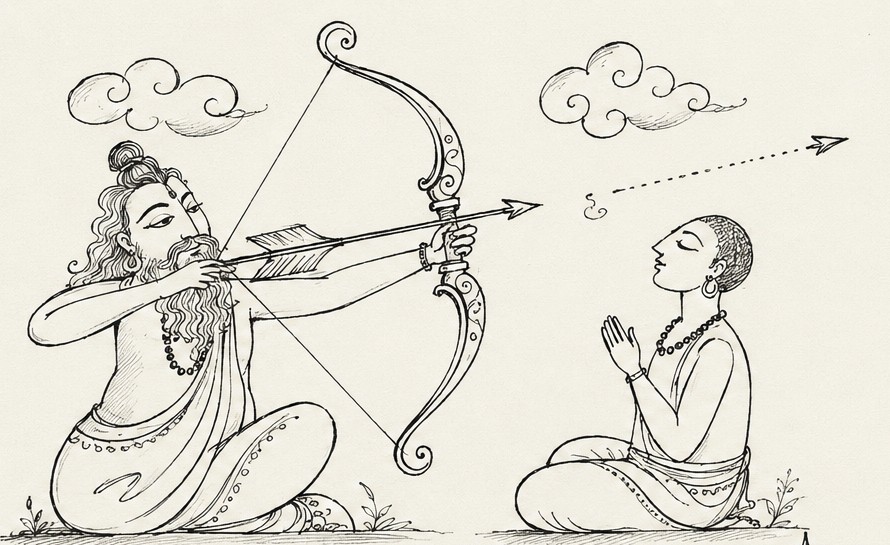
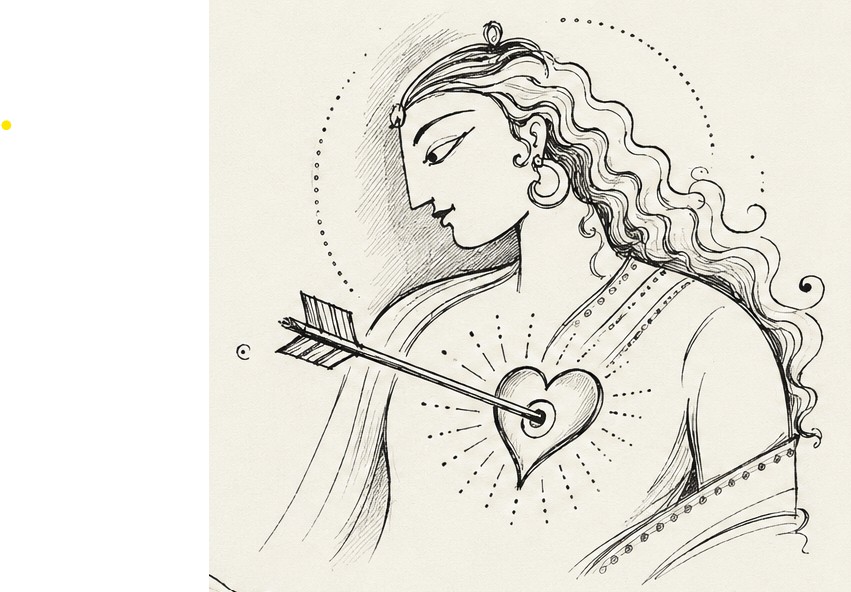
The satguru took up the bow, and let the arrows fly. But the one shot with love — that one stayed lodged within the body.

Finding a guru — or someone who opens up our inner consciousness — is a theme that repeats quite often in Kabir’s words. A life that has been untouched by the master almost seems worthless.

The ability to surrender abjectly in front of a person — to trust his words, his actions, his commands — to follow him — is a thought that seems so absurdly impossible. How can one surrender? How can the rational mind take a backseat? It seems impossible and implausible.

Yet, I have read about so many such accounts — of Narendranath Datta meeting Ramakrishna Paramhansa and surrendering before him and becoming Vivekananda. And then, of course, there is the mythic Neem Karoli Baba, and so many of his followers who were touched by him. Not to mention the stories of Sai Baba, who has become a deity from a person.

Coming back to Kabir — the doha talks about how when an accomplished teacher comes into our lives, it undergoes a complete transformation.

सतगुर लई कमाँण करि,

As soon as the teacher picks up the bow, this is also symbolic of how the teacher accepts the pupil — he decides to invest his actions in transforming the shishya. This act of acceptance is itself the first threshold. The moment we cross that —

बाँहण लागा तीर।

the arrows start flying. The process is on, and in certain ways, relentless. The guru is not looking at compartmentalisation — he will not solely focus on one aspect, say, like Dronacharya taught Arjun the skill of warfare. But he will go beyond. Everything is under the range of his bows and arrows; everything that he does will bring that change.

एक जु बह्या प्रीति सूँ,

But even in his quiver, there is this one specific arrow that truly stands out — that is love, or devotion. Whatever else one might do in life — in terms of learning, acquiring skills, gaining experience — it is only when one is touched by that sensation of divine, cosmic love that one truly understands the real meaning of existence, the purpose of life itself, the real concept of Brahman — the universal force. It is only through love and devotion that we can realise the god.

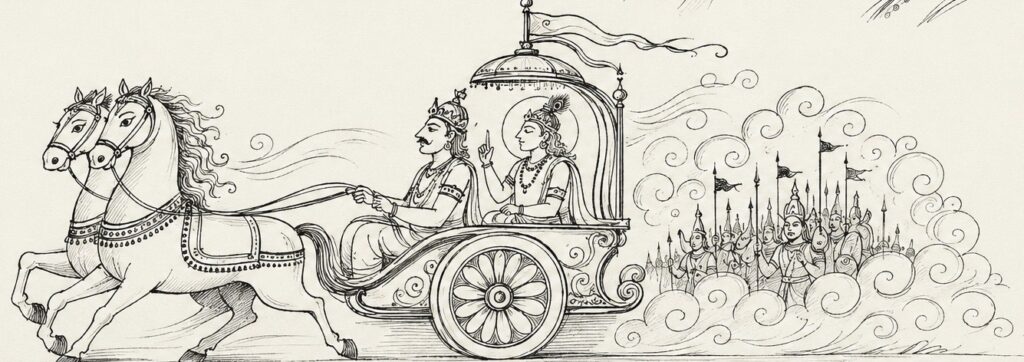
In short, a guru can be a transformative person — guiding you when you fail or falter — like Krishna, right in the middle of the battlefield, spelling out the course of action that must be undertaken, dispelling the doubts. But Krishna is unique. He is celestial, divine, friend, and also the guru — he is the arbiter, and the one to whom all our actions accumulate. When he declares — अहं ब्रह्मास्मि, “I am the universe” — it doesn’t seem like a claim, but merely an attestation of fact.

भीतरि रह्या सरीर।।

And now, when that arrow of love and devotion pierces through us, it embeds itself. It transforms. It does not leave us. This is the arrow that takes us down the road of realisation — toward union with the Brahman.

Every other arrow the guru shoots — knowledge, skill, discipline — does its work and is spent. Only this one stays lodged. Only this one keeps working on us after the guru has stopped teaching, after the lesson is long over.

Because this arrow does not just point outward, toward the Brahman. It turns us inward, first. We meet ourselves. And it is only by that route — through ourselves — that we meet our maker.

Meet the fantastic Ficus krishnae

The Ficus genus is vast and varied; there are about 850 species of plants in the Ficus genus, ranging from woody trees, shrubs, vines, or epiphytes in the family Moraceae. Approximately 115 species of ficus are present in India, the most popular being the Peepal (Ficus religiosa), the Banyan (Ficus benghalensis), and so many others. 

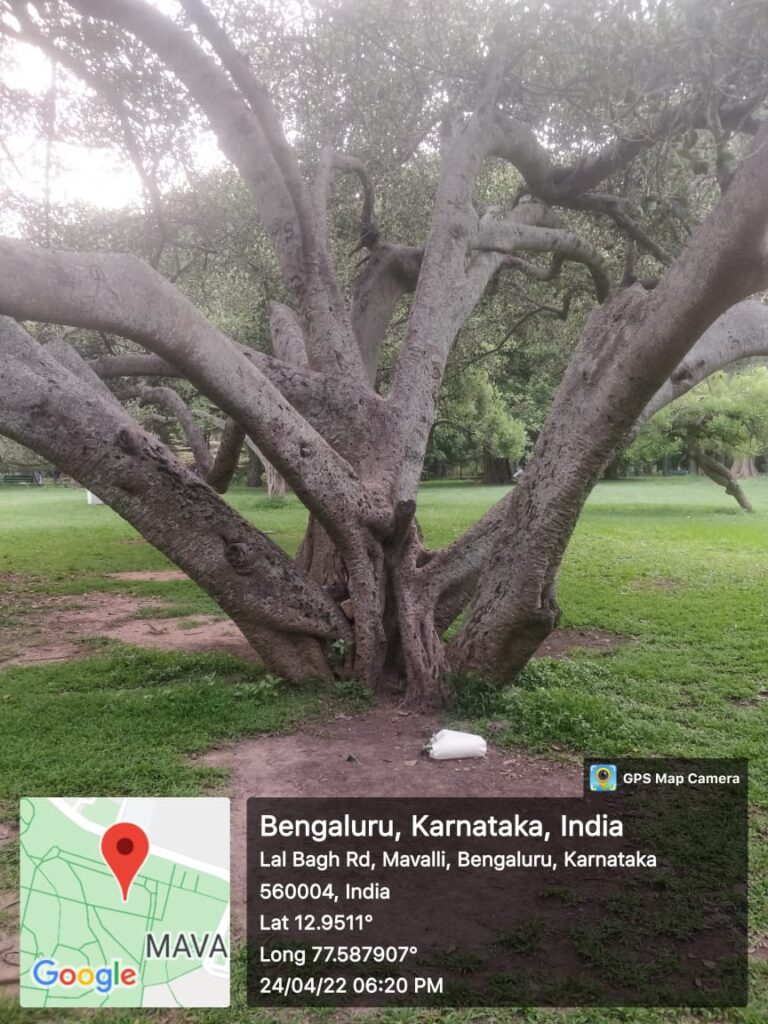
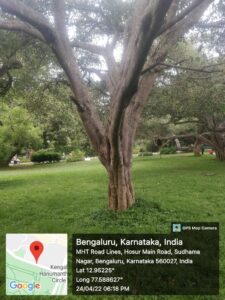
Of the many such figs that stand tall (or rather spread wide) is a particular tree in the Lalbagh Botanical Gardens in Bangalore. Dubbed Ficus krishnae, it is thought to be a banyan tree variation and is often treated as a subspecies. But that was not the case when first classified in the early 1900s as a new species. However, a few decades later, it was marked as a freak variant of the common banyan tree and was named a sub-species: Ficus benghalensis var. krishnae. 

More recently, based on genetic research, the tree has been re-designated as an independent species in its own right.

But apart from all the taxonomic details, here are some reasons why this tree is truly special. The tree is a native of India and is quite rare. While there are many similarities to the banyan, namely the spreading branches with aerial roots that thicken and become trunks that support the crown. Or the similarity in the texture of the leaves, which look a lot similar.

Yet, the differences persist. This tree does not display a dense and spreading canopy like a banyan, and the bark also feels quite different. But the most significant difference is the way the leaves are shaped; they seem to have a single jarlike funnel. The basil loves of the leaves that spring from the stem twist backwards to form a “cup”. 

According to legends, the name Krishna comes from Lord Krishna, who rolled up the leaves of an ordinary banyan tree so that he could hide his butter in it. Thus it is also known as Makhan Katori/ माखन कटोरी or Krishna’s buttercup, Krishna vad/ कृष्ण वद.

As mentioned in Vijay Thiruvady’s book Heritage Trees, this particular tree is around 150 years old. Thus when the tree came into being, India was under colonial command, and Queen Victoria was the empress. There is also an interesting story on the discovery of the species narrated by Vijay in an episode on Bangalore Walks.

You can catch the tree near the Japanese Garden, a short walk from the Lalbagh main gate. The best part is that the park guards are pretty stern and dissuade many visitors from sitting on the branches with a persistent and irritating whistle. 

A few metres away, almost 100 metres, is another younger Ficus krishnae tree. It has even a further variation to its cup-like leaves; the pocket is divided into two compartments with a stitch in the middle. It is incredible to have such rare trees living out in close cohabitation.

So, next time you are in the park, don’t forget to visit the fantastic Ficus krishnae tree and its younger brother (or sister). Here are the coordinates for the same.

वो हैप्पी-दीवाली और साल-मुबारक वाले दिन

बजे होंगे कुछ सात या साढ़े-सात सुबह के, जब घंटी की आवाज़ से नींद टूट गयी। जहाँ तक याद था, कचरे का डब्बा रात में ही बहार रख दिया था, तो इस समय जमादार का घंटी बजाने का सवाल नहीं होता। एक बार सोचा जाने दो, किसी बच्चे की शरारत होगी। मगर जब दूसरी बार घंटी बजी तो नींद को टा-टा करना ही पड़ा।

खैर जैसे-तैसे, उठते-उठाते, बचते-बचाते, दरवाज़ा खोल ही दिया, तो सामने साक्षात जमादार-भैय्या के दर्शन हुये। लेकिन वो कुछ अलग दिख रहे थे, कपडे साफ़ थे, वो कुर्ता-पैजामा पहने हुए थे। आज तो चेहरा भी दिखाई दे रहा था, जो अक्सर किसी कपडे या गमछे से ढका रहता। एक अजीब सा तेज उनके personality से प्रवाहित हो रहा था। सच बोलै जाये तो मुझे कुछ मिनट लगे, उन्हें पहचानने मे। उनकी यह वेश-भूषा देख कर नींद गायब हो गयी।

हाथ जोड़के, शीतल विनम्रता से जमादार-भैय्या ने फ़रमाया, “साब, हैप्पी दिवाली, साल मुबारक”। यह सुनते ही, मेरे दिमाग की बत्ती जल गयी, मुझे पता था आगे क्या आने वाला था, मगर फिर भी, बनावटी अल्हडपने से जवाब दे दिए, “आप को भी वैरी हैप्पी दिवाली”। अब जबकि हम दोनों ने दो राष्ट्र-अध्यक्षों की तरह दिवाली ग्रीटिंग्स की फाइलें हक्ष्ताक्षर करके बदल ली थी, एक सन्नाटा सा छा गया, जैसे हम किसी शोक सभा में मौजूद हो। सच बताऊ तो मैं वापस बिस्तर पे जाना चाहता था, और हमारे हैंडसम जमादार भैय्या को भी कम जल्दी ना थी। कई और घंटियां बजानी थी, एक घर पे थोडिना इतना टाइम बर्बाद कर सकते थे। “साब, दिवाली की बक्शीश” कह कर वो सीधे मुद्दे पर आ गए।

अगर सत्य कहु मुझे इस बेवाकी पे जरा भी आश्चर्य नहीं हुआ, यह कोई नयी बात ना थी। बड़ी दीपावली का अगला दिन, नए साल के रूप में मनाया जाता है। यह, एक गुजराती परंपरा हैं, जो बाकी सारी गुजराती चीज़ो की तरह राष्ट्रीय और अंतर्राष्ट्रीय हो गयी है। इस दिन सारे काम-करने वाले लोग निकलते हैं, अपने हक़ की बक्शीश लेने। भले ही आपकी दिवाली कैसी भी गुजरी हो, अगले दिन हैप्पी-दिवाली बोलने वालों की कमी नहीं होती। भले ही आपकी गर्दन पर चाकू नहीं रखा गया हों, मगर वो प्यारी मुस्कान की नोक कुछ कम ज़ालिम ना थी। एक तारीकी से कहिये तो यह sanctioned extortion या मुम्बैया भाषा में कहे तो एक प्रकार की वसूली थी।

जमदारजी की बात सुनके मैंने पापा की पेंट जो अलमारी पर लटकी थी, उनकी जेब से वॉलेट निकाल के बीस रुपैये थमा दिए। रात को दुश्मनी हमले के पहले हम लोगों ने पूरी स्ट्रेटेजी बनायीं थी नये साल के आगमन के लिये। बक्शीश की शुरुवात बीस से होगी, और चूँकि उस समय कौन बनेगा करोड़पति का ज़माना ना था, तो अगला पड़ाव २५, ३०, ४० और उसके आसपास ख़तम हो जाता। हम पिछले कई दिनों से छोटे denomination के नोट इक्कठे कर रहे थे।

Continue reading

Are you Swim-Dad or Swim-Mom? Here’s a way to find out..

Swimming when you do it for leisure is pretty harmless. In fact, it is a good and healthy vocation for the body and the mind. But, when it is taken as a sport, it kind of transmutes into something else. Swimmers seem like a different species altogether. They are focused, private individuals who are interested in just three things: swimming, eating, and sleeping, not necessarily in the same order. In that way, swimming as a sport is something quite different, it is an abiding passion that not only sucks in the sportsperson but also their folks, their parents.

Sometime between when the kid is practicing in pools and participating in local meets, a strange transformation takes place with the parents. At some ill-opportune moment, they transmute from normal fun-loving folks to an obsessive passionate lot. Called as the Swimming Parent (a Swim-Dad or a Swim-Mom), these are pretty normal beings most of the times but shows traces of abnormalities in the proximity of a water-body like a swimming pool or a sea. Abnormalities include garrulous or loud behavior, a fascination for trivialities like splicing or leg movement, and obsession over lap-times. The inflicted one is not shy and inhibited in showing his/her excitement or disappointment to the world at large. At meets, the Swim-Dad can be seen nervously timing the different heats and thunderously timing the ones that have his kids. Usually, he or she does not swim yet, knows the nuances of each stroke. He or she is well aware of dietary practices even though their body might not reflect it. He or she is obsessed with timings, records, and tournaments. And usually is not much liked by officials and coaches. The good thing is that, once away from the pool, the Swim-Dad displays normal tendencies, but now and then, some mutations occur and the Swim-Dad is equally obsessive even in while sitting in the living room.

To know whether you are afflicted by the syndrome, here’s a list of statements of the primary traits. Count how many the number of traits that you agree with and then compare it with the result at the end. So, let’s find out if you are a Swim-Dad (or a Swim-Mom). Here goes:

If pools excite you, 50 mt makes you happy, 100 mt makes you ecstatic and anything less than 25 Mt is disappointment

If keeping records of your kid’s performance is your favorite hobby, or better, your only hobby

If you go to meets armed with your camera, clipping all races for posterity Continue reading

How long will you live; Dad?

Ok God, if I cross that line before that car does, you will add 20 years to my mummy and papa’s life. Done!,” Mumbling something like this I would dash full speed ahead, trying to cross an imaginary on the street before the car coming from the front does so. To be honest, the line was always drawn in a manner which would be a trifle hard to attain but with a certainty nonetheless. Also, the opponent car would be selected with care, the slow-poke stuttering Fiats and Ambassadors would be preferred over the flighty Marutis. Not surprisingly, I would win almost all the contests, crossing the line, winning the race and yes, adding years to my parent’s lives.

Though I am not too sure as to when I started playing this game, it was surely when I was less than 10. I guess, there’s something about that age when we suddenly become conscious of mortality, about life, death and the things beyond our control. We see birds dying, people dying sadly in films and on TV, we hear about the deaths of some far-off uncles and aunties, and then there are these absolute strangers that die up in some conversations, that were snatched away by  the pot-bellied Yama in some accident, disease, crime, or just about anything. Sadly, the blissful reverie and the innocence of childhood is besmirched by the burly god of death riding his dark buffalo to the underworld. It is at this age that it dawns upon us that life is a balloon that can be punctured by the prick of death. La Vita, is not necessarily and not always, est Bella.
The vulnerability is acute when it comes to our parents. Somehow the majority of the people dying seem to be strangely of about the same age as that of the mum and dad. In fact, the very thought of a lifeless dad or mom can absolutely ruin the fun and frolic much common to that age. We do realize that the parents are pretty crucial, as providers of course, to our existence. They buy us gifts, they give us food, new clothes, fees, toys, and other things. And though they can be pretty irritating with their lists of dos and donts, they are like a protective shield around us, saving us all the times from the big bad in the world. In a manner of speaking, parents are a necessary evil for our existence, like that sour medicine that spoils the taste but makes us healthy nonetheless.
Even the fairy tales are replete with instances of how terrible life can be without parents. I mean look at poor Snow white who lost her real mum, or for that matter Hansel and Gretel who were almost cooked to a curry because of their step-mum.  Or the reason why the big bad wolf was able to gobble down Red Riding Hood was because she had no mum and dad to take her care. You see, in almost all the fairy tales, the misery for the kids is beset by the death of a parent, most often a mother that is replaced by a wily step-mum.
Such tales kind of underscore why we kind of need our parents at that age, and why we are so interested in them living out long — often very very long. 100 years to be the very minimum!
It is the interesting conversations that I have with Idhant and Vihaan that reminds of my childhood dash that helped me to add continuous years to my parent’s lifeline. Invariably, any discussion that even has a hint of death and tragedy ends up with a discussion of how long we both (dad and mom) will live. Numbers are thrown up, calculations are done, and then a figure is arrived at.  At present, as per the current negotiations, we are supposed to live at least a century, a number of 150 years is not all that undesirable either.

Continue reading

From Class-less Mumbai Trains to Caste-less Indian Society

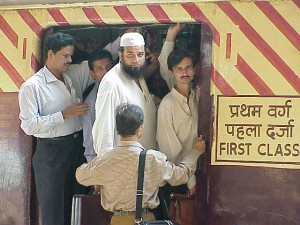
Abbé aee— first class hain, First. Chal peeche waala dabba mein ja,” (this is first class, go to the compartment behind) is a common refrain that can be heard in the suburban trains of Mumbai day after day. Depending on the time of the day, the tone and the tenor of the words change; it will be irritated and scruff in the mornings and evenings during the peak hours when space is at a premium and it will be calm and brotherly during the afternoon, or late at night when there is much space around.Mumbai-train-station-main

In 10 cases out of 10, the admonishment above would have been uttered and directed at a person based on how he looks and what he wears. If a man is a short, black fella with oil in his hair and in chappals or slippers, if he is wearing faded shirt and a worn out pant, if he carrying a common bag on his back, a cheap mobile in his pocket; he (don’t know if it happens in a she-compartment) is most likely to be reprimanded so, and reminded of his status in the scheme of trains. In most cases, the man uttering this phrase is right in his judgement, as ridiculed one would look around confused and dazed, and would scamper out to squeeze himself in the ‘other  compartments’ meant for him. In this way the ‘premium’ness of the First Class is assiduously protected. And rightfully too, after all the fares of the First Class are around thrice and more of the Second Class, there are just 3 coupes of First in a train of 12. This economic barrier is what ensures that a corporate executive travels to work comfortably while reading news from a pink paper, and poor peon hanging for his life and trying not to become one.

Pic: http://shoooonya.blogspot.in/2012/07/mumbai-local-first-class-vs-second.html

Pic courtesy: http://shoooonya.blogspot.in/2012/07/mumbai-local-first-class-vs-second.html

Honestly speaking, there is no real physical difference between the First and Second Class in the suburban trains, at least no discernible one. Both arrive at the station simultaneously, the interiors are the same, and so are the exteriors. Even the seats are the same, and the pattern of seating. It is not as if, after paying a premium you are showered with fresh scented air, or extra leg space or something. Neither do you have the privilege to disembark first or something, like you have in planes. In fact, travelling in either class is the same, what really changes is kind of gentry, and so the attitude of the traveller based on his or her perceptions. Thus, a First Classer is much gruff around with his personal space, they will only seat 3 on a seat that on a supposed to seat 3, unlike in the Second Class, where they always ‘adjust’ 4, and even more based on size of the occupants.  Continue reading

How mythology is not a science, and why it should not be treated as one!

“Who really knows?
Who will here proclaim it?
Whence was it produced? Whence is this creation?
The gods came afterwards, with the creation of this universe.
Who then knows whence it has arisen?”

 Rig Veda, 10:129-6

 Somewhere embedded deep inside the Rig Veda — which happens to be one of the important canonical texts of Hindu religion, the four Vedas — is Nasadiya Sukta, or what is known as the hymn of creation. Of unknown authorship, this hymn poses some very cryptic and incisive queries on the purpose of life and the very existence of an all-bearing god. There is an element of agnosticism, of query, of doubt. It starts in a rhetorical fashion, posing incisive queries questioning the singularity itself. And while numerous interpretations of the Sukta have highlighted the scientific temper and the inquisitive Indian mythology1temperament of the early sages who penned this and the very many hymns found elsewhere, the fact remains that Nasadiya Sukta is also a very humane and emotional query. For instance, when asked to believe in something, don’t we always begin with scepticism and doubt, it is only later when through understanding and acceptance that we move to the next level. Until then, we are atheists, sceptics, agnostics and so on.

In that way Nasadiya Sukta is most special, it accepts doubt and empiricism as part of the man’s spiritual and scientific journey. It encourages questioning the very fundamentals, even the existence of a supreme being or many is not taken for granted. It is in this sense, Hinduism differed from all else, you did not have to believe anything that your rational mind did not. Faith was not a mandatory imposition; that is, not believing in the trinity — Brahma, Vishnu, Mahesh — did not make you any lesser of a Hindu, than say a temple priest who spent a lifetime propriating the very triad. And so the ancient Vedic Hindu was a questioning, open-minded, person, not a self-deluded proud oaf who saw Meru as the centre of the universe, denying everything else.

Much has changed in the journey from a Vedic Hindu performing a homa on a vedi in the ancient time, to the modern Hindu blogging and posting on the Vedas on FB and Twitter today. The progress of technology and evolution has left its mark on the religion itself. New gods have emerged, old have been dislodged, there have been numerous reformist movements from Arya Samaj to Theosophical Society, from Iskcon to Art of Living. Hinduism probably is the only religion in the world, where new deities keep emerging at different time, and all the time. Take the case of Sai Baba, there are numerous temples dedicated to him and many more are sprouting all the time. In fact, Shirdi which was the seat of Sai Baba has become a huge pilgrimage centre, with annual donations running in many millions. Faith is always good business in any religion.

Sadly, the Vedas to a large extent have now been relegated to the domain of the experts and the scholars, with newer texts taking their place. The Hindu theology can be broadly classified into three buckets:

  • Vedas & Brahmanas
  • Upanishads 
  • Puranas & the Epics

The four Vedas – Rig, Yajur, Attharva, Sama — primarily are a collation of hymns, rituals and prayers, propitiating the various Vedic deities (32 approximately), like Indra, Agni, Varun, Maruts, Prajapati. There’s much lesser storytelling in them, and whatever are there, the purpose is to present a reasoning for a certain ritual or sacrifice. For instance the tale of Apala in the Rig Veda provides a clue as to why certain rituals like the turmeric

Indian mythology3ceremony is performed during the nuptials. Thus, the tales are a sort of story to explain the science. There is a purpose, a well-thought objective. The sheer depth and complexity of the Vedas are tempered by such tales. Also, it is important to note that there is a lot more cultural and scientific material in the Vedas, through careful examination and interpretation, one can understand the nature of being, and the natural world that surrounds it. Indeed, there is theology and philosophy, but only to a limited extent. For instance, we get to know about how the world was created through Purusha Sukta and to an extent the Nasadiya Sukta. Matters like philosophy of religion is dealt with much greater emphasis in the subsequent works like the Upanishads.

So, broadly speaking Vedas are the scientific texts, Upanishads are the philosophical treatise, and by the time we reach the Puranas, all we are left with tales and myths. The Puranas are much later compositions and were written for a specific purpose to promote and endorse one deity over all else, thus in the Shiv Purana, you are told that Lord Shiva is ‘dev adi dev, mahadev’ (the super-duper god), the Vaishnav Purana would tell you about the Maha Vishnu, who creates a million universes with each breath lorded over by a smaller Vishnu in his own image. The Devi Purana, similarly pronounces the supreme-ness of the female deity. All this is done through prose stories, and almost every time the story of creation is reinvented with a new twist.

Meanwhile, the epics Mahabharata and Ramayana penned by Vyas and Valmiki respectively are Maha-Kavyas, great poems and work of fiction, like say Iliad and Odyssey. These are fantastical tales possibly of fantastical people and times, but then in lack of larger proof in terms of historical finding or artefact, they cannot really be considered as real.

Yet, since the epics are much a part of the religious ethos, the Hindus treat them Hindu mythology 2with much deference and respect. Considering that the two major Vishnu Avatars are at the core of each of this epic, raises the religious value of these works beyond comprehension. Little wonder, when the same epics were adopted on television the actors playing Rama and Krishna were treated like gods, and there are stories of how people would offer flowers and fruits to the TV when the episodes aired. In that particular timeslot the television set would turn into a temple of sorts. That is the power of belief.

Little wonder, the amazing tales told in the epics, or even the Puranas, are not fiction for many. There are numerous who believe them to be real, and so many scholars and researchers spend their lifetime looking for clues, meanings and physical markings of all the things and places etched out in them. This is a sort of retrofitting research, wherein you try and find the physical manifestation of a fictional object or thing. People give real world dates, 4000 BCE, 8000 BCE, 80000 BCE and so on. Ramayana came first, Mahabharata second, and so on.

Ravana_seizes_the_chariot_Puspaka_from_KuveraAnd this is essentially where the anomalies start, in the fascination and fastidiousness of proving the epics as historical contrivances, supposed scholars start building fancy hypotheses.  Thus, a Brahmastra in Arjun’s  quiver becomes an equivalent of an atomic missile, Ravan’s Pushpakvimana turns into an early age helicopter, Gandhari’s mechanism of having kids by raising 100 embryos in 100 earthen pots is like test-tube baby, replacement of Ganesha’s head with that of an elephant is surgical procedure, the Jambudweepa is another term of the ancient Pangea, the extreme slowness of Brahma’s time is actually time dilation, the Krishna’s precise and pinpointed Sudarshan Chakra is actually a cruise missile, and the list just goes on and on.

Looking from the prism of today, these scholars try to reinvent the past using the epics as the base. The core idea is to impress upon us that our lineage actually hails from a very scientific and advanced race. It is like reading Verne’s ‘20,000 Leagues under the sea’ and deducing that the medieval man had a powerful nuclear submarine like Nautilus, or using HG Wells novel to claim the indisputable existence of a time machine. The lines between fact and fiction gets blurred.

By the way, in no manner do I imply that our great ancestors were some pastoral oafs. Indeed they were ahead of their times, inquisitive and used science as a tool. Anyone who has ever visited any Indus Valley Civilization’s ruin — even excepting Harappa & Mohenjo Daro (because they are far too superlative to not impress) — would immediately realise the scientific temperament of the ancient Indians, the town planning, the right-angled streets, the sewer system, the trade mechanism, etc. do provide a glimpse into the scientific past. Continue reading

Here is what they should not tell you about Hindu mythology

While I much respect and admire the kind of work Devdutt Pattanaik is doing in bring Indian mythology to the fore, he has written numerous books and spoken at various TedX events on the same, yet I am much disappointed by his latest post on qz.com, titled “Here is what they don’t tell you about feminism and sexuality in Hindu mythology”. It is a well-written piece on a well-read website, yet at the core of it, it makes a lot of errors not only in terms of judgements but also on inferences drawn from them. The very first words of the piece start with, “Hindu Mythology reveals”.  This can be a very dicey phrase to beginMahabharat1 with. You see, mythology by a simple definition is actually a story or a tale. And being one, it cannot really reveal anything; one can only make interpretations of it, to guess what the thought process was in that time when the same had been supposedly penned. Thus, as a corollary, etiological study of epics like Mahabharata or Ramayana are as prone to misinformation, as say an archaeological study is.

Coming to the primary premise of the said piece that talks about a very important issue of feminism and equality in ancient Indian times. The objective is much noble, but then, it starts of in a weird manner, stating that in the Mahabharata, there is an allusion of a time, where “men and women were free to go to anyone, until it became important to establish fatherhood.” Mahabharata is a vast epic that has much in it, like an ocean, where you can dive and find different gems every time. Hence, finding instances that support such inference is not really a surprise. Yet, in the phrase above, the allusion seems to be either on promiscuity or freedom to choose partners in ancient India.  Continue reading

Will someone kick the #StupidBucket

Imagine for a second, what would happen if  someone pours a bucket of ice-cold water over your head? A slight chill runs through the body, the hair gets spoilt, the dress gets wet, and god forbid if you are carrying your wallet or your phone on you, the person with the bucket would possibly be buried in one.

But what if you could have some fun, get publicity, and indulge in friendly ICB11bantering with your colleagues or friends, and finally, the beatific feeling of having contributed to a good cause, all at the same time. If imagine you could get all this by having a bucket of cold water poured over your head, would you not agree to it?

This is what essentially the Ice Bucket Challenge (or as it is known #IceBucketChallenge) is all about. Lots of fun, PR gimmicks, bantering and all this in the name of a charitable cause. Apparently the Ice Bucket Challenge is being taken for spreading awareness on ALS or Amyotrophic lateral sclerosis. A neurological disorder affecting the nerve cells in the brain and the spinal cord. Patients suffering from ALS or Lou Gehrig Disease as it is also known suffer from a degenerative loss of control over their bodily functions, leading to total paralysis and subsequent death. Typically, the time-span between the onset of symptoms to death is around 2-5 years. It is a painful and traumatic disease, which leaves the person debilitated and is incurable. Hence, people having fun with cold water in the name of such a traumatic disorder must make you sick. Right?

Not really. In our disjointed world, something as abominable as this is repackaged as a philanthropic and social exercise. SO, the Ice Bucket Challenge has a social side, the participants in the challenge have a choice of donating $100 or having a bucket of ice-water poured over their heads. Ideally, you’d expect folks (especially the uber rich ones) to opt for donation, so that there can be more research on the disease, and the possibility of finding a cure. But no, in a sort of pseudo machismo, people will have water poured over their heads as if it is a very brave and gallant thing to do. The script is similar in almost all the videos posted, the person will ICB2“accept” the challenge, rattle of a few more names, steel himself/herself up, have the bucket emptied over self, smile, shriek or just look bewildered. The length of the video varies from 30 seconds to over 2 minutes, directly proportional to how desperate the person is for publicity. In fact, in many videos the celebs don’t even mention ALS or do it very casually, thereby defeating the whole purpose for taking up the challenge (remember the greater good of spreading awareness). Continue reading