सतगुर लई कमाँण करि,
बाँहण लागा तीर।
एक जु बह्या प्रीति सूँ,
भीतरि रह्या सरीर।।
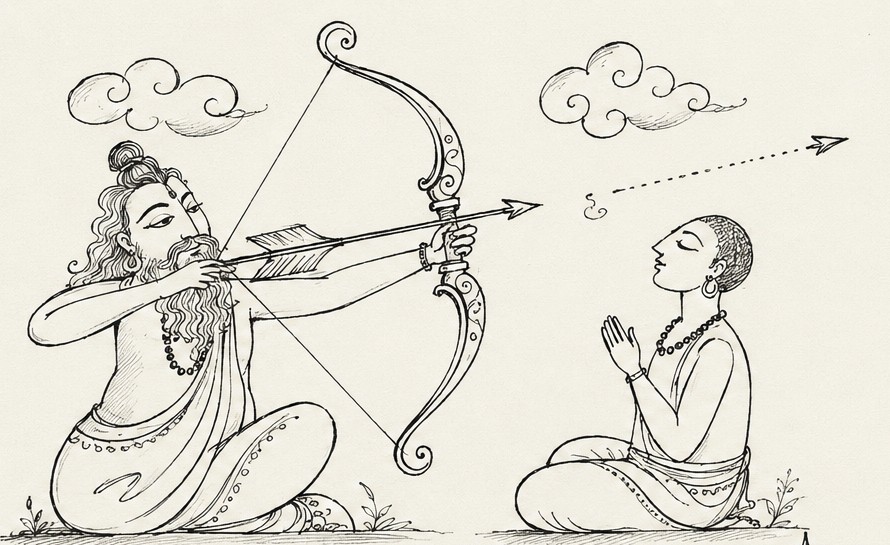
The satguru took up the bow, and let the arrows fly. But the one shot with love — that one stayed lodged within the body.
Finding a guru — or someone who opens up our inner consciousness — is a theme that repeats quite often in Kabir’s words. A life that has been untouched by the master almost seems worthless.
The ability to surrender abjectly in front of a person — to trust his words, his actions, his commands — to follow him — is a thought that seems so absurdly impossible. How can one surrender? How can the rational mind take a backseat? It seems impossible and implausible.
Yet, I have read about so many such accounts — of Narendranath Datta meeting Ramakrishna Paramhansa and surrendering before him and becoming Vivekananda. And then, of course, there is the mythic Neem Karoli Baba, and so many of his followers who were touched by him. Not to mention the stories of Sai Baba, who has become a deity from a person.
Coming back to Kabir — the doha talks about how when an accomplished teacher comes into our lives, it undergoes a complete transformation.
सतगुर लई कमाँण करि,
As soon as the teacher picks up the bow, this is also symbolic of how the teacher accepts the pupil — he decides to invest his actions in transforming the shishya. This act of acceptance is itself the first threshold. The moment we cross that —
बाँहण लागा तीर।
the arrows start flying. The process is on, and in certain ways, relentless. The guru is not looking at compartmentalisation — he will not solely focus on one aspect, say, like Dronacharya taught Arjun the skill of warfare. But he will go beyond. Everything is under the range of his bows and arrows; everything that he does will bring that change.
एक जु बह्या प्रीति सूँ,
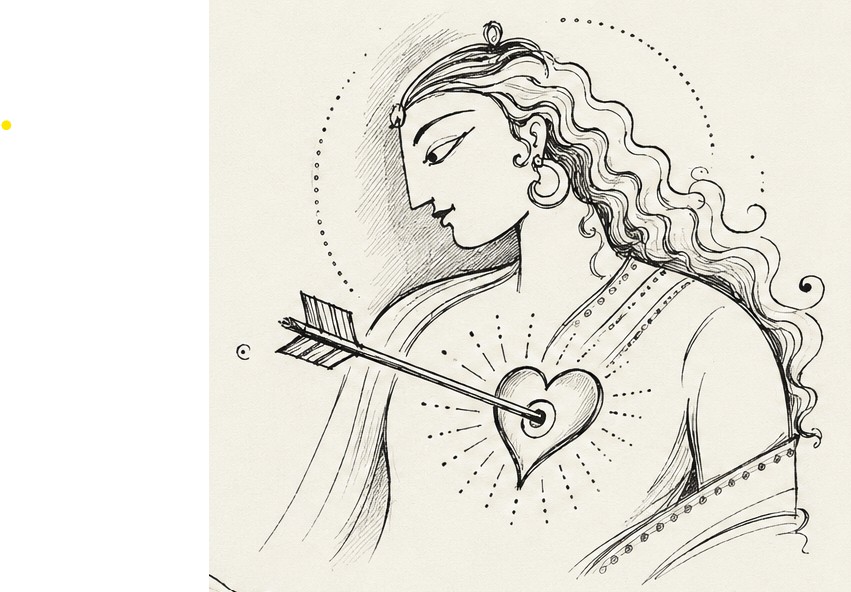
But even in his quiver, there is this one specific arrow that truly stands out — that is love, or devotion. Whatever else one might do in life — in terms of learning, acquiring skills, gaining experience — it is only when one is touched by that sensation of divine, cosmic love that one truly understands the real meaning of existence, the purpose of life itself, the real concept of Brahman — the universal force. It is only through love and devotion that we can realise the god.
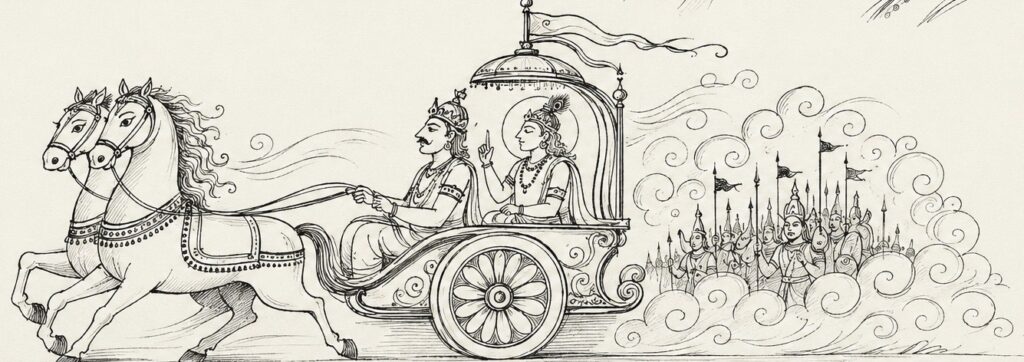
In short, a guru can be a transformative person — guiding you when you fail or falter — like Krishna, right in the middle of the battlefield, spelling out the course of action that must be undertaken, dispelling the doubts. But Krishna is unique. He is celestial, divine, friend, and also the guru — he is the arbiter, and the one to whom all our actions accumulate. When he declares — अहं ब्रह्मास्मि, “I am the universe” — it doesn’t seem like a claim, but merely an attestation of fact.
भीतरि रह्या सरीर।।
And now, when that arrow of love and devotion pierces through us, it embeds itself. It transforms. It does not leave us. This is the arrow that takes us down the road of realisation — toward union with the Brahman.
Every other arrow the guru shoots — knowledge, skill, discipline — does its work and is spent. Only this one stays lodged. Only this one keeps working on us after the guru has stopped teaching, after the lesson is long over.
Because this arrow does not just point outward, toward the Brahman. It turns us inward, first. We meet ourselves. And it is only by that route — through ourselves — that we meet our maker.