
There is something about successful people that we resent, especially when they have risen through the ranks. Their ascent underscores the smallness of our own existence of how we have wallowed in the bottom while these people made it to the very top through the force of their will and determination, by not following conventions, by breaking all rules and norms and in that process leaving their personal imprint. Our lives are but imprints on the sand of time, while theirs is a marker etched for ages.
We admire these souls even as we envy them. We gape at their ascent and somehow celebrate their fall. It’s the heel that we look at in every Achilles.
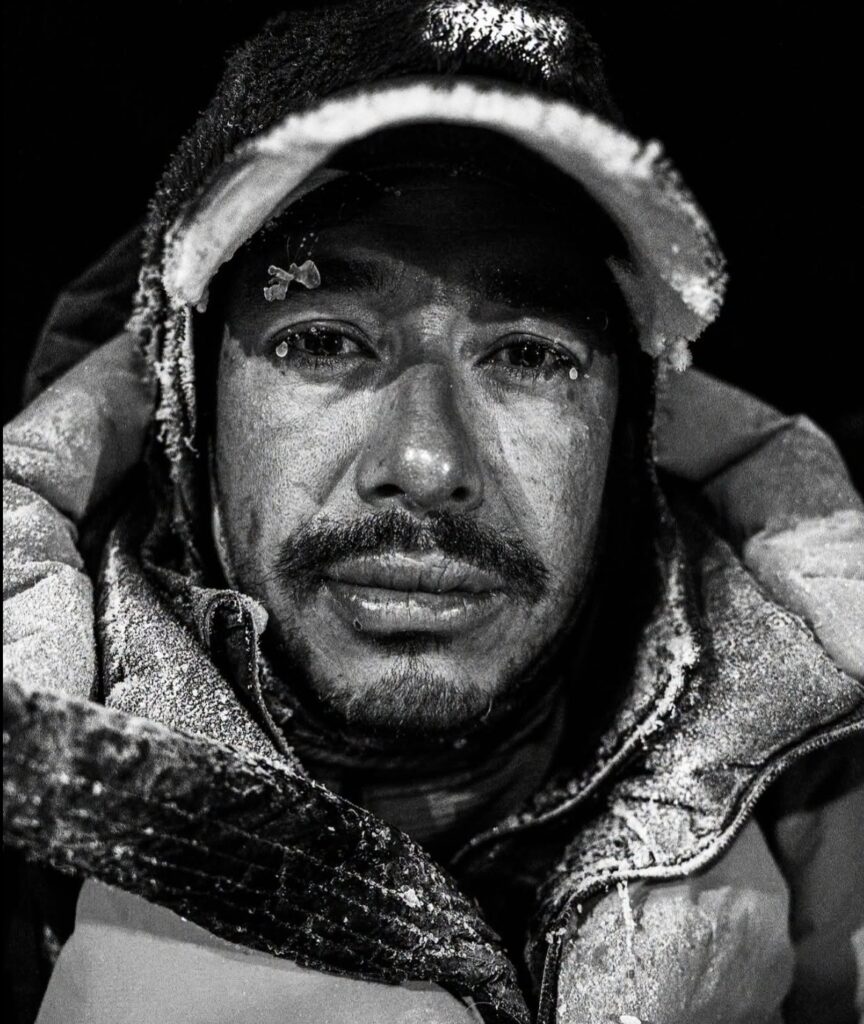
The story of Nirmal Purja or Nimsdai, as he was popularly known, follows the same pattern. The irony of it is that it took an avalanche to stop him.
Nims’s death on Broad Peak in Pakistan brings an untimely close to a chapter in mountaineering history: the story of a man who, in a matter of a few years, created a name and legacy that will inspire people, and that many will revile.
It was in 2019 that this man from Nepal barged his way into global news with his extraordinary feat of summiting the 14 highest mountain peaks in the world (the 8000ers) in less than seven months. The previous record had stood at seven years, and this man, with his seemingly insane bravado and chutzpah, scaled these peaks like we undertake a morning walk at Lalbagh, climbing the little hillock there.
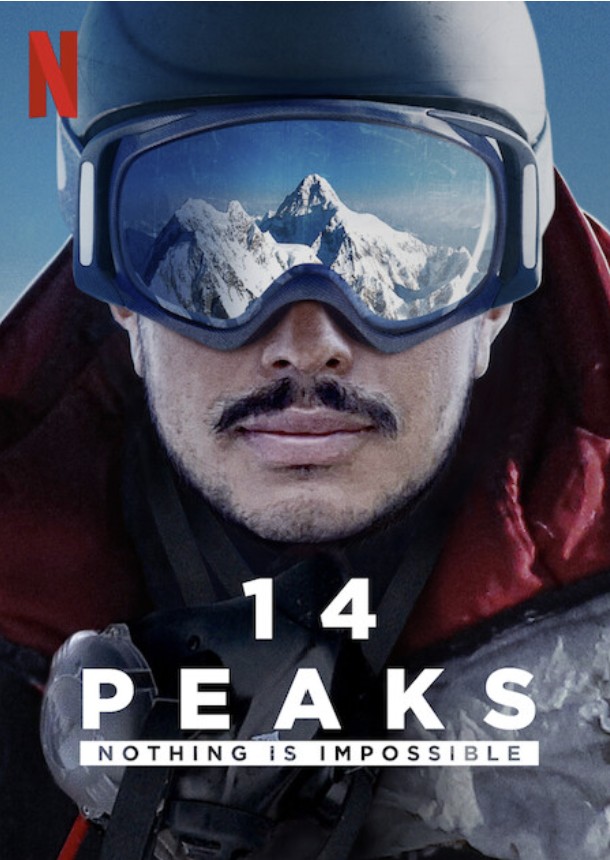
But while his achievement stood out in the news, it was actually the documentary on Netflix “14 Peaks” that turned him into a global icon. The documentary was released in 2021, and “Nothing is Impossible” was a mantra that inspired many mountaineers.
There is one clip in particular during one of his ascents, when other climbers are in doubt about going through with the climb, he smiles to the camera cheekily and says, in a sing-song way, “Giving up is not in the blood, sir.”
One could argue that he was no Hillary, Norgay, or even Messner, and he seemed quite aware of it. Instead, he was always wanting to do better than them. There is this anecdote of Michael Phelps, the most decorated Olympian in human history, when a younger version of him was told that he had a chance to be the second Mark Spitz (another record-breaking Olympian), he scoffed at the suggestion, stating that he rather be the “first Michael Phelps.” In that sense, Nims was not a mountaineer, the kind who simply enjoyed the challenge of going up the mountain and pushing themselves against the limits. He was a competitively charged sportsman for whom limits were merely a hurdle to overcome – someone who wants to be on the podium under the arclights.
Through the times, we have witnessed how mountaineers metamorphise when they summit a peak. Astronauts who blast out into orbit undergo something similar, it is called the Overview Effect. Looking at the planet from above, their perspective undergoes a change. They don’t see boundaries, countries, or borders, but a fragile blue planet in the seemingly endless darkness of space.
Similarly, standing at the top of Everest, mountaineers realise the fragility of human life and the sturdiness of human will. Standing at a height, at which commercial planes operate, with the clouds underneath their feet – it is hard not to feel invincible. But those agonizing hours in the death zone, where every step is an achievement by itself, there is also that respect for the elements, for nature. There is a realization that sort of creeps in – the ascent and the summitting was not an act of subjugation or triumph. But rather a fortuitous benediction, a passage that was granted to them. Standing 25000 feet closer to heaven, you become aware about the power of the elements – lets call it the Overstanding Effect.
Did Nims feel the same reverence towards the mountains?
Maybe. But he didn’t really show it, if at all he felt it. For him the peaks were there to be summited, mastered to be conquered, to be vanquished.
He did grant some allowance to the forces of nature, when he underscored that he did not take the mountain for granted and asked for a safe passage. But ultimately he believed in himself. “The biggest strength I have is, I have no fear.” Like Phelps, he scoffed at conventions, when people expressed doubt at the possibility of his 14 Peaks project, he dubbed the endeavour as Project Possible, a sort of a middle finger to his naysayers.
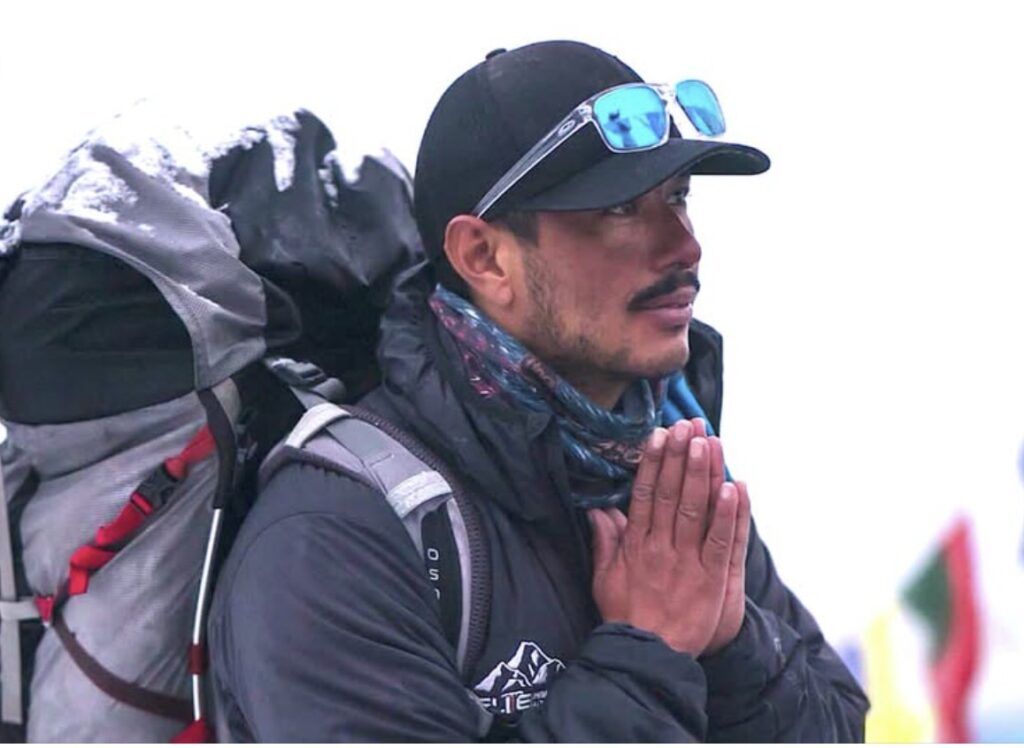
In the documentary, there is one sequence that truly stumped me. Generally, any expedition to the Everest peak or any other starts in a sombre manner. In a sort of ritualistic way, with the climbers performing puja, beseeching the mountain gods for safe passage.
On 12th of May, 2019, he summits Dhaulagiri – the second mountain in his project. He then travels to Kathmandu for a meeting a client, who could be an important funder. He parties with the client all night drinking and dancing till 6 AM. Then, without resting he proceeds directly to Kanchenguna, the third one of his project, and reaches the summit in a single ascent from bottom to top. In the video, he seems so groggy and high that it seems absurd he was able to do it at all. You could credit the climb to his elite forces training, his endurance or even to the acclimitisation. Yet, even accounting all the possibilities, this one was an extraordinary feat. Somehow, between the rituals and the revelry, it makes you wonder if the mountain gods have truly lost their mojo. I mean, if someone could amble up an 8000er in a hangover, what’s the fuss about all that reverence and deference? Is the sublime soluble in alcohol?
This is where Nims was different from us Middle Earth people, who are thankful to fate and the powers above for whatever little or more scraps destiny throws at us. Not Nims, he believed he deserved a lot more, and would snatch his glory from the gods if they dared stand in his way. Life became a relentless pursuit of the next summit. After tasting success and creating a record that would be hard to emulate, Nims did not sit back and start enjoying the fruits of the work by writing books and giving talks. Well, he did do all that, but he wanted to do something harder, something almost impossible to emulate: creating one mountaineering record after another. And so he did:
The first winter ascent of K2. All 14 peaks without supplemental oxygen. The first person to complete all the 8000ers and the Seven Summits. A record number of 8000ers climbed. Eighteen Guinness World Records.
When his 2019 ascent of the 14 Peaks was questioned over the use of supplemental oxygen, he climbed all 14 peaks again without oxygen support to prove his superiority. This time, it was 2+ years instead of 7 months.
His expeditions were arduous and tough, but also very organized. He ran it like a well-oiled machine, helicopter transfers, fixed ropes, hardened and dedicated set of Nepali sherpas in his team. He created a commerce-driven ecosystem with him at the very centre – with companies like Elite Exped, Nimsdai Store, Nimsdai Foundation, Skydive Nimsdai and so on.
Nims was not only hard-headed mountaineer, but also a canny businessman – smart and astute. He was well aware of the power of story-telling. He built this aura of invincibility around him. He was the brand, the icon – the living embodiment of Nothing is Impossible mantra. All his posts on social media featured him and him alone. And he had lots of followers – on Instagram he had over two million followers; on X (formerly Twitter) more than 100,000; on YouTube, 500,000.
This was the commercial engine, through which he was raking in the money.
The irony is that in 2019, during his climb to the top of Everest – he had taken and posted a picture of the traffic jam to the top – showing hundreds of people lining up in a single file on Hillary step to reach the top. The picture went viral sparking a debate on commercialization of mountaineering – especially on Everest.
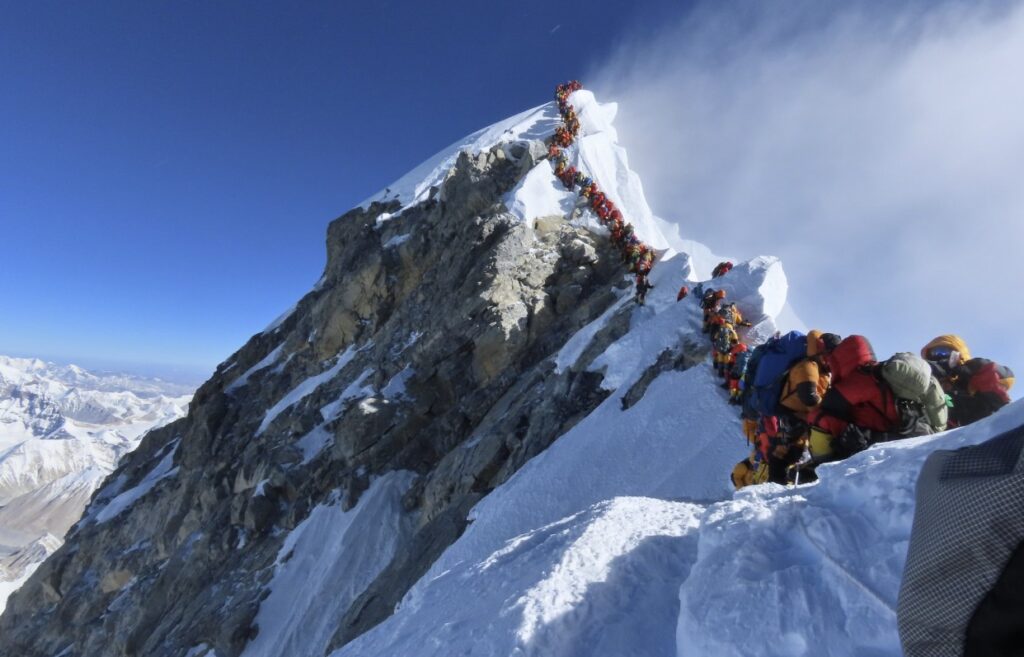
In 2019, Nims was hinting at this commercialization and by 2026, he was a prominent beneficiary of it.
Nims explained this contrast by talking about the benefit this accrued to his country and his people. Despite being a UK citizen, Nims was a proud Nepali within. Time and again he emphasised how Nepali climbers, especially the Sherpas and the porters, went unrecognized despite of them ascending the summits multiple times in their lifetimes. To right these wrongs, he set up a core team of Nepali climbers who seemed to share his passion and chutzpah.
In the Netflix documentary, when he completes the mission, he pronounces loudly that had a Westerner or a white man conquered the 14 Peaks in this record time, there would be ten times more renown and acclaim – it was a grouse of a brown man living in a world designed to deify the white man. And this was something that he railed against through his life, about being vilified, or being scorned and belittled. The only way, he could break the hallowed citadel was through the sheer will of his determinations, through the bolts of his records. He knew that because of his origins, the accented English or the colour of the skin, he will never be accepted as one. But the mountains don’t make such distinctions, they do not judge or moralise. For them a brown, a white, or even a purple is all the same. It didn’t matter if the climber was humble or arrogant.
But his irreverence and the unconventional mountaineering style made him a target – he had many detractors. While Nims focused only on the summit and the ascent, a great alpinist like Reinhold Messner emphasised: “The summit is only halfway.”
People would constantly point to the purist approach to mountaineering, called Alpine style: doing it on your own, without much support or logistics. By that measure, Nims was surely a deplorable pagan, a barbarian.
In his short lifetime of fame and glory, there were other accusations too, from financial ones to sexual abuse. But in his characteristic manner, Nims fought back, loudly and strongly. He could not be cowed, neither by the peaks nor by his detractors.
He knew that whatever the outcome, so long as he stayed ahead of the pack, he would continue to reap the rewards. His focus was singular: creating new records. And that, in some way, was also his undoing.
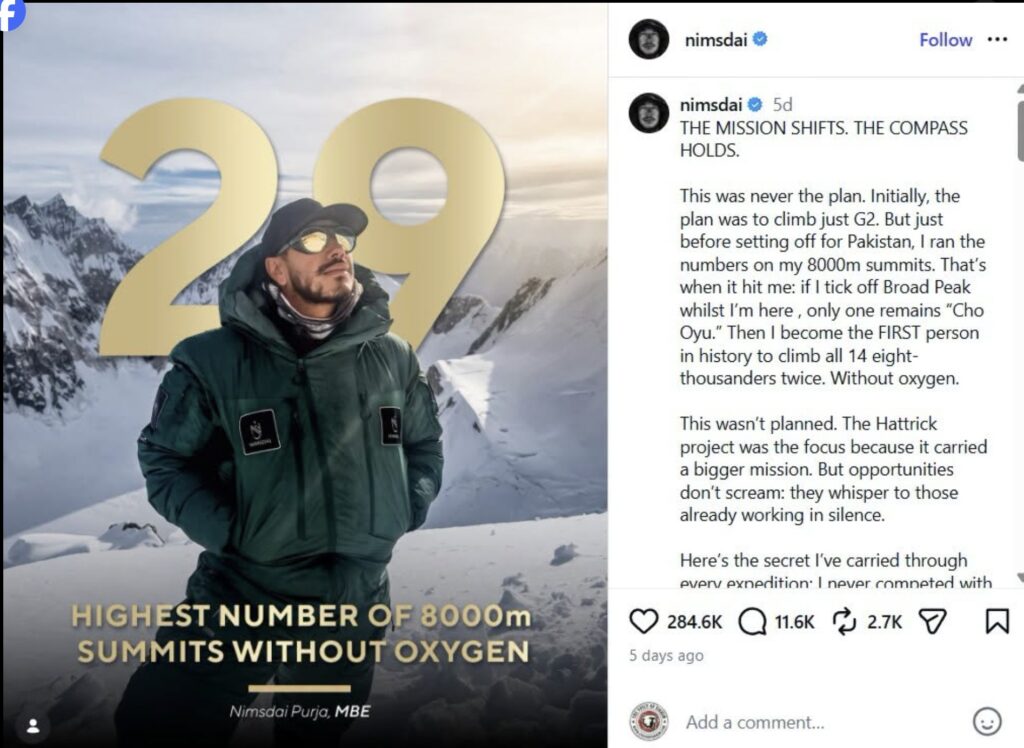
His last post on Facebook revealed that he was in Pakistan, climbing G2, and while preparing for the expedition, he did a number check: if he were to climb Broad Peak in Pakistan, it would be his 13th peak, and then only Cho Oyu would remain to be conquered, making him the first person in human history to have ascended the 14 peaks twice without oxygen. That would be his hat-trick record of climbing the 14 peaks, something, again, almost impossible to emulate.
Broad Peak had an interesting connection to Nims. During his first record-breaking attempt, after he summited Everest, Lhotse, and Makalu in 48 hours – becoming the first person to do so – he headed to Pakistan to climb the five treacherous mountains there: G1, G2, K2, Nanga Parbat, and Broad Peak, all the five 8000ers.
Nims ascended the five peaks in a record time of 26 days, a record that has been unsurpassed and is likely to stay that way for a long time to come. The last peak he conquered was Broad Peak. It was here that he created the record, etched his legacy.
It is also here that the Nims story comes to a sad end.
Perhaps the mountain gods, incensed by the irreverence and nonchalance of this mortal, were waiting for their chance, biding their time. They enticed Nims with a record-breaking feat, and then, when they had him vulnerable and in a spot, they crushed him under the weight of snow and ice.
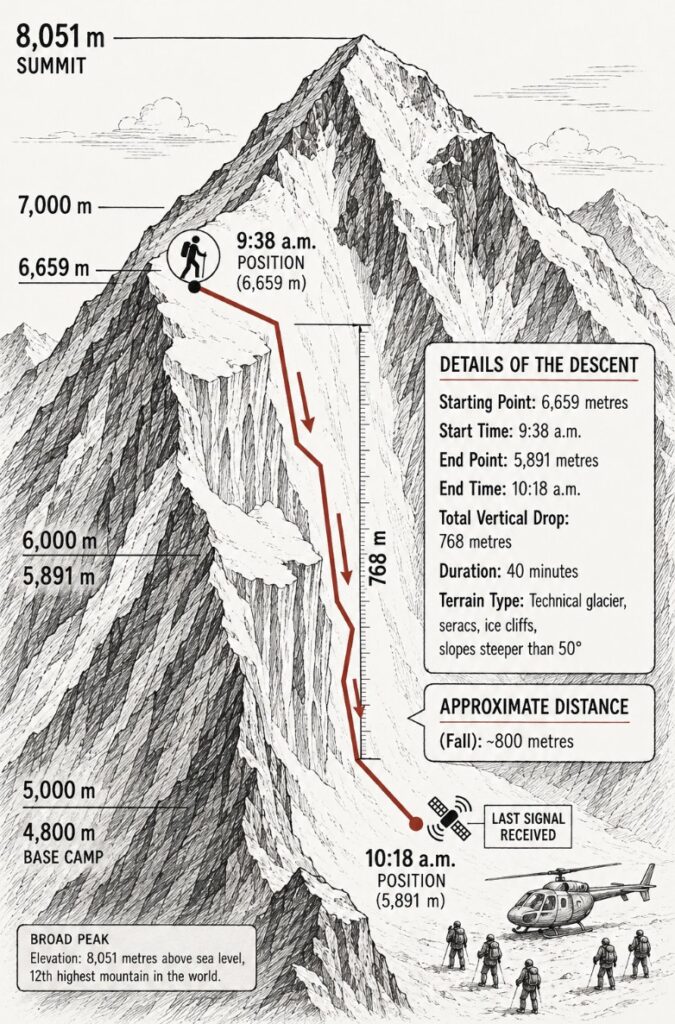
Through his short mountaineering life, Nims was famous for his rapid ascent. The quick strides whereby he would climb metres in minutes – reflecting on his superior physicality. The avalanche that extinguished his life took him on a rapid descent.
There is aphorism that goes something like – there are old climbers and there are bold climbers, but there are never old, bold climbers.
Nims was definitely a bold one. He now is part of an extraordinary league of legendary climbers who lost their lives in the very mountains they loved, starting from George Mallory, to Anatoli Boukreev, Alex Lowe, Ueli Steck to David Lama. The list is long and illustrious. Nims will be among the rarified stars.
In his brief life, Nims burnt through the stratosphere like a rocket. His life will become a folktale, people will retell, emphasising how dreams come true and how impossible becomes possible if you really believe hard enough. Destiny can be manifested.
Others will warn that ambition and arrogance are a heady concoction, that it will almost always result in tragedy. Don’t upset the fates, they will love to rip you out, they will warn.
That is quite understandable. After all, people who live and die in the safety of terra firma will never really know what it is to soar over the clouds, to be closer to heaven, to live and to breathe deeply, to drink heavenly ambrosia standing on the top of the world.
We will focus on the heels. But then, Achilles would never have it any other way. Rest a bit, Nimsdai, you finally can.
Continue reading