Is Bhagvad Gita actually an *(Asterisk) in prose?

Bhagvad Gita is one of the most sacred, if not the most sacred of Hindu texts. It has gained cult status, with people from different walks of life, from religious to completely non-religious background emphatically thumbing their support for it. Even the common man is sensitised to its sacredness, what with the oath of honesty one has to take while in matters of courts and law. In that way, it is to Hindus what Koran is to Muslims or Bible is to Christians.

Yet, Gita is not a standalone work or complete in itself, like say the Koran and Bible are. It is a part of an overall epic of Mahabharata. In fact were we to make a size based comparison, it is very small part of the epic, having some 700 verses in a family of some 200000 verses. Nevertheless, Mahabharata is not sacred, but Gita is. I well remember in the past, there was a pervasive notion that if there is a 101734067Mahabharata copy in your, there will fights and clashes in the family. Result, not many would keep the Mahabharata copy at home. But Ramayana, and more importantly Gita always find a place of honour in any Hindu god-fearing home.

Recently, while discussing Mahabharata at the Comparative Mythology class, there was this bit about how Hindu epics like Mahabharata and Ramayana had numerous editions of interpretations. Through the ages, these stories have been told and retold, with a little tweak and a little addendum, for instance, Ram in a version of Bengali Ramayana is portrayed as a weakling, while Sita is the strong character (not surprising since in Bengal, woman have been always at the centre of things be it literature Labonya in Gora, films – Charulata (Satyajit Ray), or even in politics like Mamta). Similarly, in a tribal version of Ramayana from Madhya Pradesh, the second brother Lakshman takes a much bigger role, and is central to the theme. Meanwhile, in places like Thailand and Surinam, Hanuman is much more than a devout monkey-follower of Ram. Thus, in every retelling of a tale, there is some embellishment of it.

Mahabharata too has undergone many such interpretations, the story being told from varying perspectives, be it Karna, or Duryodhan (or should one say Suyodhan). There is even one work from the perspective of Karan’s wife. The sheer depth and character of the epic, lends itself to such works.

Gita somehow seems to have escaped from the cycle of interpretations. I mean there is much work and analysis on Gita, but there is not much interpretation. As the lecturer said in the mythology class, storyteller and mythologists always keep a healthy distance from Gita. It makes you scratch your head, as to what could be the reason for it?

Sharma-055One of the explanations is to look at the nature of the content of Gita. Unlike the interesting milieu of the Mahabharata, Gita is a fairly staid. Essentially, the whole of Gita is actually an elongated sermon, given by Krsna to a confused Arjun, who is sort of dithering before the great war. Right through the 18 chapters Krsna more or less sums up the Hindu philosophy of birth, death and living. While answering to doubts raised by Arjun, Krsna lays the philosophy of divinity namely that of Advaita (non duality) and merges the concept of karma, addressing Arjun (and thereby all of us), to surrender on to him and think not the consequences of action. The chapters are an assimilation of the three schools of thoughts in Hinduism, what are dubbed to be the paths leading to god, namely, karma, gyana, and bhakti. Continue reading

How the Indian PM was abused & denigrated in the name of democracy

Reading the excerpts of Sanjay Baru’s book on Prime Minister Manmohan Singh, The Accidental Prime Minister (http://bit.ly/1iawxNv), I am somehow reminded of a cartoon that was done by the brilliantly nonchalant Abu Abraham. Published in the tumultuous period of the Emergency, it shows a rather ungainly President in the bathtub, signing off the proclamation. Indeed, on midnight of June 26, 1975, the office of the President of India was delivered such a body-blow, that it has not recovered even till today. Not surprisingly, the president of the nation, was considered to merely a rubber-stamp, a puppet in the hand abu_abraham_cartoon_20120326of the government, who signs off the bill, the ordinances, proclamations of Presidents Rule, etc., living off the lard in a cosy colonial palace, the Rastrapati Bhavan. Indira Gandhi, who selfishly wanted to avoid the embarrassment of having to resign following a verdict of Allahabad High Court, decided to enact the most brazen and oppressive abuse on Indian democracy. The rest of the government, including the President, were merely stooges or at-best hapless no-bodies, who could no nothing.

Somehow, the stratagem that was deployed by Indira in 1975, was mastered by her daughter-in-law in 2004, who foisted on a nation a political cipher as a prime minister, just to warm the seat for the eventual transition to her son, Rahul Gandhi. Manmohan Singh as a prime minister in 2004, was as much as an accident as much as it was a design. Just like her mother-in-law, who was under fire for electioneering crimes, Sonia Gandhi was under pressure over her Italian root. The then President APJ Kalam too had apparently raised the issue of her origins, and showed reluctance in ordaining her as the PM. After having burnt her fingers with a thankless PV Narsimha Rao and ambitious Sitaram Kesri, Sonia decided to find a PM that was not only pliable and amenable, but also deferential to the 1st family, and drawing his support from the family itself. Thus by a curious tragedy, in 2004, we never really got a prime minister but rather a care-taker prime minister, someone who was always “caring” the needs of the family and careful not to fall out of favour with his mentors.

While the stratagem deployed by Sonia Gandhi was vintage Congress-stuff, the implications and ramifications were far wider. Over the course of reign from 1966 down to 1984, Indira Gandhi had ruthlessly destroyed all the power-centres that could pose a challenge to the PMO. Stooges were given positions of power, and those who stood in the way were somehow sidelined and cut to size. For instance, not many were surprised when Giani Zail Singh on being made the President had apparently remarked, that “If my leader had said I should pick up a broom and be a sweeper, I would have done that. She chose me to be President!”. Little wonder, when Operation Bluestar was launched, the President did not even know a thing about it beforehand. India was Indira, and Indira was India, truly speaking. Continue reading

Tale of the Farmer, Rats and a Cobra

Long long ago, in a not so far-off land, there lived a farmer with his prosperous land. The piece of land was much fertile, in fact so much so that it could easily feed the farmer and his family, and even leave him a decent surplus. Sadly, wherever there is prosperity, follows the crisis. Not surprisingly, the farmer’s land was invaded by a bunch of fair-skinned rascals, who took over the land, made the farmer toil, and took away all the surplus. Suddenly, in the field which used to feed and leave a surplus, the farmer and his family were facing starvation. For what seemed like a long age seemingly stretching for two centuries, the farmer suffered, starved and toiled. The land was his but the produce was not. He strove hard against the new lords, and finally was able to evict them. And he heaved a big big sigh. His land was his again, the food was his again. He dreamed of a good future, quite unlike the time before the fair-skinned crooks had come.

With a renewed vigour and zeal, he started toiling, it was his time in the sun. And then one day while taking a stroll in his field, the farmer heard a squeak, and spotted a little mouse. Looking at the field that produced so much, the farmer thought how much could the poor famished rat eat. So he let it be. Time passed, and as the farmer toiled through the day and night, getting his rewards, he could hear the squeaks getting multiplied. But then he was too happy and glad, to bother about a few or more rats.

‘God has been kind, and its his wish’, he say to his family. This went on for a long time, and in the same time the mice turned into medium sized rats, and then into huge bandicoots. They thrived on the land and its surplus. And then came a time, when the pestilence grew so much that the farmer’s output was affected. First his surplus was steadily wiped off, and then his subsistence ration was. The farmer realised his folly, but alas it was too late. He tried killing a few with sticks, scaring them, but it would make no dent. The rats had reached a point, where a few dead was no issue. Newer ones were quickly added. Continue reading

The Legacy of Sultan Manmohan Singh Tughlaq

Time is a rather malleable entity, unpredictable and quite unfathomable. Linear it is, say many, like a fabric all meshed up, say few, heavy like gravity, like a quasar, multi-dimensional, ephemeral, unreal, say the rest. The passage of time, quantified by the circular rotation of two sinewy arms on our clocks, is meant to signify a sort of permanence, a moment that is lost or gone, ceases to exist. There’s nothing that one can do to bring it back, lost in the ever-infinite sea of eternity. Past is past, and present is present, and never the twain shall meet, is good a testament, that could have well been etched in stone on that tablets that were forged at Mount Sinai.

And yet for all its permanence, time sometimes also seems permeable, like a sponge or something. The little circles on one side forming a connection to another side. The connections are unmistakable, inescapable. And while the recorded history of our species only stretches a couple of thousand years, even in this short period we have seen events taking shape in different time, different climate, mirroring each other in a very strange ethereal manner. Separated by a vast ocean of time, yet, these events seem like some sort of cosmic clones of each other. History (which is a product of time) indeed has a very uncanny knack of repeating itself.

To give you an idea, lets flashback to 14th century India, much long before the very idea of India even firuzexisted. The precise time on the dial is set to sometime in the latter half of the century, somewhere say 1380s AD. The place is Firozabad, not very far from modern-day Delhi, and it’s the reign of Malik Feroze ibn Malik Rajab or more renowned as Sultan Feroze Shah Tughlaq. The Sultan is a septuagenarian man, lording over a dominion that is much weaker and lesser than what his pre-decessor had bequeathed to him. He is a sort of weakling, little in control of things around him. He had succeeded the strong-willed and maverick Sultan Muhammad bin Tughluq, who was most famous for his decree to shift the capital from Delhi to Daulatabad or his experiments with token currency that failed spectacularly. But unlike his predecessor, Feroze Shah Tughlaq was a softie, or a little more of fruitcake. When he took over in 1351, the empire was vast but in a mess. There was much confusion as Muhammad bin Tughluq had died without an heir, and in the ensuing unrest, Feroze was enthroned as the new sultan. Continue reading

A billion reasons why India should be scared — really scared!

Years back, when I had a stopover at the Heathrow Airport for a connecting flight to Mumbai, I had noticed something amusing. Over the 8 hours spent there, I spotted more browns than black or white. The whole airport complex was teeming with Indians. Left, right or wherever one could see there were Indians (possibly Pakistanis or Bangladeshis, as they are hardly discernible from us). I have been, ever since, joking about how we are extracting sweet revenge against the ‘Goras’ who colonized us for 200 years, by reverse-colonising them. And this time, there won’t be a battleground or bayonets, say like the Battle of Plassey. Instead, every fertile womb in India is a battleground, and every loaded prick is a bayonet. These ‘teen-gunaa lagaan’ British gentlemen will forever rue the fact as to why they ever came to India. It is now time to pay back ‘teen-gunaa’ (three times) for all those lagaans (taxes).

While India’s teeming story is fairly pervasive everywhere across the globe, from ‘Kaneda’ to Australia, thep-1 demographic boom is most visible in India itself, say in a city like Mumbai. Over the past three decades that I have been around this metropolis, I have seen the city been inundated with numbers far beyond the capacity. Earlier in the city, you had peak hours and non-peak hours for travel, based on the crowds and the absence of it. But now you have peak-hour and hyper-peak hour. There’s no escaping the crowds anywhere, anytime. For instance, I grew up spending very many evenings that turned into starry nights at the Juhu Beach, building castles of sand and digging pits. Nowadays, let alone building castles or forts, if you find yourself sufficient place to even stand, you would count yourself lucky. And no, this isn’t a phenomenon in Mumbai, as a handful of politicians who play migrant-politics would like us to believe. Mumbai is just a snapshot of the bigger illness.

Quite like Mumbai, India is bursting at the seams. There are just too many of us, at any given time. India accounts for a meagre 2.4% of the world surface area of 135.79 million sq km. Yet, it supports and sustains a whopping 17.5% of the world population. The fact of the matter is right there for anyone to see, the population of India is almost equal to the combined population of USA, Indonesia, Brazil, Pakistan, Bangladesh and Japan. Continue reading

Death of the Purple Canaries

Mining can be a quite a hazardous vocation. Deep inside the burrows of the earth, miners dig for minerals, coal and other stuff to satisfy the ever-increasing appetite of our society, risking their very life and limbs in the process. In the wibbly-wobbly shafts, that can collapse at a moment’s notice shutting them forever from their loved ones, the miners look for reassurances in whatever manner they come, be it scientific or superstitious.  A little yellow canary in a cage is one of them,  renowned for its life-saving charms.

For ages, these little-cute-yellow-fluffy-birdies have been carried down the mine tunnel, often at the very front of the miner party as a good luck charm. These pale-coloured birds are very sensitive to dangerous gases like methane or carbon monoxide, and whenever they encounter it, they die rather swiftly and stoically. Their deaths are construed to be an alarm by the miners, to exit the tunnels immediately before the leaked deadly gases affect them.shutterstock_66032467

Do the miners love these canaries while they are alive, or possibly love them even more when they are dead, no one knows for sure. Yet, the death of these little canaries spells life for the many miners. Or one could say, that their deaths is a precursor of worsening times ahead, a warning of impending doom or destruction in case of status quo. It is a rather poetic or a prophetic end, depending on one’s objectivity. But one thing is for sure; no canary has been celebrated or knighted once dead. When they die, these birds are unknown and unwept. Their death is not a sacrifice, but merely an early sign. That’s how cruel life is.

Much like the canaries, though not an iota as cute, lives a species in our modern-day society. They are celebrated and feted, and fed and fattened. Yet, when they are sacrificed, not many tears are shed. This urban species is rather purple in its behaviour, and swiftly meets the end, when the economic conditions wary. They are most sensitive to forces of economics things like recession, depression or slowdown hit them hard. And their doom should be a warning for lot others, yet is often ignored.

Who are these little fluffies living out in our modern day cities, who aren’t so little anyways? Well, these purple canaries are also known by other synonyms like the fourth-estaters, the journalists, the presswallahs,  the jhollawallahs or whatever you call them. They live boxed in little cages, twittering nicely on a sunny day, when all goes well. Yet, when things go south, so do these chaps. In most cases, they will be the first ones to be retrenched, sacked or just booted out. A little visit to the local press-club will enlighten anyone on this rather ironical tale of a breed that gets to break bread with the high and mighty, yet, when the bread is at a premium, they are broken up easily instead. Thus, whenever there’s an economic descent or a slowdown, you will find more journos with their resumes on sites like Naukri.com and others. Continue reading

India Gangraped

In the aftermath of the heinous Delhi gang-rape case and the Mumbai gang-rape incident, numerous people were out on the roads holding candles, placards and what not. The media, as it is nature, went into frenzy; solemn anchors asked dire and direct questions. Panels were formed, experts were asked, politicians expressed outrage, protestors ranted loud. Newspapers and magazines too joined the  frenzy, with relentless coverage, sad statistics, and unending stream of visual infographics that drove home the point firm and hard: India is being raped and brutalised; left, right and centre.

Rape, yet again, was the hot potato, right from the panel studios to the living room. Rapes were being reported with amazing regularity from all over the country, foreigners, Indians, no one was spared. Numbers that came out only underscored the point. Here are a few statistics that will scare you:

rape 1


  • 24,206 rape cases were registered in India in 2011, according to NCRB.

  • A woman is raped every 18 hours or molested every 14 hours in the Capital

  • Cases of rape went up by 873% in the last decade. Shockingly, between 2007 and 2011, rape incidents increased by 9.7%, three times faster than all other crimes put together

  • Nearly 68,000 rape cases were registered across the country during 2009-11 but only 16,000 rapists were sentenced to prison

  • NCRB data shows there were 1,22,292 cases of molestation during 2009-11

The statistics don’t stop, like an endless stream of data they just keep going on. But what essentially can be summed up is that women in India are never safe, with one being raped every few minutes in some part or the other. The figure could be very high, as it is generally assumed that a majority of cases are never reported out of fear or shame.

The moot question is, how did the affairs come to this end so suddenly? Were we always like this, or have we become so in the past few years? Were the Indian males sleazy, opportunistic bastards all this while or have they become one suddenly? Continue reading

Why Mumbai needs Meru? And, why there’s more to it than meets the eye?

On Feb 4th, major newspapers in Mumbai carried a fervent (and a rather long one as well) appeal from Meru Cabs, asking the lay public for support, something that went like, we served you now, support us. Saying it in short, the ad talked about how hoodlum practices had forced the company to stop its operation and how in spite of almost all the drivers wishing to return to work, they were not let to, by a “handful of people with ulterior motives”. At the end, there was a business plea, to let a corporation carry out its business unhindered by political machinations.

792378_483166851742724_1067871411_o

For many of us in Mumbai, the current Meru fracas is certainly not a new one. Over the past year or two, it has become a regular affair. Over some trifle issue or the other, the olive-green taxis will be off the road, and after some reconciliation they will be back. Only for the same cycle to repeat all over again. In fact, the ad itself mentioned that the company has suffered such “strikes” 6 times in the past two years. None of the competitors, the Mega, the Easy or the Tabs, have faced such issues. So, what exactly is the company doing so wrong that it’s facing such backlash again and again?

Curiosity finally, got the better of me, and I started Googling on the subject and asking my friends in the industry to find out how and why things had come to such a pass. And here’s how the story unfolded. Starting off in this very city of Mumbai in 2007, Meru today is India’s largest radio taxi operator and world’s 3rd largest company, operating some 5500 cabs in metros like Delhi, Bangalore and Hyderabad, in addition to Mumbai. Statistically, Meru serves more than a million passengers a month; executing over 20,000 trips on a daily basis (it even holds a Limca Book of Records for the same).

Now, just as Redmond is synonymous with Microsoft or Atlanta with Coca-Cola, or even closer home how Bangalore is synonymous with Infosys, Mumbai and Meru have an intrinsic connection. In fact, it should be a matter of pride for all of us that in a short course of half-dozen years, a start-up from the city attained such success that it was even featured in WSJ or even as a Wharton case-study. Meru’s success is symbolic of Mumbai’s entrepreneurial acumen, where if you have a great idea and a determined will nothing can come in the way to success. Except possibly for politically-aligned trade unions.

Time for flashback. When Meru started operations back in 2007, we Mumbaikars were completely at the mercy of the city cabs (referred locally as kaali-peeli). Hyper-inflated bills, rowdy behaviour, rash driving, and others were all the calling cards of the kaali-peeli. Commuters were helpless in front of these cab-wallahs, who ran according to a writ of their own. In this mire, appears Meru, a professional run-taxi operator, that delivers a swanky sedan at your door, with a civil driver and a mechanism to ensure no over-charging. While over the years, Meru added a lot many features to their cabs, like web-booking, credit-card payment, etc., the earlier 3 were its only USP. Continue reading

The Hypocrisy of Outrage

A 17-year old girl comes out of a pub in downtown Guwahati and is suddenly beset by self-assisgned moral custodians, who set upon her like a pack of dogs, molesting and marauding her collectively. In a country where a woman is raped, molested or murdered every single minute of the day, this would not have been of much consequence. Except that this time round, there was a meadiawallah, right on the dot, armed with a camera to capture the gruesome act. In all it was just another crime against women in a nation, where such occur by the dime and dozen every single minute. But then destiny had something else in store.

A brief look at the chronology of how things enacted, more or less tells the story. The shameful incident took place on Monday night, the video aired on the next day by Newslive. The police as usual is the case, did not take notice of it at all and life would have gone on as usual. But sadly for the accused, the video went viral on Thursday and the nation suddenly woke up to the gruesome act. The collective outrage on Thursday, with even Amitabh Bachchan tweeting on it, set the balls of law into motion, with the police waking up and arresting 4 of them.

The whole incident raises many question, not the least the role of media in the entire heinous crime. What in the god’s name was the cameramen doing there, recording the whole outrage faithfully, as if it was some National Geographic video, that he’d let nature take its own course. Why did not the cameramen try to intervene, at least make an attempt to diffuse the situation? Why did molestors not react angrily at their video being taken, they almost seemed to be chummy-chummy with the reporter? Did he rush to the police immediately and offer the video as a documentary evidence or was he more interested to take it to his studio? Why did the channel not suo muto reach out to the police, before airing this video? Continue reading

From Gol Maal to Bol Bachchan; the 100 crore fall of Hindi cinema

1979 was a very weird year for Bollywood. In the sense, there was no real defining trend for movies succeeding those days. Thus you had extremely divergent genre of films like the ghoulish Jaani Dushman, romantic Sargam, picturesque Noorie, zesty Mr. Natwarlal, Lahu Ke Do Rang (my dad was a sound recordist in this one), were raking in the moolah at the BO. No one really knew what the ‘public’ wanted. There was no real formula for success.

Among all these films, a social-comedy that had an average-looking-nobody-sort Amol Palekar in the lead too was released. Directed by Hrushikesh Mukherjee, this film was the perfect amalgamation of talent, great script, punchy dialogues, amazing acting by the cast, right from Palekar to Utpal Dutt to even the small Kesto cameo. The film Gol Maal relied heavily on subtleness, it wasn’t Chaplinisque one bit, but like a literary adaptation. Nothing was absurd, loud or over the top in it. Take for instance, a scene in the movie in which Ramprasad makes fun of Bade Babu, who is constantly plucking hair from his nose, stating that how if only the lands of the country could be as fertile as his nose, cut the crop in the evening and a new one awaits in the morn. Babu laughs at the pun, before stopping and asking, “are you making fun of me?” This was the real essence of Gol Maal; it was making fun of a lot of people and archaic values, but in a manner in which wasn’t offensive to anyone.

Honestly, I don’t really know whether the film made even a crore at the BO in those days, or was a hit in those times. But what I do know is that time has indeed proven that when a film is made with good intentions and robust work, it lasts fairly long. Thus, even today, when the film runs on the myriad channels for the nth time, I still stop and enjoy the movie like I did many many years back.

Cut to 33 years later, a film loosely based on Gol Maal just released. And it stands for everything that the original stood for not. Thus, you have flashy sets, over the top acting, bawdiness, reigning superstars, exploding cars, and what not. Just the perfect masala to make a 100-crore film. In the next few days we will come to know that Bol Bachchan has indeed made a 100-crores (underlining yet again that there is no paucity of money-spending morons in India), the makers will throw a flashy party on the success, the actors will further increase the fees, some reviewers will pan it and some will praise it to the skies, and even a sequel to the same will be planned. In all this melee for success and BO records, the real essence of movie will be lost and colluded. Continue reading

Paulie’s Euro Predictions

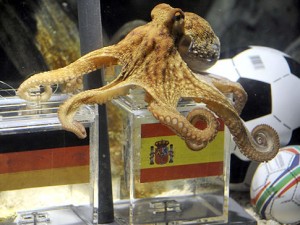
Early last morn, had a very unlikely guest dropping by for a visit. With sinewy, blotched arms (full 8 of them) and a rather bloated head with large oblong eyes. For a moment, I was shocked, dismayed and scared, and almost decided to wake up. But then, the fella put his arm around my shoulder in a rather reassuring way, telling me that he came in goodwill. After a little hi-hello, he introduced himself in an awkward brit-germanic accent, stating that he was Paulie. ”

Paul the Octopus,” I exclaimed. “Prefer it just Paul,” he stated, “the overemphasis on the octopus part is basically meant to sensationalise my predictions. I am, or rather, was just like any other guy round the corner with some ESP”. I nodded my head in appreciation, it was a sleepy nod though.


Following a little here-and-there, about the rains, the impending water-cut, pesticides in vegetables, end of night-life in Mumbai, Sunny Leone

‘s upcoming film and my to-be magazine launch, he came to the exact topic. “I have come here to reveal you the winners of the next matches” Obviously, he didn’t quite li
ke my reticence,so repeated himself again. This time, knowing what he expected, I kinda exclaimed, “yeah, yeah, go on”.

“Would you like, a tank of water with flag-cards, so you can settle on them and reveal the winners.” “Dude, first up, I am not what I was, so we can easily skip all that part. Anyways, that was all for the cameras, the guy at the zoo, use to keep my fav mussel on one of the flags and I used to settle down on one of them for a nibble. I could have easily shared my choice on an iPad, I would have preferred it more,” he said, glaring at me. “Anyways with you, since, we already are having a conversation, it would be easier to tell you right”. Yet, again I nodded, even sleepier.

After a few moments of silence, in which he possibly expected me to beg and implore, which I did not obviously. “Well, so here’s my prediction my boy, between Italy & Germany, it is the Italians, who will win again” “What? Italians? Germans are better off,” I retorted in shock. “No, I tell you boy,” he was condescending again, “those deutsche guys choke when it comes to deliver, so they will lose.” “I hope it ain’t personal, after all, did not a German restauranter offered to offer you up in a plate, when you last predicted their loss.” Continue reading

How BJP won (from) the Presidential Elections!

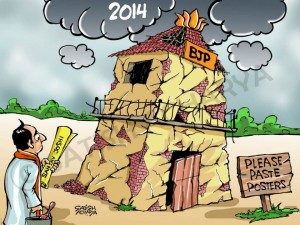
Till about a fortnight back, BJP as a party was in complete disarray. Beset by bickering and squabbles involving almost all its leaders, from Joshi to Modi to Gadkari to Advani, the party seemed like a Titanic destined to sink in the choppy 2014 waters. With so much politics in-house, BJP was all on a course to lose whatever little moral high-ground that it had come to occupy in the past 8-odd years of UPA rule. The prognosis was dour; namely, the lotus was wilting, and wilting much fast.

But just about when the whole of nation was getting sick and tired of the Joshi posters and the Modi jibes; something much bigger happened that took the whole focus away. Quite like Lord Krishna who supplied unending yards of chiffon sari to save Draupadi’s honour, destiny intervened for BJP with the announcement of the Presidential Elections. To be fair, a president in India is merely a titular head, and barring a few exceptions most individuals have been p

eople without a head (so as to say). Essentially, a president’s job in our socialist-secular-democratic-republic is to serenade on the Rajpath surrounded by a bevy of brawny surd bodyguards dressed in red and riding horses on the 26th of Jan, and secondly live in a very ostentatious palace and play host to foreign dignitaries. In fact, a year or so back, there was a contest that had been announced for the ‘world’s best job’, namely, that of a caretaker of a scenic coral island. Somehow, I think, being president of India is somewhat similar to that, an eternal holiday for 5 years, except that you have to sign a few bills forwarded by the cabinet now and then.

Coming back to the current presidential frenzy. Right from the start, the presidential race was set to be much exciting from the word go. Thanks to her numerous foreign jaunts and her lack-lustre performance otherwise, Pratibha Patil had ensured that she and her brood would be vacating the palace on Raisina Hills, with no even an atom of a chance of re-election. This time round, UPA, led by Congress also did not have all the numbers to enforce its choice and were largely dependent on like-minded (rhymes with money-minded) parties to help them build a consensus. On the other hand, while UPA was weak, NDA led by BJP was even weaker when it came to its votive power, and had little or no choice but to merely nod in agreement, under the sham of consensus.

There was little doubt that much like last time, Congress would yet again be able to install its man at Rastrapati Bhavan, who will oversee the important 2014 elections. Basically, it was Sonia Gandhi’s game to lose. And much surprisingly she did! Continue reading