
The elections in West Bengal are done and dusted. Yet, things seem far from settled. Former CM Mamata Banerjee has refused to step down, and violence has flared on the streets, including looting and the high-profile killing of Suvendu Adhikari’s PA. It appears it will be some time before normalcy returns to Bengal.
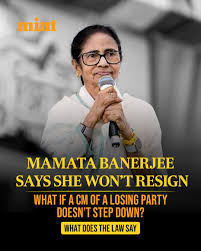
Not surprisingly, the media is in a frenzy. The saffron wave that unseated Mamata Banerjee after 15 years has become the singular focus of newsrooms and op-eds. The scale of the BJP’s victory is not only unparalleled but, frankly, unimaginable. Every analyst worth their salt is dissecting the reasons behind this seismic shift—from the Special Intensive Revision (SIR) deletions to anti-incumbency, and from governance failures to perceived arrogance.
As the battery of psephologists takes a breath, political observers have begun crediting the BJP juggernaut for the landslide—primarily the duo of Prime Minister Narendra Modi and Home Minister Amit Shah. We are reminded that this result was 15 years in the making; how Amit Shah made it a life’s mission, spending 15 days and nights in Bengal (apparently, sidelining his ministerial duties, but let’s not say that). We are inundated with statistics: the number of rallies by the PM, the roadshows by the Home Minister, and how booths were managed—or, as some might say, how votebanks were “mobilized.”
To get a clearer picture, let’s look at the data. In this election, the BJP won 207 seats with a vote share of 45.84% (approx. 29 million votes), while the Trinamool Congress (TMC) was relegated to 80 seats with 40.80%. For context, in 2021, the BJP held 77 seats (38.15%) while the TMC won a handsome 215 seats (48.02%). The overall voter turnout was historic at 93%, with approximately 6.55 crore votes polled out of a registered pool of 7.05 crore.
The defining factor was the 7.2% swing away from the TMC. As the expert Yogendra Yadav noted in one of the appearances when the results were being declared; TMC’s vast grassroots connection could absorb a 5% swing, but anything beyond that would be calamitous. That threshold was decisively breached.
Where did this swing come from? It was driven by an unprecedented consolidation of the Hindu votebank. Historically, West Bengal’s demography—with a 27% Muslim population— they have played an important role in the politics of the state – especially because they are assumed to vote en masse as a bloc. With the Hindus divided around numerous lines, caste, class, language, the so-called Muslim votebank has always been a significant factor in Bengal elections.
In 2026, for the first time, Hindus voted as a monolithic bloc. An estimated 65–70% of Hindu voters chose the BJP, up from 50% in 2021. Notably, 68.2% of Hindu male voters backed the BJP, while the TMC managed to retain only 38% of the Hindu female vote, a significant blow to their “Laxmir Bhandar” advantage.
The Bangladesh Factor
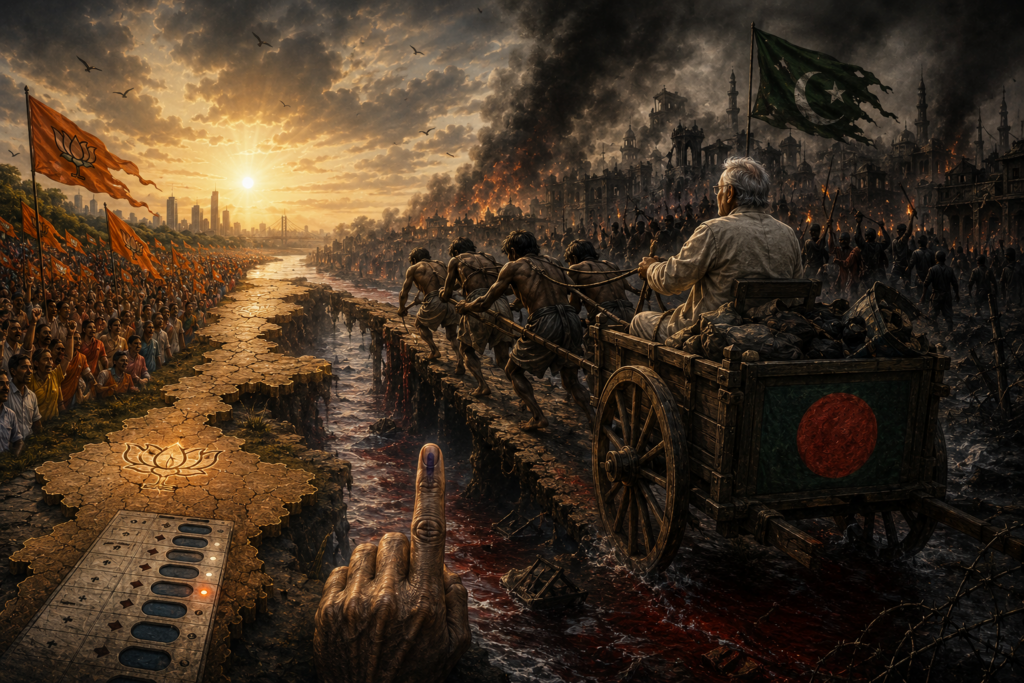
To understand this shift, one must look 70–80 km southeast of Kolkata. In August 2024, a student-led agitation unseated PM Sheikh Hasina in Bangladesh. Her escape to India led to a massive anti-India backlash across the border. In the aftermath, the interim government led by Nobel laureate Dr. Muhammad Yunus was unable to quell systematic violence against Hindus.
Throughout 2024 and 2025, reports of murders and the desecration of temples created a visceral sense of “existential threat” among West Bengal’s border populations. The BJP, with its unabashed saffron credentials, was perfectly positioned to reap this crop of fear. In districts like Nadia, North 24 Parganas, and Malda, the Hindu vote didn’t just grow; it exploded.
West Bengal shares a 2,217 km border with Bangladesh. The frontline districts account for roughly 115–120 seats. In 2026, the BJP won 92 of these seats, up from 48 in 2021—a growth of over 90%.
The Matua Factor and SIR
The Matua community (Dalit refugees) was the “X-factor” in this border surge. Constituting roughly 17.4% of the state’s SC population, they influence outcomes in 40–42 seats. This community was hit hardest by the Special Intensive Revision (SIR). Of the 91 lakh names deleted from the rolls, approximately 22 lakh were Matuas (though 1.9 lakh were later restored).
The fear of disenfranchisement led these voters toward the BJP, which promised them permanent status through the Citizenship Amendment Act (CAA). Consequently, the BJP swept nearly 90% of Matua-dominated seats.
The landslide was also fueled by the abject liquidation of the Left Front and Congress. In 2021, their combined 10–12% vote share acted as a buffer for the TMC. In 2026, this “Third Pole” crashed to a historic low of under 7.5% statewide (CPI(M) at 4.45% and INC at 2.97%), leaving them with just three seats combined.
Simultaneously, the Muslim vote fragmented. New players like Humayun Kabir’s Aam Janta Unnayan Party (AJUP) and the ISF sliced the TMC’s base. In Murshidabad and Malda, the AJUP won key seats like Rejinagar and Nowda, allowing the BJP to sail through the middle in Muslim-majority constituencies like Beldanga and Kandi.
Finally, the “Bangladesh Factor” permeated the middle-class consciousness of Kolkata and Howrah. The BJP’s narrative shifted from “Border Security” to “Urban Demographic Protection.” This resonated with a bhadralok class previously skeptical of the party, leading to the fall of TMC fortresses like Bhabanipur and Rashbehari.
Conclusion: The Sword over Supplication
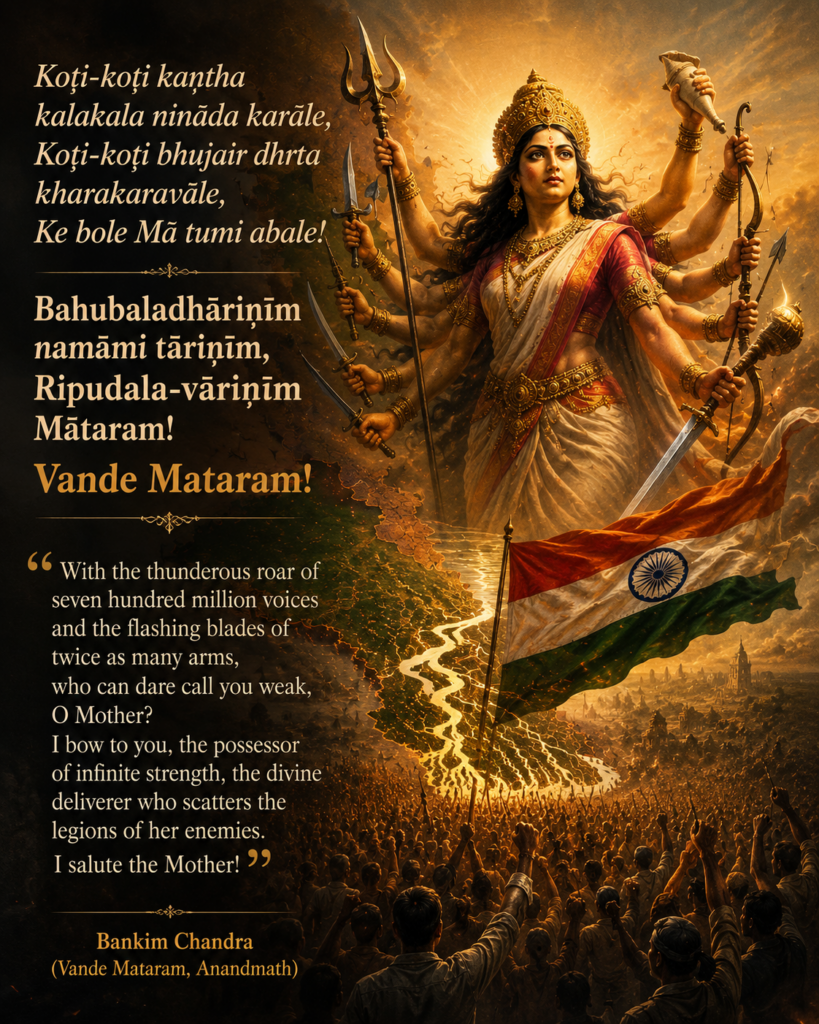
On December 8th, 2025, just months before the polls, the Central Government initiated a full-day debate on the national song, Vande Mataram. By highlighting the historic “injustice” of retaining only two stanzas, the BJP passed legislation restoring the full six. By invoking the militant spirit of Durga, the BJP portrayed its members as modern-day Santans—the ascetic warriors of Bankim Chandra’s Anandmath—defending the land against “aliens.”
In that sense, the ballot box in 2026 became the modern Anandmath, where the ‘Sword’ took precedence over the ‘Supplication.’