
आग जलनी चाहिए — The Fire Must Burn

A post from a friend about a Malayalam movie, Amma Ariyan, forced me to confront what I had been trying to avoid for quite some time.

Like so many of us who live for the simple रोटी, कपड़ा, मकान and don’t want to be न किसी की तीन, न तेरह — ignorance, at times feigned, is an amazing cloak. It wraps you into a stupefaction, a sense of disbelief that even if “all izz not well,” it might just eventually be — and that when it does end well, all will automatically be well.

It is this meekness within you that covers your vision — rendering you unable to see things the way they are, or to come to terms with reality as it is.

Over time we tend to become so much like the courtiers in the Emperor’s New Clothes — muffling our conscience for a little bit of peace.

And then, when the curtain over our eyes is jerked out suddenly, you are ashamed of your wretchedness, of your own weakness. The world suddenly seems so raw and unvarnished — you now have to confront the sheer wantonness that is so ubiquitous, the squalor, the putrefaction of values, the sheer morbidness.

It is suffocating — how could one buy peace in such conditions? How can one come to terms with it?

It is disgusting, infuriating — you hate what’s around you, and also what you have become, buying scraps of peace with conscience as the currency. But now the price seems just too high.

And just when you are sort of drowning in this slough of despondency, Dushyant Kumar appears like an apparition — speaking words of revolution, of change. His words give warmth, they give hope, and most importantly, they give you a roadmap of how things could shift.
हो गई है पीर पर्वत-सी पिघलनी चाहिए,
इस हिमालय से कोई गंगा निकलनी चाहिए।

His short poem — ho gayi hai peer parvat-si… — is an anthem of revolution, of courage, of standing up, of not giving up.

आज यह दीवार, परदों की तरह हिलने लगी,
शर्त लेकिन थी कि ये बुनियाद हिलनी चाहिए।

This does not imply making a compromise with either the system or its stooges — maggots that have grown fat feeding off the lard of corruption, even as they dress up nobly and act saintly. The system needs to be dismantled. It needs to be overhauled.

हर सड़क पर, हर गली में, हर नगर, हर गाँव में,
हाथ लहराते हुए हर लाश चलनी चाहिए।

We need deep-seated change — a shift away from all the encumbrances that bind us down: caste, creed, language, religion. These compartmentalizations must be eviscerated. A system plagued by rampant inequity and steeped in corruption cannot, and must not, be allowed to beguile or misguide us any longer.

सिर्फ़ हंगामा खड़ा करना मेरा मक़सद नहीं,
मेरी कोशिश है कि ये सूरत बदलनी चाहिए।

Many times in the past there have been moments when people rose, only to retreat when confronted by the state. Silence is the price the system demands. And ironically, disquiet is the only way the system can be jolted. Whether it will change or shift, one can’t say — but that should not deter us from the objective.

मेरे सीने में नहीं तो तेरे सीने में सही,
हो कहीं भी आग, लेकिन आग जलनी चाहिए।

The only regret is that the bravado that comes with youth is often amiss elsewhere. Experience is a lousy teacher — it teaches only profit, ROI, benefit, survival. It does not concern itself with society, nation, or state; it prioritizes only self-preservation.

Little wonder, then, that it is the young who are at the front, leading the call for change — getting whacked, getting beaten, and yet persisting. It is they who give us hope of a possible breakthrough.

हो कहीं भी आग, लेकिन आग जलनी चाहिए।

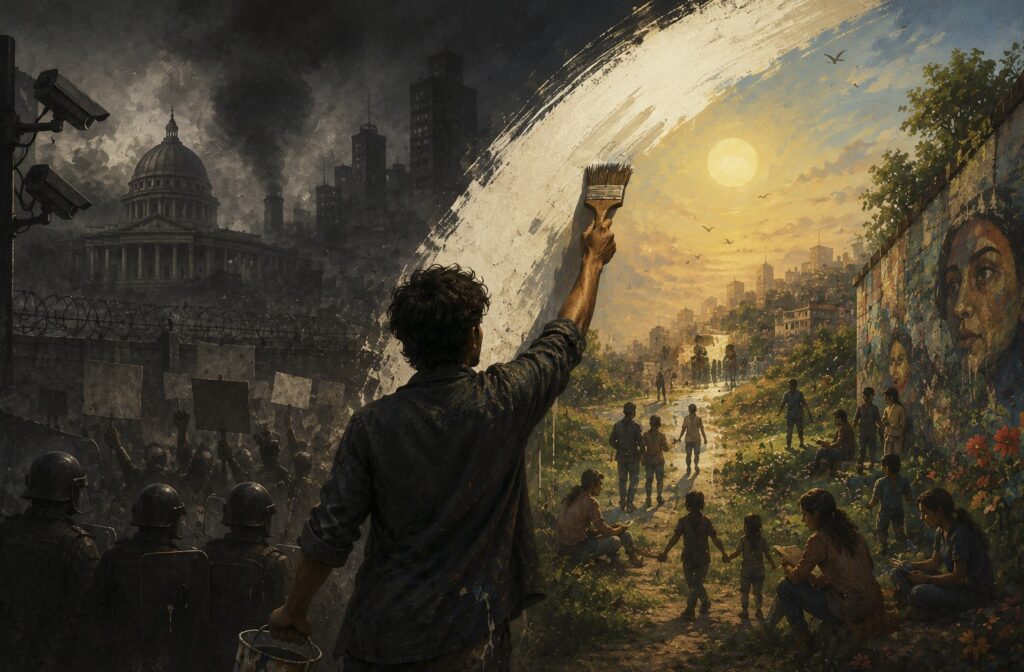
Indeed, the fire must keep burning and consume all — so that something new can be created from the rubble. Something that belongs to all of us, and to which we, in turn, belong.

Here is the full poem – without break

हो गई है पीर पर्वत-सी पिघलनी चाहिए,
इस हिमालय से कोई गंगा निकलनी चाहिए।

आज यह दीवार, परदों की तरह हिलने लगी,
शर्त लेकिन थी कि ये बुनियाद हिलनी चाहिए।

हर सड़क पर, हर गली में, हर नगर, हर गाँव में,
हाथ लहराते हुए हर लाश चलनी चाहिए।

सिर्फ़ हंगामा खड़ा करना मेरा मक़सद नहीं,
मेरी कोशिश है कि ये सूरत बदलनी चाहिए।

मेरे सीने में नहीं तो तेरे सीने में सही,
हो कहीं भी आग, लेकिन आग जलनी चाहिए।

— Dushyant Kumar

Open Letter to Arvind Kejriwal

Dear Mr. Kejriwal,

Hope you are doing well. Inspired by the note that you wrote, I thought of dropping you a little one myself. I mean, the nation knows (apologies to Mr. Goswami) your views are pretty firm about how corrupt politics and crony capitalism has spoilt this “sone ki chidiya” nation of ours. You have taken on the very haughty and mighty, through your press conferences, revealing things that could not be revealed earlier, as there was no proof of them, before or now. While, going through your recent letter, I was impressed by your sheer concern about the nation, and its resources, and how it needs be saved at all costs. But then a sudden thought stuck me, a rather jarring one, and I thought I will ask you for an explanation, through your preferred route, an open letter.ArvindKejriwal2

The thing that concerns me is your silence on how bureaucracy (more so the corrupt one) has been one of the biggest bane of this nation. You have been unusually silent sir, on how cronyism and corruption is rampant in Indian bureaucracy. While there are but some 500 odd political leaders, and a few thousands MLAs. The bureaucracy is just around a  million strong and growing, and yes, in terms of corruption index they are no less above the board when compared to say a politician, or a business person. In fact, come to think of it, they are indeed more dangerous, I mean, you don’t have an idea of how much are these babus making, till one day there is an IT raid, and crores of cash, jewelery and property pop up. The corrupt bureaucracy is like a termite that is not on your face, but hollowing the insides. Ironically, Transparency International whose non-existent report you quoted, has apparently stated in one of its real reports that 62% of Indians have paid a bribe to get a job done at public office. There’s also some survey from 2009 that states that Indian bureaucracy is not only one of the least efficient but also one of the most corrupt among Asian nations. Continue reading

The Legacy of Sultan Manmohan Singh Tughlaq

Time is a rather malleable entity, unpredictable and quite unfathomable. Linear it is, say many, like a fabric all meshed up, say few, heavy like gravity, like a quasar, multi-dimensional, ephemeral, unreal, say the rest. The passage of time, quantified by the circular rotation of two sinewy arms on our clocks, is meant to signify a sort of permanence, a moment that is lost or gone, ceases to exist. There’s nothing that one can do to bring it back, lost in the ever-infinite sea of eternity. Past is past, and present is present, and never the twain shall meet, is good a testament, that could have well been etched in stone on that tablets that were forged at Mount Sinai.

And yet for all its permanence, time sometimes also seems permeable, like a sponge or something. The little circles on one side forming a connection to another side. The connections are unmistakable, inescapable. And while the recorded history of our species only stretches a couple of thousand years, even in this short period we have seen events taking shape in different time, different climate, mirroring each other in a very strange ethereal manner. Separated by a vast ocean of time, yet, these events seem like some sort of cosmic clones of each other. History (which is a product of time) indeed has a very uncanny knack of repeating itself.

To give you an idea, lets flashback to 14th century India, much long before the very idea of India even firuzexisted. The precise time on the dial is set to sometime in the latter half of the century, somewhere say 1380s AD. The place is Firozabad, not very far from modern-day Delhi, and it’s the reign of Malik Feroze ibn Malik Rajab or more renowned as Sultan Feroze Shah Tughlaq. The Sultan is a septuagenarian man, lording over a dominion that is much weaker and lesser than what his pre-decessor had bequeathed to him. He is a sort of weakling, little in control of things around him. He had succeeded the strong-willed and maverick Sultan Muhammad bin Tughluq, who was most famous for his decree to shift the capital from Delhi to Daulatabad or his experiments with token currency that failed spectacularly. But unlike his predecessor, Feroze Shah Tughlaq was a softie, or a little more of fruitcake. When he took over in 1351, the empire was vast but in a mess. There was much confusion as Muhammad bin Tughluq had died without an heir, and in the ensuing unrest, Feroze was enthroned as the new sultan. Continue reading