To (H-1)B or not to be?

Criticism against the H-1B visa program is mounting with easy passing day with increasing job losses in the US. Will Indian companies, IT sector particularly, be able to whether the storm as they were the chief beneficiary of the program?

November 4th, 2008, will forever be remembered as a historic date, as it was the day a black man (Barrack Obama) was elected as the 44th President of the United States. His victory against all odds was wildly celebrated not only across towns and cities in the US but also across the globe. Thousands of people across different continents were seen cheering and celebrating Obama’s election to lead US for the next 4 years. But back here in India, there was muted scepticism for the new president. Though overtly, there were congratulatory messages being exchanged and right noises being made, deep down inside there was a niggling fear of Obama as a policy maker and Democrats in large.

The trepidation was not without reason, the world at large and the US specifically is facing one of the biggest economic challenges in the past few decades. Prompted by the Sub-prime crisis, the US economy has been going down, and going down fast. With factories shutting down and jobs being retrenched, Obama promised a policy that was a complete anti-thesis of the Republican pro-toh102_31march2k9business line. He talked about pumping money in the economy and more importantly ensuring that Americans did not lose their jobs to migrant workers (read Indians). In fact, he had even spoken against the H-1B Visa program, wherein companies were allowed to bring in specialist workers for some 6 odd years in the US.
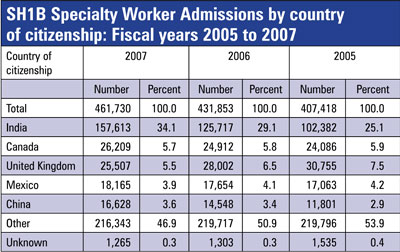
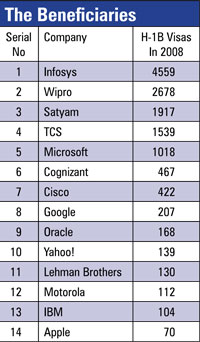
The main beneficiary of the H-1B Visa program were Indian tech companies, namely, TCS, Wipro, Infosys, likes that sent their workers in the US on deputation. Using H-1B Indian IT companies could offer a range of outsourcing services to corporations across the US. But as the job losses seem to be at historic high in the US, the shrill against the H-1B program is growing stronger by the day. In fact, the latest data released by the US immigration authorities, shows that Indian IT majors received the maximum number of H-1B work permits in 2008 (see table). It is certainly not a new trend as Indian IT majors had dominated the list of H-1B recipient list last year as well. Last year 163,000 immigrant workers applied for 65,000 slots. These figures are being used by the critics of H-1B program, ranting against the dominance of Indian IT firms.toh103_31march2k9
The Noose tigthens

Protectionism is indeed on the rise in the US. There are numerous senators who are lobbying hard to have the H-1B program be scrapped or have severe restrictions imposed. Not surprisingly, last month, when President Obama presented the $787 billion federal stimulus bill to the US Congress, he spoke about how restrictions would be imposed on H-1B use by financial-services firms that receive bailout funds. On the other hand pressure is also rising on the US MNCs asking them not to employ H-1B workers, for instance, Senator Chuck Grassley sent letters to Microsoft mentioning that the company had “a moral obligation” to put the jobs of US citizens ahead of H-1B immigrant workers amidst layoffs.

There was also much hue and cry among the Indian community in the US over the three-month deadline to leave the US for H-1B visa holders who have lost their jobs. U.S.-based organisations of Indians have asked for an extension of the deadline as a falling market it is difficult for returnees to sell their assets and settle their affairs.

Back in India, the response has been much refrained. While quite a few politicians have decried against any sort of protectionism, not much has been forthcoming from the IT sector. Nasscom for its part expressed ‘serious concern’ at the turn of things. Government officials in India are lobbying with the US government to work out an amicable solution to the issue.

Likely Impact?

So, how bad is the news for India and Indian companies in particular; is the big question that is on everybody’s mind right now. There is a body of thought, that in order to stay competitive companies in the US will have to looks at ways and means of increasing productivity while at the same time cut costs and hence they cannot do away with outsourcing all together. It is simple economics and no amount of politics can really score over it. Also, the fact remains that in spite of his Democratic antecedents, the Clintons (former president Bill Clinton and current secretary of state Hillary Clinton) have been supporters of the H-1B program. In fact, the wind seems to be still blowing in favour of the H-1B program, as Obama chose Senator Judd Gregg as the Secretary of Commerce. Gregg had in the past stood out in the Senate in strong favour for expanding the cap on H-1B visas from the current 65,000 per year.

In the meantime, companies and job seekers are again gearing up for applying for the H-1B visas that will become available in financial year 2010, which begins in October. The USCIS will receive application for the 65,000 visas on April 1. Business icons like Eric Shmidt (Google) and Bill Gates (Microsoft) are known proponents of the H-1B program. Thus, there is the likelihood that all the words might not really translate into action, and Indian companies might continue to benefit like they have done in the past.

In the end, it all boil down to the economics, if the crisis worsens and there are more job cuts and losses in the US, the opposition against outsourcing in general and H-1B in particular will increase by manifold. Banks and financial institutions that have been bailed out by the US treasury will be under enormous pressure to hire American citizens over immigrants. With a bevy of banks being funded by the US government, this is certainly not a great scenario. Also, if perchance the massive bailout fails to enthuse the economy President Obama will be coerced into adopting more radical means of kick-starting the US economy.

On the other hand, if in the next few quarters the pall of gloom lifts and there is an improvement on the ground in terms of the US economy, the tirade against the outsourcing will lessen. Indian companies are desperately hoping and praying for the same as their own health is intricately linked with this scenario. The big question is will it happen that way? And what if, it doesn’t?

(This article of mine had been recently published in Dataquest)

Bad Times cometh!

Recently, India’s largest media house Bennett & Coleman (the Times of India, for the uninitiated) sent across a mail to all the employees, detailing austerity plans: freeze on salary hikes, cutbacks on past increases, etc.

In the rather detailed and inspiring mail, Ravi Dhariwal, CEO, called upon the employees to “make personal adjustments and sacrifices  for a  greater cause”.  And for the sake of oneness, there are salary cuts across the board.

What I am really curious about is that, when the times were good, and the business was booming, where was this spirit of oneness then? Why were not there salary increments across the board? Or is it that, when things go good it is because of a few bright souls (of course the top brass, who needs to be patted and rewarded accordingly) and when it is a downturn, it is everybody’s problem and the spirit of ‘oneness’ comes to fore. Well, such is life.

Nonetheless, the salary cuts at Times will have a domino effect on the rest of the industry, am sure a lot more media company CEOs will be emboldened by this step and must be drafting a visionary piece of letter, that makes it sound almost like a necessary sacrifice. For all of them, I am pasting Mr. Dhariwal’s inspiring piece.

Just one request to all the CEOs. whenever you send out the mail, let the daggers be out. Please don’t sugarcoat it with moral platitudes of oneness and togetherness. In these trying times, the last thing one needs is platitudes.

The original (and inspiring) piece:

Confidential: Times Pay Revision Cut

Dear Colleagues,

Over the last five years we have had a dream run  as a company. In July 2008,  we grew to be a billion dollar company, growing at 20% per annum, nicely profitable, growing shares in almost all geographies, expanding our editions into newer territories and winning important competitive battles. Why do I  call it a dream run? Because we met success everywhere, including  against competitive attacks in large markets. This encouraged us to think of expanding even more rapidly. We made plans to double our capacity, launch many more new editions, take Mirror to other cities and continue to grow our business at the same pace.  Not only our business, we all grew both professionally and personally in the last 5 years.
Continue reading

Go ahead Otis, sell Gandhi

Over the past few days there has been a big hullabaloo raised over the sales of some of the items belonging to Mohandas Karamchand Gandhi, more popularly known as Mahatma Gandhi or just Bapu. It so happens that an ingenious American (the Americans are very ingenious in things like this) named James Otis over the years put together a rather impressive collection of Gandhian memorabilia that has things like Bapu’s specs, sandals, bowl and plate, watches, blood report and other such mundane stuff.

No one knows for sure as to how Mr. Otis got hold of such stuff and how much did he spend. Considering the way, we Indians treat our heritage, it should not have been difficult or costly either. Check any Christie or Sotheby catalog and you are sure to spot hundred of temple idols and paintings that have been sourced from some obscure part of India for some few USD and sold for millions abroad. Mr. Otis, simply put, has done the same with Bapu. And though, he might paint his motive with a shade of nobility, the fact is that he intends to make a few easy millions through the sale. Simple business, what Americans are best at.

But, here in India, everyone is going berserk on the sale. All hell is being raised at such a blatant sale of our nation’s heritage, news channels are running scores of programs with all these experts and high-profile people talking about what Indian government needs to do. There are these grand daughters and the great grandsons of Gandhi coming on TV making an emotional plea for the items to be brought back. Then, newspapers are full of stories on how Bapu saw a vision of modern India through those specs.

In between officials from the ministry of culture, MEA, PMO, all are running helter-skelter to either stop the auction or negotiate with Mr. Otis. I am sure, at this very moment, there must be a team of high profile Babus out there in the US, trying to work out an amenable solution. Even stinking rich NRIs are being courted and asked to buy the items and gift them to India. And finally, no less the PM of India has raised the bar by sending out a poignant plea ‘do everything to get hold of Bapu’s stuff’. Unnecessary emotions, what Indians are best at.

In all this theatrics of the absurd, one small point is being missed, by all this dramatics and stuff, we are really walking into Mr. Otis’s trap. He must be so much gleefully rubbing his hands at the moment. Over the past few days, the reserve price for the stuff has gone up by a few hundred thousand Dolllars, and it all goes into his account. So why the hell are we going crazy over it?

Continue reading

Schadenfreude Millionaire

It’s evening time at the posh Lincoln Plaza Cinema, in Broadway, New York an Amy Wilder is sitting perked up and looking with disbelief at the film running on the big screen ahead. Though, she has never really visited India, but has heard a lot about the country especially due to the job losses in the US. Like many else she believes that every white-collared IT worker that is retrenched in US is replaced by a brownie in some obscure city of India. Over the years, Amy, and many like her, have come to believe that India is no merely a land of elephants, snake charmers and the rope trick artists, but a potent threat to the workforce because of its laborious and educated workforce. The stereotype had steadily been effaced.

Yet, sitting in the Lincoln Cinema, she witnessed an image of India that she has often heard about but was not sure that it existed; an impoverished country wherein people were reduced to despondency, fighting, bickering, cheating, and killing each other. Thanks to the ‘Incredible India’ buses that flitted on the Broadway Street, her image of India as a third-world country had been replaced by that of an emergent and mystical land, the country of IT and that of the Taj Mahal. But Slumdog Millionaire got her thinking again

Seeing the two little orphans scampering across the cramped and filthy streets of Mumbai made her realize that India was not really a country that should be loathed, but rather pitied. In fact, on coming out of the theatre, Amy felt better about her existence, even though she was facing tough times in the face of job loses and defaults on mortgage payments, but at least it wasn’t as bad as in India, where small boys were blinded and made to beg on streets, or mobs of religious fanatics went about killing people just like that. Thank you lord for not making me an Indian, she heaved a sigh. Continue reading

Space debris a concern: ISRO chief

Recently, when I spoke to ISRO chairman G Madhavan Nair (one of the best interactions I had in a long time), I could not resist but ask his views on space debris in light of the latest collision of US Iridium satellite with that of a defunct Russian satellite.

According to experts, there are currently at least 17,000 objects measuring 4 inches or greater circling the Earth. The US government estimates that there are 200,000 objects in the 1-3 inch range and tens of millions smaller than an inch. Thus, it poses a major hazard to any space mission, including the upcoming ones from ISRO.

Hence, I asked Mr. Nair, his views on the subject, and this is what he had to say:

“Space debris is a real issue and a serious concern, though the threat as of now is not very high as the probability of a collision happening is very bleak, approximately one in a million, less than that of a road accident. We have been facing this issue and need to take care of it because these objects are
travelling at around 7.5 km/sec and any collision at that speed can be
quite disastorous.

Of course during the launch of satellite, we keep a track of a catalog
of known objects and we ensure that they are taken care of. But beyond
that there is a lot of minute and small objects that are hovering
above the ear and pose a threat to any mission. Fortunately, an American agency has made a detailed catalog of the objects and they share it with us all the time. The issue of space debris will get more critical in the coming years as the clutter increases in the time to come.”

Coming from the man behind the Chandrayaan mission, this is indeed a serious concern. The big question is whether there is anything that we can do??

A Mama am I

Yesterday, precisely at 2 pm in the afternoon, a small bundle of joy made a grand appearance on planet earth; a charming lady with a cute little nose. While the arrival was not surprising, as she had been in transition for the past 9 months and some 6 odd days, nonetheless, her grand coming was a great joy and relief to many.

The lady (nameless, as of now, since the parents are still bandying over the name) has already changed the way a lot of people are called or will be known henceforth. Like some writ from the monarch who doles out peerages and lordships, we all have been bestowed with various titles, Parul, my sister will be Ma (mother) and Anish, my bro-in-law will be Papa (or pop). My mom will be a Nani and my dad a Nana (grandparents). My little sister will be a Mausi (aunt) and best of all, I am bestowed with the title of Mama (uncle).

Now, ever since the Mama-izing news was delivered to me, I have been pondering over the matter, what are the pros and cons, what are my rights and of course the duties? Should I be an indulgent Mama, the one who keeps pampering, or a snooty one, that any child will not necessarily like to have. I have also been thinking, what is exactly expected out of me, considering the enormous responsibility on my shoulders, as I am a MA-MA (that is twice mother, as the Hindi equivalent of Ma is Mother). There has to be some grave reason why I am a Ma-Ma (mother-mother).

Sadly, the role models that are available are not really rolemodel material, for instance, there is Mama Kansa who tried to get rid of his nephew Krishna by sending heinous monsters. Then, there is of course the popular Shakuni Mama, who misguided his nephew Duryodhan and literally dragged him and his brothers to doom. Apparently, and if I am not wrong, Ravana took the help of his deceitful Mama Marich, to abduct Sita. Thankfully, it ends there in mythology, as there are no more gnomish Mamas in literature, or if there are, they aren’t all that popular.

For some strange reasons Mamas continue to be reviled in modern framework, being portrayed as scheming villains in scores of Hindi movies. The precedent set by literature is hard to get rid of.

But, there is one benevolent Mama, that looks down upon us every night, expect a couple every month. Smiling, reassuring that all will be fine. Chandamama is indeed the best Mama of the lot.

So returning to the charming-lady-with-no-name-who-has-made-me-a-Mama, I will try and be like the Mama we all love, good ol’ Chandamama, smiling, happy, and observant. I just pray that the task is at least as easy as it sounds. As of now, looking at the cute little lady, anything else is unimaginable.

Interview: Filippo Passerini (Head, P&G GBS)

In an interview, Filippo Passerini spoke about the changes wrought by him at P&G and how he transformed P&G and the company transformed him.This story was published in the Dataquest Magazine.

**********

One of our strategies has been to anticipate the future, to stay ahead of the change

In his 27 years at P&G, one thing has been constant for Filippo Passerini; his quench for thirst and his pursuit of excellence. And in these years, he has held a series of leadership positions the UK, Greece, Italy, the U.S., Latin America and Turkey before taking the leadership of P&G’s Global Business Services (GBS) organization.

GBS is responsible for providing key business support and solutions to 138,000 P&G employees working in over 80 countries worldwide.  In addition to IT, the services provided include finance and accounting, employee services, strategic sourcing, facilities management and consumer relations.

Hailing from the ancient and wondrous city of Rome, Passerini has earned his Doctorate in Statistics & Operating Research. On being asked about his passion, pat he replies, “I am passionate about learning, as I believe you always can do better or do more. Lessons can be learned in every aspect of your life+.  In my youth, I used to play competitive chess. This taught me that you can only think so long; at some point, you need to move. This lesson is extremely relevant to the work we do in GBS. In a world that is accelerating faster than ever before, we must be able to develop our strategies — and act — quickly.” Little wonder, till date, GBS already has saved the company more than $600 million through shared services alone.

Climbing his way through the corporate world, Passerini is an avid mountaineer in his real life as well. He has scaled three peaks higher than 15,000 feet. He lives with his family in the US, working in P&G’s Cincinnati headquarters. In an extensive interaction with Dataquest, Passerini talks about the various issues that are critical to success of a company that was founded way back in 1837 and currently has 23 brands that have more than $1 billion in net annual sales and another 18 have sales between $500 million and $1 billion. Excerpts.

How is IT used to string together a mammoth enterprise like P&G that spreads across over 80 countries and having an employee base of over 138,000?
When we set out on our journey we had a clear IT vision. We wanted to bring the back office to the boardroom – leveraging IT as a driver for business transformation and growth. The approach we took was global, holistic and founded on partnership. First, we looked beyond IT, positioning ourselves as the “go to” organization for all key business services. Today, our Global Business Services organization covers over 85 services in the areas of employee services, finance and accounting, strategic sourcing, facilities management and consumer relations too. Secondly, we decided early to globalize our operations. Just as an indicator we standardized 72 systems in 70 markets in just 3 years and focused work in 6 global service and data centers. Finally, we reached out to grow relationships with strategic partners who support us in our work. Our IT partnership with HP is a great example here. Together, we have not only achieved above-projection cost savings with better services, we have also been able to tap into HP’s innovation capabilities and become much more agile. Continue reading

Interview: Bob Rickert (CIO, Barclays)

In an interview, Barclay’s CIO Bob Rickert spoke about his own experiences with IT and banking. This story was published in the Dataquest Magazine.

*********
I am willing to outsource the doing but not the thinking

For Bob Rickert, cooking is more than a hobby. In his free time, he can be seen in his kitchen tossing up salads or fashioning up new cuisines and dishes, especially so for his 15-year-old son and 13-year-old daughter. The best thing about cooking is that you get to know immediately whether you did a good job or not because people will either eat your dishes or they wont. There is no two-ways about it, says Rickert.

Rickert uses the same fundamentals of feedback and response as he heads the IT department of one the top twenty companies, according to Forbes Global 2000 rankings, Barclays. He is CIO, Global Retail and Commercial Banking (GRCB) Technology, Barclays. Rickerts responsibility is to lead 7,000 IT colleagues globally to deliver IT capabilities and support for GRCB.

Starting his career at IBM, Rickert has taken up quite a few challenging roles in the design and development of technology before switching over to manage the IT systems at KeyCorp, the eleventh largest bank in the US. It has been around two years since Rickert has joined Barclays and is leading the charge in terms of making the organization more oriented toward customer needs and wants. To be successful, we need to understand that the reason we exist is to support Barclays customers and all the great technical wizardry is of no use if it is not creating value for our customers, he adds.

In an extensive interaction with Dataquest, Rickert talks about different aspects of IT management and what it takes to lead a major financial institution like Barclays. Excerpts

How do you think has the banking sector embraced technology? Was it willingly or was it coerced, due to legislations, etc?
The banking sector has embraced technology very aggressively and willingly. Many vendors would say that financial institutions are leaders in terms of technology adoption and usage. We at Barclays are focused on providing great service to our users and given just the volume of transactions, one would want to automate as much as possible. A company would like to maintain a consistent quality of service, which is hard to get if you rely on manual processes. This sort of philosophical approach is universal across the financial services industry, hence, banks and their likes are very much leaders in technology adoption.

How strategic is IT to the change management process, considering that the company has a history that goes back four centuries? Continue reading

I lived in the time of Obama

There is little doubt in my mind that in the coming years when I grow old and haggard and sit down for a chat with my grandchildren telling about all the things that I have witnessed in my lifetime, November 4th 2008 and January 20th 2009 will be two important dates.  I will mention the fact that the biggest and the most powerful nation of my time, for the first time ever achieved what it used to proudly proclaim, liberty and equality. It took nation some 232 years to finally deliver the promise it had made. By becoming the 44th president of the United States of America, Barrack Hussein Obama has finally proved that the nation is one of dreamers and achievers, not of Catholics, Protestants, Jews, or Mormons. Today the White House in Washington, DC, is no more just a white’s house.

Surely, my grandchildren will wonder as to what was so great about an African American becoming a president, when there were a huge number of Black Americans in USA. With a benign smile, I will tell them of the class struggles, how the Blacks or African Americans were niggers in the past. How through the ages, slave traders from Spain and Britain used to capture innocent people from Africa and make them lead a despicable existence in some farm. I will divulge how in spite of all tall claims of modernity, the American society was very much fractured on the basis of colour, though it might appear otherwise. I will give examples of rampant discrimination in every form, be it schools, colleges, workplaces, restaurants and even public transportation, talking about the life in ghettos, full of crime and penury.  I will also tell them about an incident that I had known about the race riots in America, after a Black (Rodney King, hopefully) was mercilessly battered by a few White cops.

In this context, I will paint Obama as a bigger hero than he was.  I will proudly boast of how I was in the US when the elections results were declared and how I witnessed the frenzy. Even as I talk, I will reach for my cupboard and from therein I will pull out yellowing copies of SF Chronicle and NYT dated November 3 and 4th, 2008. I will also show off the round pin-up batches of Obama campaign that I had picked up from an old vendor from San Francisco, with a small American star and stripe flag. I will preen about those days, reminiscing about how the entire world was completely wonderstruck and joyous about a Black Democrat being the President of the USA.

And then, I will tell about January 20th 2009, when Obama took the oath of office in front of millions of individuals that had thronged the White House.  I will briefly mention the whole ceremony, and also tell them of how Obama spoke to the world at large from the podium.  I don’t think I will be able to tell much about what he spoke, since his speech was not up to the historic moment.  Even now when I think of it, there is little that I can recall about his speech, it was just like the hundreds he has made over the past year or more. I will rue in front of my grand kids of how I sat in front of the television, waiting for every word from his lip, hoping that he will touch my chords, make me proud of this moment, reassure that course of history has been corrected, paint a picture of beautiful and equal future and how Obama did noting of that.  I will give them the example of Pandit Jawaharlal Nehru’s speech on India’s freedom, “at the stroke of the midnight hour, when the world sleeps..”.

Hopefully, I will have a lot more to tell my grand kids about Obama and how his presidency was vastly different from the rest, that he was not merely a Black or an African American President but a great one and that he might have made history by becoming the supreme commander, but he left a bigger mark on history as the supreme commander.

Just in case, my memory fails when I am older, I will read this post written on that historic night of January 20th, and then ask my grand kids to gather around me and tell them the story of a certain Obama and how I lived in his times.

1000 already. how many more?

Over a 1000 Palestinians dead in the past 18 days of conflict, the news caster announced with a deadpan face.  The statistics might not be big enough to scare, after all what is a mere thousand, when hundreds die every day.  In a typical day, a couple of hundreds meet gory death somewhere in Middle East or Asia, if the terrorists are in the mood. For instance in the recent strike on Mumbai by terrorists (BBC prefers to call them gunmen; they are terrorist if only they hurt US or Brit citizens), within a span of 72 hours some 183 people lost their lives. Or in any of those car-suicide-blasts in Baghdad, 50-60 people getting blown away in bits is not uncommon. So, when one looks at 1000, somehow that does not seem all that much. After all, how many hundreds died when F16s dropped cluster bombs on Bosnia, just so that President Bill Clinton could divert the attention from the Monica Lewinsky affair (if one believes Michael Moore).

But that’s the trouble with statistics, they can look alarming or innocuous simply by the comparison one makes. Thus, compare the 1000 deaths in Gaza to the hundreds that die every day across the globe it doesn’t seem much. Now, think of your own personal loss, death of a close relative or at a close friend’s home. Picture now, a 1000 fathers, a 1000 mothers, a 1000 children, and a few thousand others wailing and beating their breast in anguish. Imagine the pervasive drops of tears that refuse to subside. Consider the anguish and the pain that a single traumatised family goes through. And suddenly this 1000 becomes depressing. Continue reading

No ‘Jai Ho’

Sitting in front of the TV, yesterday, I was bit by the slumdog. All the news channels were going gaga over the fact that the film was a major hit at the Golden Globe Awards, walking away with four awards. But the biggest news was that our very own AR Rahman had broken the shackles and landed a golden statuette, crediting a “billion people from India”.

Since then, every news channel makes me want to puff my chest in glory and take pride in the fact that an ‘Indian’ had won the coveted award. Every one that is anyone is talking highly either about the film or about AR Rahman; the actors in the films are traipsing from one studio to another talking animatedly about how close they are to Rahman and how wonderful Slumdog Millionaire is. But that isn’t all, Karan Johar has penned an article about his experience at the Beverly Hilton Hotel in Beverly Hills, California in BT. Then let Shahrukh Khan land in India, there will be a whole lot more stories of how Bollywood is now as great as Hollywood. Continue reading

Why demonise Raju?

It is a sad irony that what took 22 years to be made, crumbled in a span of 2 weeks. Satyam,one of the biggest IT players in India, would never be one again, not at least in its current form. The fear that is stalking every one’s mind is it an ill omen of more blood bath on corporate street, more skeletons tumbling out, more biggies taking a bow. If B Ramalinga Raju, the recipient of the Dataquest IT Man of the Year Award 2000, E&Y Entrepreneur of the Year Services award 1999, the Asia Business Leader Award 2002, and the Golden Peacock Award for Corporate Governance, cannot be trusted, who can be?

But let’s clear one thing, though Raju cheated the investors, clients, etc. he is certainly not a corporate thug out to make billions. Unlike Kenneth Lay from Enron, or Bernie Madoff, Raju claims to have been a personal fortune from the whole fiasco. The accounts being fudged at Satyam, were because of accounting indiscretion, what he referred as, “The gap in the balance sheet has arisen purely on account of inflated profits over a period of last several  years (limited only to Satyam standalone, books of subsidiaries reflecting true performance). What started as a marginal gap between actual operating profit and the one reflected in the books of accounts continued to grow over the years. It has attained unmanageable proportions as the size of the company operations grew significantly (annualized revenue run rate of Rs 11,276 crore in the September quarter, 2008 and official reserves  of Rs 8.392 crore).”

Don’t forget, Raju’s philantrophic interests, the Byrraju Foundation (that operates numerous charitable clinics, schools, hospitals in rural Andhra Pradesh), the Satyam Foundation, and the much appreciated 108 EMRI service in several states.

So, while might be very fashionable to compare the whole Satyam saga to WorldComm and Enron, it is important to distinguish between the two. The only time that Raju speaks his heart in the letter to the Board is when he says that the whole fraud exercise was akin to “riding a tiger, not knowing how to get off without being eaten.”

If that is indeed the case, then lets punish him for his follies, but lets not start a witch-hunt and demonize him. Even the mighty err, so could have Raju. The only thing that upsets me, is why didn’t Raju own up to the thing earlier, even as the things were going down he was reassuring everyone that all was good. If only he would have owned up then, B Ramalinga Raju would not have been such a maligned name, neither would have Satyam become a synonm for corporate fraud and treachery.

Continue reading