
The Curious case of Two Mr. P(s)

One of the most baffling mystery that plagues mankind is whether our existence moves on pre-determined course or whether we are chance entities that live, exist and die in complete randomness. Is there really something abstruse as luck, chance, fate, destiny and if the cosmic movements of some 12 odd celestial bodies that keep moving in time and space dictate indeed our lives? Can all of mankind be divided into 12 sub sects, namely, Gemini, Virgo, Pisces, Capricorn, etc?  In fact, day after day, Marjorie Orr and her ilk come out with predictions based on these celestial bodies that are true for all mankind, so as to say. And they would like us to believe that inane predictions like, “you will have a fight with your loved one and you will suddenly discover a fortune under your financial dealings” is true for all Pisceans apparently, and there must be quite a few 100 million of them around.

Personally, I am unable to commit myself to either of these view planks; while it is hard to swallow that all my actions and its consequences are preordained, thus for instance, the fact that I am writing this article has been written earlier and the words that I will be using have been chosen beforehand, is a wee bit unfair to me. On the other end, there seems to be something as malleable ether that enshrouds us, that ensures that my contemporaries are well paid, well sought, and wealthier than I am. Hence, I won’t be naive to question the existence of certain lady who seems to be lucky to few and indifferent to rest, at the risk of antagonizing her.

Beyond the personal experience, now and then one does comes across strange happenings of life, that seem to indicate that the 12 celestial bodies do play a role in our lives. The curious case of Two Mr. P(s) is one such occurrences of life that is hard to put down as just another coincidence. Pushpa Kamal Dahal and Velupillai Prabhakaran are two people that have been much in news in the past few weeks. Rather well known as Prachanda and Prabhakaran, both are leaders of revolutionary movements in their respective countries and have been blamed for much mayhem by their detractors. And now, even as you read these words, both are facing the biggest challenge in their lives, while Prabhakaran is fighting an up-hill battle for his (and LTTE’s) survival, Prachanda is caught in a quandary, should he take on his old ‘Maoist’ mantle or stick on with the new democratic one that he donned a few months back. Both Mr. Ps are fighting a pitch battle at the moment, one of survival and other or relevance.

And it is not only the letters of the name that is common to these Mr. Ps; the links between the two are much deeper. Apparently, Mr. Prabhakaran and Mr. Prachanda were both born in same year 1954 and within a few days of each other, while the Tamil tigerist was born on November 26, the Nepali Maoist was born December 11. If an Indian astrologer was paid to make a janampatri (birth-chart) of these two Mr. Ps, there would be much in common between the two of them in terms of the 12 houses and the celestial bodies that inhabit them. Hence, astrologically speaking, the destiny curves of these two people must be more or less the same. And rather strangely it is.
Continue reading

VFXing its Way…

Bollywood, the largest film industry in the world, has finally come to terms with computing power, as more and more filmmakers are jumping on the VFX bandwagon for cost or for glory.

Babubhai Mistry is a name not many are able to recall; even in Bollywood. The few that do, are completely oblivious to Babubhai’s (as he was fondly known) state of affairs; whether he alive or is no more. And yet, just a few decades back, he was a star in his own right, dubbed as the ‘trick scene director’, he was the person who made it possible for Hanuman to lift the Gandhamadan mountain or Hatimtai to fly on a magical carpet in Hindi films. For over 50 years, Babubhai was the man who gave wings to film maker’s and viewer’s fantasies, he was India’s premier special effects director with around 300 films to his credit as director or special effects cinematographer. Many dub his most active years, from 40s to 70s, as the age of the mythologicals (in another words, the age of special effects).

Till around 1970s, Indian and Hollywood films were more or less the same in terms of usage of technology and output. When Babubhai made Mahabharata in the 60s, around the same time Hollywood saw the release of The Ten Commandments, Benhur or the King of Kings. There wasn’t a major difference in the way action sequences were displayed in these movies.

All that changed with the emergence of George Lucas on the international scene. Lucas’ Star Wars in the 1970s opened the realm of possibilities with the use of robotics and computer effects. Meanwhile, Steven Spielberg brought to life aliens in E.T., dinosaurs in Jurassic Park, sharks in Jaws and alien machines in War of the Worlds. Hollywood had discovered the magic of computers and was eagerly trying to redefine the realm of possibilities.

Finally, Peter Jackson went a notch higher, the Lord of the Rings trilogy proved what modern high-end computing can achieve. And if that was not enough, he put life in the giant ape King Kong. Visual Special Effects or VFX in Hollywood is getting bigger and bigger by the day, every year big blockbuster movies are released that heavily rely on VFX to pull the audiences.
vfx-1
In sharp contrast, Indian films lagged as filmmakers persisted with the same old techniques. The reluctance to adopt computing platform resulted in a yawning gap between Indian films and the ones made in Hollywood. So, while the two were on the same level till the 70s, over the next 2-3 decades, Hollywood raised the level of moviemaking to such an extent that the comparison itself seemed laughable.

Continue reading

Happy B’day Manikda!

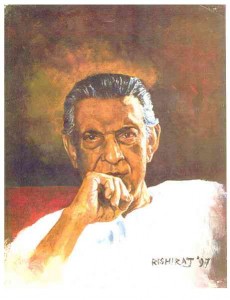
It must be a special day up in the heaven today, considering it is Manikda’s earthly birthday. In the lavish celestorium up above, there must be back-to-back screenings from the mastsatyajit_rayer’s repertoire, starting with Pather Panchali and if possible going on till Agantuk. Probably all his contemporaries and admirers like Renoir, Bergman, Bunuel, Fellini, Kurosawa must have arrived from their respective heavens, revisiting his  masterpieces, discussing, dissecting and deliberating on them. Meanwhile, the birthday boy himself, would be sitting in a corner, away from the glare, dressed up in white dhoti-kurta and a shawl draped over his torso. Sitting cross-legged, a pipe hanging from his mouth sending out small small tufts of tobacco clouds quite like the steam engine in Pather Panchali that amused Apu and Durga. Satyajit Ray or Manikda as he was known within the film fraternity, must be observing all and sundry with intent full eyes, and probably thinking of what more embellishments could have been made to these movies or how many more he could have made, only if he had seen Bicycle Thieves a little earlier or the finances had flown in evenly through the years. Or just probably, he might be seeing those movies now not as a maker but as a viewer and enjoying them as thoroughly as we all do.

Manikda lived for 70 years on this planet and in it made some 28 feature length films and some half-a-dozen odd documentaries; he started at 32 and ended only when his time on tera-firma was up. In these 35-38 odd years, he completely reshaped the cinema in India and also across the globe. If ever one is coerced to take a single name whose influence on film making has been the most impactful, it has to be Ray. Though, he was not beyond the slur of numerous critics and self-appointed nationalists; yet he never did let anything or anyone bog him down and much like Gupi and Bagha in his two comic capers (which were heavily satirical as well) continued to enthrall his audiences across the globe.

“Not seeing Ray’s film is like living in the world, without the sun and the moon,” Kurosawa had stated once, and there is little more that can be added or appended to it. Manikda’s film encapsulated life and times of an India that was caught between the past, present and the future. On one hand, he captures the rigors and tribulations of rural life in Pather Panchali, Ashani Sanket. And then he brings the camera into the city, capturing the vagaries of modern life in Apur Sansar, Mahanagar, Jana Aranya, Agantuk, etc. And even when he dealt with all these serious issues, Manikda never preached and seldom took sides. His films were npt about good or bad or balck or white,  they were merely grey much like the color they were shot in. It was as if, he was trying not to be biased for and against his characters, so in Jana Aranya, you have the son (the main protagonist) who is steadily becoming an instrument of crass capitalism, there is the idealist father who is trying to come to terms with the new realities of life and then there is indifferent brother and his caring wife. Between the four of them, Manikda captured and presented all the differing views that any Indian might be troubled or beset with.

Continue reading

On Kashmir and Kashmiriyat, & Tahaan as well

Saw the movie Tahaan today. Have been wanting to see that film for a long long time and it had even been broadcasted on some channels a couple of times but I somehow used to miss it. Finally, I got my hands on the DVD and after much wait I managed to see it. The Santosh Sivan film tells a tale of young Kashmiri kid Tahaan (which literally translates into God’s blessing) and his donkey Birbala.

Through the intricate interweaving of the two central characters the story keeps moving indolently much like the gentle stream that is constantly shown in the film. While the story is about innocence, it somehow reflects upon the deep scars that have been imprinted upon the valley. More than a movie on Kashmir, Tahaan is a movie on Kashmiriyaat.

For me, Kashmir is basically a beautiful haze, a charming valley of deodar trees, where saffron flowers abound. Then there is the beautiful charming Dal lake, on which shikaras or small canoes keep floating hither-thither carrying all sort of goods and merchandise. Houseboats also abound on the Dal lake, where honeymoon couples can spend a few days and nights in looking at the millions of stars that shine in the clear skies. Then comes the lilting music that has notes from Sarod and little or no words, except the melodious twang of the strings. This is followed by the supposedly amazing Kahwa that is boiled continuously on curvaceous Kashmiri kettles. The amazing and intricate rugs come next, rather royal and heavy these carpets are fairly ubiquitous and yet hardly affordable.

Surely, one cannot talk of Kashmir without talking about Pashmina shawls, made from the wool of a much rare mountain goat these fabled shawls can fit in a matchbox or pass through a ring, even people who have never set an eye on these shawls can be heard swearing on these miraculous features. And finally, the oh so beautiful women of the valley, whose cheeks are even fuller and redder then those apples that are much famous   all over.

This is the image of Kashmir that we have kind of grown up with, embossed again and again by the numerous Hindi films and tales from parent and grandparents. Thanks to Kashmir ki Kaali, Silsila, Roja, Mission Kashmir, Fanaa, etc. there is a Kashmir that we all cherish in our minds, fantasise about in leisure, dream of a day we will see with our own eyes.

And yet there is another Kashmir that forces itself on our consciousness, a Kashmir of guns, grenades, blasts, killings, Terrorists, encounters, LOC, rocket launchers, Amarnath Yatra, JKLF, AK47s, Kargil, army patrols, strikes, revolts, anti India protests, Article 370, army atrocities, secessionists, Wazir-e-azam, POK, Panun Kashmir, displaced pundits, child warriors, curfew, dull elections, etc. There is a deep chasm between the Kashmir we dream off and the Kashmir we dread.
Continue reading

Eight Things You Used to Pay For But Can Now Get FREE

Cost rationalization is the flavor of the season. With every enterprise — small or large — looking at reducing costs on all fronts, IT budgets are getting affected too. While large enterprises are moving to outsourcng model and bargaining hard with the vendors, many small companies do not have that kind of option. Yet, they need to minimize costs more than anyone else to be in business.

This story started with the idea of giving some cost minimization tips to small and medium enterprises. But as we were working on it, someone asked: why less cost, why not free? And lo, the effort steered towards identifying IT areas where the enterprises used to spend on, but which they can now get for free. The result is this compendium of free IT heads, largely on using the web. We have even added one free audio conferencing service in the list.

But the challenge in trying to compile such a list is that subjectivity becomes a challenge. The inherent danger of compiling such a list is that a lot many people might not agree with the elements in it and debunk it impractical or childish, while on the other hand a similar audience might actually be happy with the same and use it to their benefit. One man’s honey is truly another’s poison.

The chief purpose of the list is to provide a small guide to the emerging companies to put in place a growth strategy and be able to deal with some of the common pain points. Another point that needs to be noted here is that much of the free software movement has been carried out by the Open Source Community, hence most of the applications that are listed here are essentially open source and free software alternatives to the proprietary ones.

  • Free Storage

Backup is the single largest issue faced by small enterprises. While the big daddies have their stacks of NAS and SAN, the smaller companies or entrepreneurs don’t really know how and where to store their documents. The issue is not only of the availability of space but also the ease of use and reuse.

To start off, there are a lot of services that are available online that provide free. There is Dropbox.io that provides a 2 GB online space free to its user and then has graded payment options for people who want more.  Box.net is yet another service that allows 1 GB of space free of cost to the user with a file limit of 25MB.

But the one that takes the cake is Windows Live SkyDrive service from Microsoft that currently offers 25 GB of free personal storage, with individual files limited to 50 MB. This is a mammoth amount of storage (for enterprise and important documents) and can be accessed through the web. Earlier Yahoo! also had provided a similar service, Yahoo! Briefcase but now has wrapped it up. According to certain reports, Google also has plans to offer similar kind of service titled as Gdrive.

The Links:

www.skydrive.live.com
www.getdropbox.com
www.box.net
www.humyo.com
www.drop.io
www.mozy.com
www.xdrive.com
www.adrive.com

  • Hosting your Website

One of the most important requirements for a business today, is an online presence. Essentially a business without a webpage is basically a like a manager without an MBA degree, he/she can be successful to an extent but after a while requires some sort of formal education to excel. Similarly it is very important for a business or even individuals to have an online presence.

Continue reading

Who will be the 18th PM?

Look at any newspaper, magazine, news channel, online media, just about anything, the hot discussion or rather the only discussion that is taking place these days is as to what will happen to the 15th Loksabha, who will win, who will lose and who will stay put. The best brains of this nation are trying to come out with the answers, right from the grey-haired political analysts to the scores of psephologists who have made a well paid business out of predictions.

And yet, as in the past, all these opinion polls and surveys fail to reveal the story, election after election. The reason is simple, the inherent bias. All Indians are political, whether they agree or not. Hence, when they are asked to make the choices they do so based on their desires and hopes (which by the way are shaped by their biases). It is very hard for any analyst, reporter, or even a psephologist to get rid of that bias. And yet, they pretend valiantly to do so. Thus, before every election there are these predictions that are built upwards and then fall flat like a house of cards.

Being a political Indian myself, I strongly feel the urge to add to the cacophony of these predictions. I think can foretell the future based on my ‘gut feel’ and am quite sure how things will turn out. And since, I am aware of my limitations (rather my communal bias), I feel the best thing to do will be to find a few more political Indians like me who feel strongly on the issue and have biases that are not quite like mine. So, while I am tainted in the communal colour of Saffron, I have asked my friend or rather comrade Abhijit Deb who is dipped in Red to make his predictions, and finally to balance the 2nd and the 3rd front, we have a supporter of the Gandhian family Akhilesh Shukla pitching in for Congress I.

Among us, we are making predictions on how things will turn out in the days to come. And all this at a fraction of the cost of all those psephologists and analysts, just a couple of ‘cutting chai’. At the end of the political tamasha, we very much intend to return to this post, and am sure one of us would be grinning to himself patting his own back, while the rest will be terming this to be a rather childish and immature exercise or just that Indian politics is beyond the range of any rational analysis based prediction, it is game of tart, for the tart-headed.

So, mere pyaare desh vasiyon. Here are the 3 scenarios from three biased journalists, please take them with a pinch of salt and a tequila too (if you can afford one, that is). Here it goes:

Continue reading

Rediscovering Lakh Lakh Chanderi…

For some strange unexplained reasons, there are certain memories that linger and haunt a person for ages. This is more the case with childhood memories, a old home, a forlorn beach, a rabid fight, there is just no limit to what part of childhood you will carry with you through out your life and why?

In my case, it is a song, that too a Marathi one. I must have been no older than 7 or 8 years at max, and somehow a song that I viewed on television way back then stuck with me for all these years. In those times, early-mid eighties, there was only a single channel in India, Doordarshan and color television was not yet available (apparently it was after the Asiad games but the cost was so prohibitively high that only a select Indians could afford it).

The programs that were run on Doordarshan were fairly staid, in fact there was a regional offshoot of Doordarshan, namely Mumbai Doordarshan that broadcasted regional shows; namely plays, news, serials in Marathi. And on prime time, that is 9 pm, the national broadcaster used to take over, so you would have serials, news bulletins et al in Hindi. Since, back then there was no choice except for Doordarshan, we all sat in rapt attention watching the programs even in Marathi and even if it did not make any sense to us. For instance, I recall, just before the the Batmya (news in Marathi) at 7.30 pm, there used to be this show called at Amchi Mati, Amchi Manase, it was basically a show that was targetted for the farmers, telling them how to take care of the cattle, when to sow the seeds, etc. Also, just before the news bulletin, there used to be this small caption of lost and misplaced people, Apan yana pahilat ka, where there would be photos of missing people and sketchy details about them.

On Saturdays, there used to be Marathi movies shown and on Sundays it was Hindi. Thus our schedule was pretty packed in that sense. To be honest, the little Marathi that I know and understand is not because I had it as a subject till the 8th standard, but because I was trying to laugh at all those gags in Arr..tch tch.. or trying to figure out the news in Batmya. Continue reading

Interview: G Madhvan Nair (ISRO)

Getting to speak to Mr. G Madhvan Nair is an opportunity that I pride on. Hopefully some years down the line, I will be telling incidents to my grandchildren of how India had made a beginning with space exploration in 2008 by launching the Chandrayaan and how I interviewed the chairman of the agency.

But beyond the historical trappings, Mr. Nair came across as a very down-to-earth person, who took pains to explain the nitty-grittys to me on different aspects. Scientists are renowned to be bored of general journalists, as both talk on different planes. Yet, Mr. Nair, even while he was on other plane, ensured that I at least could understand for myself what he was talking about. Considering the kind of time pressure that he works in, it is no mean achievement. Here is an interview of the man behind India’s moon mission (as it was published in Dataquest).

******

The Moon and Beyond

On a foggy wintry November evening last year, a 34 kg instrument after traversing some 400,000 kms journey plunged on to the lunar surface and painted it with the Indian tricolour. In its short 25 minute descent the Moon Impact Probe or MIP collected crucial data with its C-band Radar Altimeter, Video Imaging System and a Mass Spectrometer. All this data collected would be critical when the Indian Space Research Organization (ISRO) launches the second Chandrayaan mission that would carry with it a moon rover. With Chandrayaan, India became a member of a very select club of nations that have planted their flags on the lunar soil. Overnight, the world woke up to the space technology might of India and the nation became a power to reckon with in the arena.

The credit for this success solely lies with ISRO that will complete 4 decades of existence in this calendar year. These years have been very eventful in Indian history, from launching INSAT satellites on Russian Soyuz Rockets to launching ESA satellites on PSLV and GSLV rockets, the transition has been phenomenal.

One of the many people who deserve accolade for ISRO’s success is, G Madhvan Nair, a leading technologist in the field of rocket systems and also the current Chairman of ISRO. Over the years, Nair has played a significant role in development of the space program, for instance he was the project director for the Polar Satellite Launch Vehicle (PSLV) development program. He was   also the director of ISRO’s largest R & D Centre, the Vikram Sarabhai Space Centre, and oversaw India’s Geo-synchronous Satellite Launch Vehicle (GSLV) successfully coming to fruition.  Recently, Nair, who is also the Secretary to the Department of Space and the Chairman, Space Commission, was awarded the Padma Vibhushan, India’s second highest civilian honour. In a tete-a-tete with Dataquest, he talks about how technology is shaping the future of India’s space program. Excerpts.

First and foremost, in light of the successful Chandrayaan Mission, what would you term as uniqueness of the mission in terms of new technology employed?

At the onset the Chandrayaan spacecraft was itself a very complex one. The payload of the mission contained instruments like Terrain Mapping Camera, Hyperspectral Imager, Lunar Laser Ranging Instrument, High Energy X-ray Spectrometer, etc. development of these systems were one of the challenges. But more important than that was the fact that to travel beyond the earth gravitational field to the distance of around 400,000 kms, which were doing for the first time, once we get out of the gravitational field of the earth, the forces that influence the course of the aircraft are very many.  Of course when the spacecraft travels long distance, the telemetry and telecommunications systems all become very important and for the same ISRO developed the Deep Space Network. These are just a few instances of the very many challenges that we successfully faced.


The annual budget of ISRO is merely a fraction of what is available to the US National Aeronautics and Space Administration or to the European Space Agency, how do you manage to stay ahead of the technology curve even by spending less? Do you feel constrained? Or does this limitation compel you to be more innovative?

No, we have actually worked out a very innovative way of developing new systems, pressure of regime of technology denial by advanced nations this has been one of the major motivational factors and our scientists put in extra effort which is needed to achieve self reliance in the area. Of course the basic thing is that almost every skill that is required for space research is available under one roof, so the next result is that our overheads are minimum and since our efforts are also concentrated on a mission mode approach we are able to achieve the results with minimum costs.
Continue reading

Dummy’s guide to Shoeing

It took some 4 odd months, but finally the international sport of ‘shoeing politicians’ has arrived in India.  At a press conference today, Indian home minister (P Chidamdaram aka PC) quite effortlessly missed a shoe that was hurled at him by a Sikh journalist named Jarnail Singh. The white shoe flipped over his right side and it never seemed to threaten him at all. The hurler also looked frail and not intimidating enough, he never raised a hue and cry, pre or post the act. He even walked away with the plainclothes policemen quite willingly. As if it was something that he was happy to get over with. On the other hand, PC had a benign smile on his face, and asked the security guys to escort the hurler ‘gently’.

This isn’t the first time that someone decided to hurl a projectile at someone else. Through the ages, humans have been hurling things at each other, it started with pebbles, stones, branches, abuses, arrows, sticks, blames, projectiles, spears, knives, rockets, missiles, boomerangs, flowers, eggs, tomatoes, dishes, cellphones, and so many other things imaginable and unimaginable. Yet, the shoeing business is a rather recent invention.

December 14, is the red letter day in the history of shoeing, when a journalist with Al-Baghdadia Channel, Muntazer-al-Zaidi, hurled his footwear at President George Bush in Iraq. In fact, he hurled two of his shoes and but for the agility and reflex action of Jr. Bush, at least one would have hit him for sure. Zaidi was also smart enough to denigrate Bush, even while taking aim and releasing the shoes, ensuring that the world at large knew his reasons even if it did not agree.

Fortunately for Zaidi, Bush was at the nadir of his popularity and became a butt of ridicule, even though he ducked the shoes magnificently. Bush even joked about the incident in his characteristic bushy way. Sadly, for Bush, it was Zaidi who became the hero overnight, especially in the Islamic world. There were protests across different countries for him to be released from prison, some one offered him a car, one person his daughter and a Libyan channel offered him a job. Shoeing was not all that bad, after all.

Zaidi had many emulators, sometime back a disgruntled German student Martin Jahnke hurled an old sneaker at Chinese Premier Wen Jiabao.  Shoes have also been chucked at the US consulate in Edinburgh and at the gates of Prime Minister Gordon Brown’s Downing Street office. There was another one hurled at Israel’s ambassador to Sweden as he gave a speech at Stockholm University. And now PC’s name is added to the illustrious list, thanks to a frail Sikh with a bad aim.

The one thing that is common to all these incidents is that all the shoers (the shoe hurlers, so as to say) were unable to hit the target even though they had the benefit of surprise element. No leader expects a shoe flying across at him when he is offering platitudes to the world at large. Except for Zaidi, no one else came remotely close to hitting the target. In fact, none of the above seemed to want to hit their targets either.

Now that is a real tragedy, after all the shoer will have to pay a dear prize in spite of all the accolades or praises that he receives. Take Zaidi’s case, he has lost 3 years of his life and when he comes out people will be too distracted to bother about a Bush shoer. So is the case with Jahnke. Jarnail Singh meanwhile has been lucky, the country is going through general elections and the no politicians want to be seen as harsh and rude. Thus, PC displayed  gandhigiri by forgiving Singh. All are not so lucky.

Hence, if you are a prospective shoer and want to make a point, ensure that you do a good job of it. What is the use of wasting time behind bars and not even hitting the target? So for all at large, here is a dummy’s guide to shoeing:

Online Netajis……

Political parties of all hues and contours are jumping on to the online bandwagon in pursuit of the Indian voter. Will they succeed or not is the big question on everyone’s mind. Here is a primer.

“Power comes from the barrel of a gun,” is what Chinese dictator Mao Tse Tung had proclaimed many decades back. The Chinese revolution in the 1950s, became the sort of template for almost all the revolutionaries across the globe, be it Fidel Castro in Cuba to Ho Chi Minh in Vietnam, from Saparmurat Niyazov in Turkmenistan to Prachanda in Nepal. Despotic governments propped up by Kalashnikovs popped up across different continents and regions. Apparently, gun and government complimented each other beatifically.

Then in 2009, to be precise, another revolution took shape, a black man with mixed heritage ascended the most powerful position in the world by being elected as President of the United States beating all the odds. A year earlier, no one would have given Barrack Obama even a sniffing chance of winning the election but that is what he did in a manner that took most of the world by surprise. His strategy was similar to the ones used by all the dictators (a promise of change that roused the populace) except for one crucial difference: instead of gun, Obama relied on copper wire. His message of change was not spread by gunshots but by telephone and cable lines across the 50 states of the US.

Medium became almost as powerful as the message itself. By winning over the White House, black Obama engendered a new template for all the politicians (usually the democratic ones) to follow, namely the use of Internet and Telephony to spread the message.

Come May 2009, this Obama template will be put to its most rigorous test in the largest democratic election of the world: when the 15th Lok Sabha elections take place. With over 8,00,000 polling stations and nearly 700 million people eligible to cast their votes the battle royale for the PM’s seat has begun for the various political parties.

The coming of Cyber Politics

Since, this election promises to be a closely fought one, no party is leaving any stone unturned in its pursuit of the voter, with much attention and time being given to the first-time voters and the tech-savvy middle class. Impressed by the way Obama spread the message of change, political parties are using every means at their disposal to spread their word, be it television, print or hoardings. From roadside walls plastered with posters to fancy adverts on television. The battle for the ballot has now spilled on to the cyberspace, with each party looking at making gains by hosting websites, blogs, or sending emails.

It is not as if that political parties have suddenly discovered the Internet as a medium, both the Congress and the BJP have had online presence for a long time. For instance, years back Congress Leader Jagdish Tytler had launched an online forum while for BJP it was their tech savvy leader Pramod Mahajan. In fact, BJP had launched its own website and formed an IT cell way back in 1997. The rest, like the Communist Party of India (CPI), Telugu Desam party, Shiv Sena, Nationalist Congress Party (NCP), and the rest, all have a web presence.

Nonetheless, the parties are now moving to the next stage, from static website to interactive Internet strategies. Again, the Obama template comes into play. According to reports, the biggest game changer for Obama was his community building exercise, which included an impressive 13 million e-mail addresses and some 2 million friends on his social networking site. Not surprisingly, parties are trying to emulate the same in India by actively using technology to reach out to the electorate.

The Saffron winner Continue reading

गूगल की जय-हो!!!

गूगल ने अभी हाल ही मैं एक नयी सुविधा की घोषणा की. इसके रहते जितने भी लोग ईमेल का इस्तेमाल करते हैं, अब वोह सिर्फ अंग्रेजी ही नहीं, बल्कि अलग अलग भाषायों में भी हो सकती हैं, जैसे हिंदी, तमिल, तेलुगु और मलयालम. यह पहेली बार नहीं हैं की जब ऐसी सुविधा किसीने दी हो, मगर गूगल के करने से भारत में भाषा-कंप्यूटिंग को बहुत प्रोत्साहन मिलेगा चुकी अब भारतीय लोग ईमेल का उपयोग चिट्टी की तरह कर सकते हैं, जैसे हम रोज़मारह बात करते हैं.

इस सुविधा का इस्तेमाल करना कठिन भी नहीं हैं, आप अंग्रेजी में टाइप करे (जैसा में अभी कर रहा हूँ) और वो अपने आप हिंदी में रूपांतरित हो जाता हैं. ठीक इसी तरह बाकी भाषाओं का भी इस्तेमाल होता हैं. जैसे में अभी namashkaar लिख रहा हों और वोह अपने आप नमस्कार, ನಮಷ್ಕಾರ್, നമഷ്കാര്‍, நமஷ்கர், నమష్కార్, में तब्दील हो जाता हैं. और ये ही नहीं, आप शब्दकोष का भी उपयोग कर सकते हैं, और स्पेल्चेच्क भी काम करता हैं. यह सब मात्र एक क्लिक पर.

मुझे बेहद ख़ुशी हैं, और यह उम्मीद हैं की इस सुविधा से लोगों को बहुत ख़ुशी होगी. और मेरे जैसे लोग, जो हिंदी का प्रयोग सिर्फ बोलने में करते हैं, न की लिखने में, शायद कुछ बेहतरी हों. अभी भी देखिये, यह ब्लॉग पोस्ट लिखने में मुझे बहुत सोचना पढ़ रहा हैं, क्योंकि मेरा दिमाग अब अंग्रेजी में ही सोचता हैं, कई शब्दों का हिंदी मूल भूल चुका हूँ, और तो और अपने मसतिक को कुछ ज्यादा ही खाकोलना पढ़ रहा हैं. मगर कुछ भी कहिये बड़ा मज़ा आ रहा हैं, बचपन में मेरी हिंदी की व्याख्या और स्पेल्लिंग दोनों ही बहुत ख़राब थी परन्तु मुझे अब इसकी चिंता नहीं हैं चुकी गूगल उसका ख्याल रखता हैं.

पता नहीं बहुत से बेवकूफ लोगो इस सुविधा का महत्व समझ न सके, मगर इस में कोई शक नहीं हैं की इस सेवा से बहुतसो की भाषा थोडी सी सुधर जाए, और इस के लिए हम गूगल के आभारी हैं.

Who is communal?

Elections ’09 are heating up in India. A shrill noise is reverberating across everywhere, as leaders and politicans adopt every single trick in the crook-book to get elected. And sadly instead of issues of development or growth the parties across the lines are just debating and discussing inane issues like ‘secularism’ or ‘communalism’.

Every single party belonging to the UPA (or rather former UPA) or the newly formed opportunist 3rd Front, swears by the word secularism and takes a solemn oath to do every thing to keep them out of power. Dubbing the right wing saffron party as a communal one, portrayed as danger to the very existence of this nation.

To be fair, BJP party has not helped its case either, by not coming out strongly on a lot of issues, like the latest controversy on Varun Gandhi. It has at times shown a rather lackadiscal approach when it comes to reacting to issues. For instance, when the Mangalore Pub attacks happen, the central leadership of the party took their own sweet time to condemn such violence in an outright manner. The result, the party is seen to be abettting such issues. Now, whether that is true or not, I know not but that is what a perception that is formed about the party.

Now, BJP or rather NDA’s 5 year term was not all that bad when you compare it with the current government’s, there were scores of infrastructure projects that were undertaken like the Golden Quadilateral one, etc.  Thus, when the party is simply dubbed as ‘Communal’ by the rest, it seems a bit odd.

Gujarat is the one whip that BJP is constantly flogged with by all, and I just wonder one thing, that the electorate that has given such a mandate to rule to the BJP, is it communal as well. Then by the same definition, so many states in India become communal ones. Continue reading