Rock Con!!

Ever since, I came across the trailers of ‘Rock On’ a month or so back, I was eagerly awaiting for the movie to hit the screens. In fact, the movie had compelled me to reach out to a couple of old college friends and I convinced them to join me on what I assumed would be a journey of nostalgia. The songs from the movie, especially Socha Hain and Picchle Saat Din, only added to the anticipation.

And when the day of reckoning came, I with my friends was completely dumbstruck by what confronted us. 15 minutes into the movie, I had started squirming in the seat; 25 minutes and had stopped counting the flaws, and after another 10-15 minutes was waiting for the agony to end. The movie in fact turned out to be so bad, that my old friends pronounced that they were happier when I was out of touch. My biggest surprise was and still is how everyone got conned by the freak show? The few reviews that I read, if didn’t glorify the movie, didn’t pan it either (which it much deserved).

Rock On is to be honest the most contrived story that I have come across after a long time, precisely after Tashan. There is so little in the movie that the one minute trailers that are being shown have the best scenes in the film. The story has some of the worst possible clichés that even a doped screenwriter would have thought ten times before jotting down. The whole premise of the story is based on how a group of rockers, having a band that has the corniest of all the names –  Magik, first breaks up and then bonds again and how each member of the band discovers life in the process.

The director for some very inane reason decides to interplay the break-up and bond-again simultaneously.  Without much thought given to storytelling, the story keeps moving back and forth. While it may seem to be a great idea on paper (and authoress Arundhati Roy made a fabulous novel using the technique), it just doesn’t work on screen for this particular film.

Through the film, we are being told times and again how this wonderful band broke up due to a ‘big tussle’ and everything went haywire. The lead singer of the band, Farhan Akhtar left music and became a successful investment banker, albeit all the time he seems to be suffering from a bad bout of indigestion. The lead guitarist, a hot-headed Arjun Rampal, transforms into a henpecked desolate person who performs at some third rate functions. The drummer Purab is now working for his dad and the keyboard Luke Kenny is working for ad films, when he is not holding his head, as if in a tizzy.

To add to the agony, much screen time is wasted on unwanted characterization like that of Farhan’s wife, Prachi Desai, who is given much footage in the film and does justice to not even a centimetre of it. To be just to Ms. Desai, Rock On is a one big non-act in itself, everyone (including the director) seems to be sleep walking through the movie, with the possible exception of Purab possibly. In fact Farhan is a big let-down, because he somehow seems to be almost earnest in his performance and yet not enough. The only part he seems to suit is when he is lip-synching his songs. And the rest of the time, he struts along in a nervous daze.

The little said about Wooden Rampal, the better. In fact, he was so wood-like in his performance that the sofa on which he sits seems to emote better. It was really surprising, how he seem to be taking his role for granted, in fact in the songs where there he is supposed to be creating magic out of the guitar, he barely moves his hands. It was as if, he had little faith in his abilities to portray the role. He now firmly and finally joins the Kishen Kumar Acting club, and has Tusshar Kapoor to keep him company. The trouble with the casting of these rockers is that they seem to be too old when they should look young college-going rockers and seem a bit too young when they should look like middle aged losers. The only one who could manage to bring some amount of sincerity in his performance was Purab.

The worse thing (of the so many other worse things, a few of them has been listed above) is the deliberate attempt to make this an emotional saga than a story of 4 friends. Numerous attempts are made to somehow make your tear glands shed a drop or two. But somehow all these ‘heart-touching’ scenes, fail to touch anything including the heart. I really can’t understand, what was the real need to show the marital issues of Farhan, and his joy of becoming a father, etc. in what was supposed to be a guy movie. As said earlier, so much attention is heaped on the ladies in the film, that it seems that probably Balaji Telefilms was funding this movie. The whole story runs at such a superficial level that not once are you able to relate to the movie, probably except for the stinking rich pop’s lads and other wannabes.

The only thing good, in fact the two things that were good in the film, is the music and cinematography. There is much attention given to lighting in the story and the hard work of the person behind the camera shows. And undoubtedly, the music by Shankar Ehsan-Loy really works; Farhan’s singing capabilities are a revelation. Even the makers of the movie seem to be well aware of the strong point of the film, as in the before the final run of title, there is a message requesting the patrons to buy original music rather than downloading them. Indeed, buying the CD of the film is infinitely better than wasting money on viewing it. I do hope that my friends are able to get over the trauma and do not think that it was nasty trick played by me. At the end, I was equally conned by Rock (c)on. In the song Pichle Saat Din, there is this specific line that was reveberating in my head as I left the theatre that best expresses how I felt; Kabhi khud pe hasa main aur kabhi khud pe roya…(at times I laughed at myself and cried as well)

(The review has been done in the interest of public good, and viewers are advised to take the advice as seriously as their mind would permit them)

Please Don’t ‘Pope’ your nose

Good ol’ Pope Benedict XVI seems to have a special affinity for things that stoke controversies. So unlike the more ‘saintly’ Pope John Paul II earlier, he is not really known to mince his words when it comes to things that should be better left unsaid. Some years back he had derided the Prophet Muhammad in his speech; later he had hinted on how Jews should return to the real fold by urging them to convert to Catholicism; supposedly when he was a cardinal in 1997, he had termed the Buddhist fate as form of ‘spiritually self-indulgent eroticism’. He has taken a tough stance on issues like birth control, HIV, homosexuality, etc. The list just goes on and on.

India also got a taste of Pope’s indiscretion recently, when he poked his nose in what can be termed as internal affairs of our nation. Pope Benedict has reportedly condemned the violence that has taken place in the state of Orissa and appealed to “religious leaders and civil authorities to work together to restore among members of the various communities the peaceful coexistence and harmony which have always been the distinguishing mark of Indian society’. This seemingly harmless comment gains notoriety if viewed in complete context of the communal clashes that are going on in the state of Orissa.

The eastern state of Orissa has been a flashpoint for clashes between Hindus and Catholics for the past few years. The reason has been the changing demographics of the region. But first a brief outline of the state; the nine largest and the eleventh largest state of the Indian union also happens to be one of the poorest. This poverty has encouraged a lot of Christian missionary organizations to set up base and start preaching their faith to the tribal population.

To be honest, if a person is dying from poverty being a Hindu or is ostracized against due to the caste-based discrimination; there is nothing bad if by changing his religion he can attain a better life or stature. But when he or she is being unduly influenced and his naiveté is taken advantage of, that’s just not right.

These missionary organizations have been able to carry on their religious agenda without much hindrance as the administration has turned a blind eye to it. They are easily able to influence the poverty stricken into their folds through monetary emoluments. The people who convert to the new faith are provided with food and shelter and the ones that don’t are left to suffer.

Thus right in the midst of the tribal land in Orissa, once can find churches and other such religious paraphernalia. The activity has increased in the past few years and this almost sudden change of demographics has resulted in lot of heightened tensions. The have-nots who continue to suffer are immensely jealous of the new haves. The whole issue came out in the open during the ghastly murder of Australian missionary Graham Staines and his two young kids some years back by Hindu fundamentalists. Post this event the chasm between the haves and the have-nots has increased steadily. And often nowadays one comes across such sectarian clashes in news reports from the region.

The latest flare up happened when some henchmen shot and killed a Hindu leader Swami Laxmananda Saraswati. This murder resulted in mobs of Hindus torching missionary offices and churches in the region, leading to death of over a dozen people in the Kandamal region in Orissa. Pope Benedict expressed his solidarity with his ‘Christian brothers and sisters’ who have borne the brunt. Almost immediately, the Catholic Bishop Council of India, called for a day long closure of catholic schools and institutions across India as a mark of solidarity to the victims of violence.

All this is fine and can could be understood. But what the Pope should have known (and respected) is that this is completely an internal affair of a sovereign nation that has millions of Catholics residing peacefully with the Hindu populations. Every day scores of Indian lives are lost due to violence and terrorism, but never before was the Pope saddened like the way he was now. Never before did he express his solidarity with the people who suffered at the hands of such ghastly incidents. Indeed, does he feel as saddened for the millions in Gaza who suffer at the hands of the Jewish administration in Tel Aviv? Or the millions that died due to Iraqi invasion by a Catholic country?

The killings in Orissa have been a result of communal frenzy, but the perpetrators are criminals and cannot be branded as some religious individuals. Don’t we Indians hate it when after some minor clashes between the Hindus and Muslims, suddenly the Islamic countries start expressing their solidarity for their fellow Muslims in India. National identity is and must supersede religious identity. By expressing his grief for Catholic victims, the Pope is insulting millions of countrymen like me, who are equally appalled by the incidents.

The Pope should have respected the sentiments of Indian citizens and should have avoided talking about the whole incident at the moment. But then, Pope Benedict wouldn’t have been his natural self, if he hadn’t spoken out. After all, he isn’t like the earlier Pope, who though a religious leader, was a human first and a Christian later. How I wish, Pope Benedict could be likewise. But if not, the least he can do is not poke his nose in domestic affairs of our nation. Can you not, Pope?

63 seconds!!

Evening time, Andheri Station, the atmosphere is sheer chaos. Thousands rushing in, a few more thousands rushing out and a couple of hundred thousand individuals passing through the 6 railway tracks. Each train rake is filled to the very brim, people hanging out of the doors like ragged dolls, shrieking, shouting, cursing and more importantly shoving with their lower torsos. As these trains keep moving from one end of the city to another, so many of these ragged men lose their grips and slid down in between the wheels. If they are indeed lucky, death comes instantly else a few limbs are lost and life turns into a living hell.

Commuters, hanging on to the doors, have become immune to such incidences and barely would bat an eye-lid on seeing a bleeding dismembered corpse lying on the side of the tracks. There is barely room for humans on these trains, let alone humanity. Day after day, millions travelling on these trains are dehumanised steadily; etiquette, civility and propriety are ritually shred from the insides. Death, accident, blood, tragedy, pain, trauma; all of these things lose their significance till it doesn’t happen to oneself. This steeling process is repeated twice a day, once in the morning from Virar to Churchgate and in the evening from Churchgate to Virar. In some strange way, this is one of the secrets behind the famous and resilient ‘Mumbai spirit’ that so many of our news channels keep harping about.

It was on one such evening that I found myself standing on Platform 1 at Andheri. Myself and my friend Abhijit Deb had a meeting fixed in the suburb of Goregaon (a mere two stops from Andheri), and much as we would have liked to take the road, the two tiny hands on our wristwatches made us decide otherwise. Now Abhijit is a gritty person hailing from mountainous paradise of Meghalaya, who though cribs about the unruly millions of Mumbai, but has made his peace with them.

Whereas, I don’t really know on which ground I stand; I hate the crowds and this sea of humanity every passing day and fantasise constantly of the day I will not be counted as one of these. Yet, I lack the courage and gumption to break free. Thus these crowded trains truly scare me. Also, another factor that works against me, is my BMI or body mass index, with the weighing scale pointer dancing around the 100 kgs mark, I am hardly athletic or even fit. And if that wasn’t enough, I had both my hand in bandages on that day, sign of a stupid me (but that is another story).

The clock made the decision for us and compelled us to join the thronging multitudes that shift with each passing train. Thus with the 7:09 Borivali approaching, visible from the bright circular yellow halo in the near distance, we geared ourselves as best we could; stiffen the muscles and tried to move as close to the edge as possible. Now, trying to board a train at a major junction like Andheri is a very tricky and dexterous business. While there are 50 shoving to board the train, some 20 are frantically pushing from inside trying to come out and a couple of them are standing on the door unwilling to give up on their advantageous positions. The key is to get in the train even before it comes to a complete halt. If you are unable to do so, then you will have to grapple and labour at the door trying your luck. All this, getting in-getting out-staying put business, needs to be accomplished within 30 odd seconds that the train halts for. And though the frequency of the trains are high during the peak hours, every 5-10 minutes, yet nothing can be gained by waiting for the next one as it will be as bad as the previous one.

Now as the 7:09 Borivali Slow came to a halt, both of us were unable to board the train, we were pushing and shoving the person in front of us. It was kind of odd, as the train wasn’t as badly packed as we had imagined. In the sense, 2-3 people were able to shove their way even when it was stationary; this was making a lot us who were pushing from the outside quite optimistic. But even when it isn’t usually crowded, it is still unusually crowded. Hence, after some customary shoving, I gave up and decided to try my luck in the next train. But gritty Abhijit wouldn’t, and would not let me either. Even with his blithe build, he managed to push a person standing on the door and asked me to do the same, i.e. push him inside.

With bandages on my hand, clutching a small valise, I caught hold of the rod that is bang in the centre between the two compartment doors. Now, I have my honest doubts as to why the rod has been put, where it has been put. I believe on seeing so many people slipping out day after day, the Railways in their generosity installed the rods, so that it can support at least a few more as they hang on to their dear lives. Thus, in no real mood to continue on, I was clutching at the life-saving rod when the train started moving towards its destination.

Hanging outside the door of a crowded compartment is infinitely better than smelling armpits and saving your toes inside. But certainly not, when you are hanging as precariously as I was. I had the valise between both the arms, and barely had my toes on the footboard. To the credit of the commuters, every time a crowded train moves out of the station, it tries to attain equilibrium, and in the process the whole mass expands and contracts rhythmically. And as this equilibrium state was being sort by the hundreds inside, I was getting the jitters. With the train gathering speed, I was being subjected by the external forces, termed as centrifugal in Physics textbooks. The person next to me, standing rather comfortably, was cribbing rather obscenely about my valise poking him in the arms and then there was huge wall of bodies that was pushing at me.

It took me a few seconds for my confidence to get shattered and I started to panic. I started to plead with all around, imploring them to shift sufficient enough for me to squeeze in somehow. The train was moving real fast by now, and I was sure that life, if it remained, would never be the same again if my hands slipped. The wind was bellowing at me, trying to unsettle my ungainly form. In a few more seconds and now I was completely shaken and stirred, my pleas to the wall became rather frantic and I was asking a person who was looking at me strangely through his spectacles to at least hold my hands. Probably, he was waiting to see me fall, so that he could talk about a ‘fat fool’ meeting death in front of his eyes, while discussing Mumbai with his folks and friends. Or probably, he was just benumbed by it all. Finally, he caught my hands, but not strong enough to reassure me.

The train was moving at top speed now, and I was still hanging the same way like I had, when we started from Andheri. Meanwhile, Abhijit had got into full action mode, roused by my frantic please he was pushing wildly at the crowd in front, and when it wouldn’t move an inch he was spewing cuss words on them trying to wake them from the comma they were in. Somehow, every time he pushed at them, the whole mass would budge like a big lard of fat on an enormous beast and then fall back again. My both hands had stiffened by now, and I could feel my feet were shivering. It was as if, my arms didn’t want to carry on the burden of my body anymore and had asked their friends (the feet) to end the trauma by letting go.

Panic was replaced by complete desperation, and sweat forming on my brow, I was doing everything I could, pushing with my torso, begging the crowd in front. Abhijeet was also desperately pushing at the people in front. And probably, my pleas and his push worked, as a little room was made and now, while I was hanging still, it wasn’t as precarious as earlier. Finding a bit more space, I could concentrate and push with my weight now, and I wasn’t as pitiless state as earlier. Abhijeet grabbed my arms and with my full force, I pushed at the lard of weight and finally managed to make some space and squeeze myself.

The train takes close to 3 minutes from Andheri to Jogeshwari, the next stop. So, all I had to do was to hang on for some 3 odd minutes, but that seemed impossible to me. I must have hung for some 63 seconds or more at max. And in that minute, my whole existence was completely shaken. I was sweating profusely, heart beating like a drum in my chest, shivering over self. Standing on my feet inside, I was unable to believe the trauma that I had just undergone. There was such a relief at being alive, to have escaped death by a few inches and a few more seconds because had I hung on for a few more, my hands would have given up.

The people inside the compartment were not exactly sympathetic to my state, holding me responsible for the situation I was in. A few people, like the bespectacled fellow who held my hands, were indeed moved by my cries and were trying to make some way and egging me to push more strongly. But, except for those few, no one else seemed to bother. I remember, there were times in the past when I was inside the compartment being forced to smell armpits, I had heard a few frantic pleas like the ones I was making today. And how I wasn’t moved by those pleas, as I blamed the person for trying to board an overcrowded train and then imploring people to save his life. But, here I was on the other side, with people staring at me in a weird odd disdainful manner.

Jogeshwari came and the train came to a halt, a few people got out and I was comfortably inside. Abhijeet had moved to the door, probably trying to shield me from the trauma or just wanting to feel the rush of air against his face. One middle aged person, who had timidly managed to squeeze in earlier, was talking about how difficult it was for him and how bravely he had faced the situation. I stood there, with my face down, thinking about those 63 seconds and how everything would have changed in those few very moments. 32 odd years dissolved in the chaos and frenzy of 63 seconds.

To be honest, when the train had started from Andheri at that very moment, I had thought of getting out, but that would have been a catastrophe as well, since the way I was hanging, I would have surely tumbled rather painfully had I done the same. By now, my arms were hurting, and I didn’t know whether to thank them or curse them.

A few minutes passed like that and our destination Goregaon came and we disembarked. I was never happier to have firm ground beneath my feet, and a thought passed, how fortunate I was to have survived those 63 seconds and how a few like me today and a few hundreds every year did not and would not survive those 63 seconds. A lifetime was nipped by a few seconds every day. My antipathy towards our animal-like existence only increases and how I wish no one would ever have to go through this trauma. The best thing about this tale is that I lived to tell it. And thank god for that. Without a doubt, those 63 seconds were the longest 63 seconds of my life.

Are you paying attention, Dr. Singh?

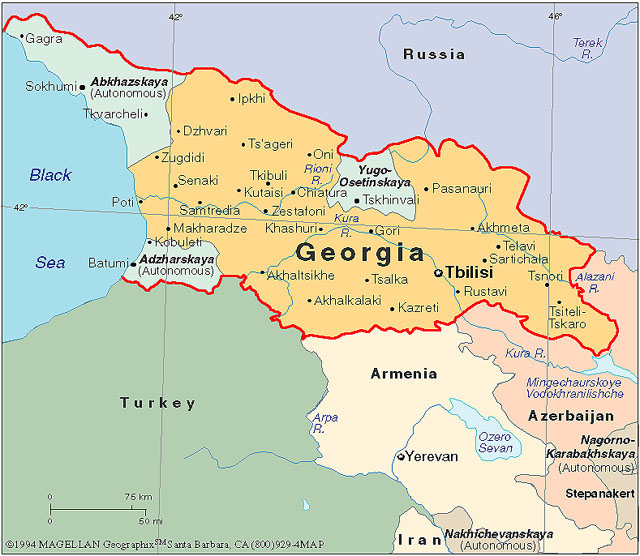
Last Thursday, just a day before the magical start to the Beijing Olympics, the populace in South Ossetia in Georgia woke up to a different kind of pyrotechnic display. A barrage of rockets fired at the behest of President Saakashvili of Georgia.  Presumably, the separatists operating out of the region had much upset the Georgian president.  He was also much perturbed by the role played by Russia and probably wished to set the record straight once and for all, through the barrel of gun.

But, what he didn’t expect or anticipate was the swift and deadly reaction from Moscow. Prime Minister Vladimir Putin condemned the Georgian adventure and rallied to the support of separatists from South Ossetia. According to the Russians, the separatists are struggling for freedom, and deserve to choose their destiny. In reality though, the Russians are upset at Saakashvili’s western leanings and were raising the tempo of separation in Abkhazia and South Ossetia to stop Georgia from joining the NATO.

The ball was set rolling, and almost immediately Russian tanks and artillery marched into the region backed by Sukhoi cover.  Putin termed it is a “humanitarian intervention”.  There was much debate and discussion in magazines like Time and BBC on how the situation would pan, after all Saakashvili might not have the numbers in terms of its armed forces, but he had invested heavily into modernization. But all that discussion was futile, because within a day or two, the Russian juggernaut had the Georgian forces on the knees. Not only were the Georgian forces pushed back from their positions in South Ossetia, but other places also came under attack. In fact there was a strong feeling that Russia would not stop till it would reach the capital Tbilisi.

Through all this, the stance taken by the world powers was rather interesting. While President George Bush came down heavily on Russia, asking it to stop “the invasion” and warning it of dire consequences. The old European powers like Germany and France, while condemning Russia, also seemed to chide Saakashvili for the corner he had pushed himself into. The rest of the world was ensconced in silence.

For the past many years, especially since the collapse of USSR; such invasions or rather “humanitarian interventions” have been the sole preserve of US and its allies, be it Iraq, Afghanistan, Serbia, Ethiopia, or wherever. The US has taken upon itself the job of world policing. Thus to have F16 flying over a state that has somehow antagonised the Americans and dropping cluster bombs, no longer comes as a surprise. As President Bush had famously remarked post 9/11, “you are either with us, or against us”.

It was a unilateral world that we lived in, till last Thursday. It all changed with this conflict. The message sent by Russia was simple and straight; love us or hate us, you can’t ignore us. For the past few years, thanks to it’s huge oil and gas fields, Russia has been gaining prominence and in the process starting to flex its new-found muscles. So be it putting its flag on the North Pole seabed or starting the fighter jets sorties over the Atlantic, reminiscent of the Cold War days.

So while the US has in some ways diminished in its strength thanks to its precarious position in Iraq and Afghanistan, Russia has been gaining strength.  And the Georgian crisis was litmus test, a indication of how thing will pan in the days to come.

Georgian President Saakashvili is a pro-western politician, who not only studied in the US but also admires it. He has been quite a trusted ally of Bush, sending a large contingent to Iraq and letting the oil pipeline from Azerbaijan to pass through its land. Between Russia and US, it was obvious whom Saakashvili had chosen. And from the way the whole event has turned, it is also obvious, as to who let him down.

Not only did Saakashvili underestimate Russia’s resolve, he also seemed to overestimate the US backup. He surely had bet for more than just harsh criticism, which was all that he got from the western world. Thus, while Condoleezza Rice and Bush did not mince any word in their criticism of Russia, they did precious little.

In fact, the tables have completely turned on Saakashvili. Georgia has as good as lost not only South Ossetia but also Abkhazia, where the rebels have started pushing out the government forces. Also, its hope of joining the NATO is now more or less a foregone conclusion. And not to mention the loss of face. The big question is: Did he really think that the Americans would shield and protect him from the mighty and wily Russians?

Now isn’t there a lesson in foreign politics for everyone here, including our economist Prime Minister Manmohan Singhji. One of the biggest argument for India signing the nuclear deal has been that we need to be on the good side of the Americans. According to people, in the current scenario, we cannot, not afford to have US as our ally. With US on our side, no one would dare rile us, fearing the cruise missiles that will rain from the heavens.

But this myth has been shattered in Georgia; while the US was making all the right noises, it was only making noises. So what is the guarantee that if we bind ourselves to the US, that we will be safer and no one will dare attack. If good friend Bush could let Saakashvili out in the wind, what the guarantee it won’t do so with India.

Imagine for a moment, that a mighty and resurgent China attacks us yet again, on the pretext of annexing Arunachal Pradesh, which it claims to be of its own. Though we might have the nuclear deterrent and the rest; we are yet no match for the Chinese might. In such a scenario, what would our friend, the Americans do?

Dr. Singh, to be honest, I am no expert in foreign policy. But there is one thing I am very sure of, never bind yourself with any power, no matter how powerful it might seem. Thus, with India joining the “I love US” club, might not be the best option available.

The Georgian crisis might not take us back to the good ol’ Cold war era, but it surely reminds us that we do not live in a unipolar world. Non aligned is a much maligned word, but in these circumstances, it just might be what the doctors would prescribe. Are you looking, Dr. Singh?

Anil Ambani and his tech dreams

Recently, I came across a piece on the Time Magazine website, authored by Simon Robinson (http://www.time.com/time/arts/article/0,8599,1817222,00.html), wherein Simon talked about Anil Ambani’s Hollywood dreams. The story talked of how there was a probability of Steven Spielberg and ADAG coming together, to be more precise; “Reliance providing between $500 million and $600 million to Spielberg’s Dreamworks SKG, financing that would allow Dreamworks to split from Viacom Inc’s Paramount Pictures.”
As, I went through the piece; my admiration for the junior Ambani brother went a few notches higher, not as much for making the phriangi Jurassic Park director indebted to us Indians, but more for the mileage that he seems to be deriving even before there was pen put to paper on the deal. Imagine WSJ and Time Magazine discussing the story and carrying them in their publications. The only other Indian businessman, who achieved this feat recently was Ratan Tata; but then he had to build a ‘Nano’ for the same after investing billions of dollars. And this is the very reason, I ‘kind off’ like Ambani, his media-savviness.

Unlike Branson (Vijay Mallya’s role model), Anil Ambani exudes a very no-nonsense business image. Each bit of news that emanates from his PR machinery subtly reminds that he is a “Wharton” MBA. The press handouts will have an image of him sitting in his corporate office, smiling benignly at you. He will hold joint press conferences with the Hoi polloi, be it Steve Ballmer or Bill Clinton. Then, of course, there are marathons that “fitness freak” Ambani runs and the innumerable trophies that he keeps accepting all the time. Some months back, there was immense coverage of the fact how Ambani Jr. had become a trillionnaire and also the 6th richest person in the world (based on the valuation of one of his company’s IPO, that tonked immediately after listing. So that was the end to that story).

There is a world of difference between how the two Ambani brothers carry on with their work. While the elder one (also the more richer) tends to keep away from media even though he owns a rather ‘costly’ IPL team. The only time Mukhesh Ambani was in news recent times was because of the $2 billion house that he is building. Meanwhile, ADAG’s public machinery seems to be working overtime, much like some 24/7 call center, trying to come up with some saucy and juicy bit.

So, there is Ambani Jr. investing millions in Fame Adlabs (a multiplex and film distribution chain in India). Or his Reliance Power is being listed (apparently, the very listing saw the end of the bull run and the return of the bears). Or how he aimed to be as big as TCS and the rest by launching a software firm Tech Reliance. Then, recently there has been these high-profile negotiations with MTN, the largest mobile operator in Africa. And finally, there’s Spielberg. He has even coaxed his good friend, Amitabh Bachchan to turn to blogging (he writes on one of ADAG’s online properties). Through all these stories, the official machinery will maintain a discrete silence. While some “informed sources” will keep the media wheels running with tid-bits and suppositions. Ask some one for a quote, and all you will get is hush-hush. Even the Time Magazine couldn’t coax them into commenting on a story.

Come to think of it, the raison d’etre of Ambani’s wealth are entities that he did not create himself, like Reliance Communications and Reliance Energy, the former was done by big brother and the latter was a PSU. And that is the reason, I like Anil Ambani; he manages to be there on my newspaper every morning somehow the other, talking of some fantastical venture or a success and when neither just plainly accusing his brother for some corporate misdemeanor. Bravo Ambani Jr! Continue reading

Feature: Ambani and Tech Reliance

Recently, I came across a piece on the Time Magazine website, authored by Simon Robinson (http://www.time.com/time/arts/article/0,8599,1817222,00.html), wherein Simon talked about Anil Ambani’s Hollywood dreams. The story talked of how there was a probability of Steven Spielberg and ADAG coming together, to be more precise; “Reliance providing between $500 million and $600 million to Spielberg’s Dreamworks SKG, financing that would allow Dreamworks to split from Viacom Inc’s Paramount Pictures.”

As, I went through the piece; my admiration for the junior Ambani brother went a few notches higher, not as much for making the phriangi Jurassic Park director indebted to us Indians, but more for the mileage that he seems to be deriving even before there was pen put to paper on the deal. Imagine WSJ and Time Magazine discussing the story and carrying them in their publications. The only other Indian businessman, who achieved this feat recently was Ratan Tata; but then he had to build a ‘Nano’ for the same after investing billions of dollars. And this is the very reason, I ‘kind off’ like Ambani, his media-savviness.

Unlike Branson (Vijay Mallya’s role model), Anil Ambani exudes a very no-nonsense business image. Each bit of news that emanates from his PR machinery subtly reminds that he is a “Wharton” MBA. The press handouts will have an image of him sitting in his corporate office, smiling benignly at you. He will hold joint press conferences with the Hoi polloi, be it Steve Ballmer or Bill Clinton. Then, of course, there are marathons that “fitness freak” Ambani runs and the innumerable trophies that he keeps accepting all the time. Some months back, there was immense coverage of the fact how Ambani Jr. had become a trillionnaire and also the 6th richest person in the world (based on the valuation of one of his company’s IPO, that tonked immediately after listing. So that was the end to that story).

There is a world of difference between how the two Ambani brothers carry on with their work. While the elder one (also the more richer) tends to keep away from media even though he owns a rather ‘costly’ IPL team. The only time Mukhesh Ambani was in news recent times was because of the $2 billion house that he is building. Meanwhile, ADAG’s public machinery seems to be working overtime, much like some 24/7 call center, trying to come up with some saucy and juicy bit.

So, there is Ambani Jr. investing millions in Fame Adlabs (a multiplex and film distribution chain in India). Or his Reliance Power is being listed (apparently, the very listing saw the end of the bull run and the return of the bears). Or how he aimed to be as big as TCS and the rest by launching a software firm Tech Reliance. Then, recently there has been these high-profile negotiations with MTN, the largest mobile operator in Africa. And finally, there’s Spielberg. He has even coaxed his good friend, Amitabh Bachchan to turn to blogging (he writes on one of ADAG’s online properties). Through all these stories, the official machinery will maintain a discrete silence. While some “informed sources” will keep the media wheels running with tid-bits and suppositions. Ask some one for a quote, and all you will get is hush-hush. Even the Time Magazine couldn’t coax them into commenting on a story.

Come to think of it, the raison d’etre of Ambani’s wealth are entities that he did not create himself, like Reliance Communications and Reliance Energy, the former was done by big brother and the latter was a PSU. And that is the reason, I like Anil Ambani; he manages to be there on my newspaper every morning somehow the other, talking of some fantastical venture or a success and when neither just plainly accusing his brother for some corporate misdemeanor. Bravo Ambani Jr!

The Time Magazine piece by Simon gives me a good excuse to post a small analysis that I had done at the time rumors were floating around on Tech Reliance. Sadly, I am only a tech journalist, so I need good “tech” reasons to write such features. I thank Ambani Jr. for giving me a reason to write such a piece and Simon for giving me an excuse to post it here. BTW, there seems to be little happening on the Tech Reliance front, the website is still a dead link. Hope the Spielberg is not another Tech Reliance story.
*************************
And now comes; Tech Reliance
The industry is curious about the latest foray by Anil Ambani. But he seems to be keeping the cards close to his chest, at the moment.

The dawn of New Year is often associated with cheer and celebration. It is the time to party, to let loose. But, it is also the time for introspection and inference. Individuals and companies alike make plans and resolutions for the coming year and gear themselves accordingly. Surely even the mighty trillionnaire Anil Dhirubhai Ambani, chairman of Anil Dhirubhai Ambani Group (ADAG), must have made quite a few resolutions for 2008, ranging from garnering a few extra billions to running the full Mumbai marathon. But then resolutions are often a private affair, conceived in seclusion and its success celebrated in public.

Yet, barely had the sherry stopped flowing at the onset of 2008, there was a small bit of news that emanated from unknown quarters. The news concerned Ambani, and more so his proposed venture. After proving his mettle in the telecom and the entertainment sector, it seems that Ambani has resolved to take on the knights of the IT industry. Of the many, or even the few, resolutions made by 48-year-old businessman, Information Technology was one of them, and it was dubbed as ‘Tech Reliance’.

Little wonder, the industry was agog with excitement. There was lot of speculation and supposition about the viability of Tech Reliance. Discrete and unknown “company sources” kept feeding news bits to eager newspersons. There was talk about the how the group would take on the Biggies of Indian IT, or how determined Ambani was to make this venture a roaring success. Through all this, ADAG was mum. The official channels churned out the normal PR spiel, no confirmation was given and no denial made. “The group continuously explores new avenues for growth and we seek to enhance value for our stakeholders,” was the only word that came out.

The battle plans
The news went that Tech Reliance would have six development centers across India by the end of December 2008. Currently, the Group has IT centers catering to corporate needs in Mumbai, Delhi, Kolkata and Hyderabad. According to reports there are over 2000 employees working out of these centers, the numbers would supposedly double by March.

The Reliance – ADAG (R-ADAG, as it is called) happens to be among India’s top three private sector business houses, with a market capitalization of over $ 22 billion, net assets in excess of $ 7 billion, and net worth to the tune of $ 6 billion. Interests of the Group range from communications (Reliance Communications) and financial services (Reliance Capital Ltd), to generation, transmission and distribution of power (Reliance Energy), infrastructure and entertainment. In the last year or so, the group has forayed into numerous industries, for instance, acquiring stake in Adlabs.

It is estimated that Group spends anything between $400-500 million on IT services for all related ventures and the Tech Reliance could start up by serving the needs of the group at the onset, saving costs and also gaining experience. It is likely that Ambani desires to put all his IT eggs in one basket. Amongst other things, Ambani also owns a BPO company, Reliance Infostreams, providing inbound and outbound customer support to India Mobile, Reliance India Phone subscribers and a few foreign clients. But at the moment, it seems that Infostreams would continue to exist as a separate identity.

Taking on the Titans
Till now the story read smoothly: Tech Reliance for Reliance-ADAG. But, the news leak went further. It would seem that Ambani is not only keen to save money (by doing it himself) but also earn big moolah through his new venture. Tech Reliance, supposedly, would be a challenger to the Indian tech giants like TCS, Wipro, Infosys and Satyam. According to ‘informed sources’ Ambani has kept aside some $2 billion for the tech venture and Tech Reliance would be in the big league in a couple of years by offering various consulting and other IT services to domestic and international clients.

In recent times, telecom services have become a big market opportunity. Quite recently Vodafone outsourced all its IT operations, with the exception of network service platforms, to IBM for five years. Earlier, IBM had won a 10-year, $800 million contract IT infrastructure for Idea Cellular. While in 2004, IBM won a 10-year IT outsourcing deal from Bharti Airtel, the deal was valued at about $750 million and has grown to about $1.2 billion currently. Meanwhile, TCS had won a 9-year infrastructure management contract from BSNL valued at around $140 million. Ambani could be looking at a piece of this burgeoning telecom pie.

The going won’t be easy, even for Ambani. TCS has been around for some 4 decades and has revenues of over $4.3 billion, Wipro Technologies with over $3.47 billion, Infosys with $3.1 billion and Satyam with over $1.4 billion. All these players have spread their operations globally, as well in India. Not to mention that MNCs also have a keen eye on India, with the Big Blue (IBM) clocking close to $1 billion in revenues from India. Breaking the stranglehold is tough, if not impossible.

To be a big player, Tech Reliance would need more than the Group IT revenues; it will need to win projects from Fortune 100 companies. But would these companies rely on Tech Reliance? Is a question that will be answered in the days to come. It is conjectured that Ambani would go the M&A way, pickup a single or a few ripe apples to expand. A joint venture is always handy in such circumstances, for instance the way Mahindra & Mahindra launched Tech Mahindra (earlier Mahindra BT) with British Telecom. Sometime back there were rumors that Reliance Communications (RCOM) was in talks with Accenture Consulting to float a joint venture to manage and operate the Group’s IT infrastructure services and processes. Somehow, nothing materialized. Maybe, Tech Reliance rose from the ashes of this JV itself.

Hot Air?
Nonetheless, media is having a field day, thanks to the innumerable anonymous sources. According to one such source, the company will be based out of centers in Mangalore and Bangalore, initially. Or the fact that Ambani has personally recruited a core team of 15 to overlook the operations and expansion of Tech Reliance. Yet, the official website of the Group does not even have a name of the proposed company. Of the numerous entities mentioned on the website (http://www.relianceadagroup.com/adportal/ADA/aboutus/companies.html) there is no mention of Tech Reliance.

Could it be that Ambani was testing the response to his idea before deciding to launch his venture? Many people (anonymously again) opine that this could be a smart way to drum up recruitment, by selectively leaking news bits. Indeed, on Orkut, a social networking website, many people are asking when, how and where is Tech Reliance recruiting. If indeed, Ambani wishes to ‘double’ his IT workforce by March, he must be making a big splash about it. But, there is a big under construction sign on techreliance.in, reflective on the state of the venture itself.

That is all there is about the venture at the moment. Till the dapper Ambani opens up about the venture, there will be lot of riff-raff about Tech Reliance. Hopefully in the days to come, there would be an end to news shrouded in anonymity and we could witness the birth on another IT company. A probable David that aspires to take on the Goliaths. Good luck, Ambani.
n

Feature: Jaipur Blasts

I was 16 and it was my mom’s birthday. All of us were waiting for Papa to come home so that we could go out to Juhu beach followed by dinner at the Evening Post, a restaurant where prices were a wee-bit higher than the usual ones and the waiters were also dressed in starched whites bowing and nodding frequently, thus making it a special place fit for birthdays and anniversaries. Post afternoon, I was standing outside our home and I noticed something quite out of the place, nervous people were rushing hither-thither and one could spot a motley group talking quite animatedly.

It had not been much time, since the city of Mumbai had witnessed the worst kind of communal violence after the demolition of Babri Masjid, we were all edgy and worried, fearing and scared about the worst. It was then that we came to know that a series of blasts had rocked the city of Mumbai. Rumors were flowing thick and thin, the news on the television or the radio was not much of help. Some were saying that there were 15 blasts and some claiming it to be 5. With every passing moment, I would hear of a blast at some another location, Air India Building, Zaveri Bazaar, Sea Rock, Sebi, Centaur, Passport Office. I was extremely worried about Pa, this was the time before mobile phones become ubiquitous, so there was no way to reassure self.

Standing outside my home, I remember looking to heavens in utter helplessness, pleading with the divine powers to take care of my pa, many promises were made, many bribes were offered. What else could a puny teenager do in the wake of these circumstances? Fortunately for me, the gods were kind. Pa missed one of blasts by a whisker, so as to say. But that wasn’t the case for hundreds of poor individuals who on March 12, 1992 met a horrific death. For so many hundreds of teenagers like me who lost their parents on that day, life would never ever be the same.

There have been quite a few bomb blasts post 1992, even another serial blasts in suburban Mumbai trains and every time my blood curdles up. What really pisses me is the impunity with which these bastards commit the crimes and get away with it. It is as if, there is little that we can do to really protect ourselves, it is so easy for these gutter-snipes to place a bomb or two where they wish and never for once does our administration wake up. Every time, I see or hear about a blast, I remember my mom’s birthday, the day I was imploring and pleading with gods to take care of my Pa. So, when I heard and saw the news on television about the blasts in Jaipur, I felt like screaming, shouting, hitting out at somebody, anybody, I felt like crying. I needed to do something, and the piece below was written in angst and in pain. I just wish I didn’t have to return to that day in 1992, again and again.
*************************

Jaipur blasts: A bloody soft state

The real answer to terror could come from hardware and software, and nothing else

Blood was splattered on the soiled ground; there was single leather shoe with singed laces; cycles, bicycles, handcarts all twisted horrifically out of shape; shattered glass everywhere; somewhere afar one could discern the silhouette of a human form – life snuffed out, and in the neighborhood, wails intermixed with groans, for the dead and for the living.

And looming large over everything was silence, an overpowering silence, a defeated silence — a helpless one. Yet again, terror had come calling and yet again we were helpless and weak in front of it.

The only thing that had changed this time was the location: instead of a train or bus in Mumbai, or the Parliament in Delhi or instead of an open air theatre in Hyderabad, or a temple in Akshardham, or a mosque in down south, it was the beautiful Pink City of Jaipur.

In 12 minutes flat, 7-8 RDX bombs changed so many lives that it will be hard to account for all of them. Official figures put the casualty at over 60, with more than a few hundred injured. These statistics are not only symbolic of our helplessness but also of the sheer callousness of the administration.
Indeed, the jamboree has already started; fingers have been pointed towards the usual suspects, LeT, the HUJI, SIMI, ISI and the lot. Of course, one cannot so easily blame Pakistan (considering the mess it, itself is in), so there is Bangladesh (but then the poor state has been in a constant mess since the time it was carved out in 1971).

Leaders in Delhi are talking tough, “We will not tolerate these kind of actions…strict action will be taken…the perpetrators would be punished,” and so on. In the next few days be ready for a few ‘terrorist encounters’, where a few of the so-called LeT or HUJI terrorist will be gunned down and on their bodies will be found maps of different temples and army headquarters.

But all these claims by ministers and administration is just hollow posturing because the people who live with their families under X,Y,Z security categories and move around in a cordon of bullet and bomb-proof cars are completely inept to handle terror.

The question that begs an answer is why isn’t the government doing something conclusive about it? When we can send a capsule to the moon or simultaneously put 10 satellites in geo-synchronous orbit, why are we not able to detect the sleeper cells of these so-called terrorist outfits within the country? Why even after so many terror strikes has our intelligent gathering mechanisms not been modernized?

Look at the way US has battled terror. 9/11 brought terror to the American soil for the first time in history. A couple of thousand died in the twin towers itself. In the aftermath of the event, US invaded Afghanistan, later Iraq, made enemies across the Middle East. The US was much feared before 9/11, after 9/11 it was much hated.

And yet, there hasn’t been a single terrorist strike in nation after that catastrophic event even though its enemies have multiplied manifold. Simply because it learnt from the event, it strengthened its intelligence gathering apparatus, virtually everything has systematized. Land in the US, there are multiple times your fingerprints are digitally captured, every traveler into the country resides for eons on the servers of the FBI or the NSA.

Even for those not in the US, there is no guarantee that National Security Agency (NSA) is not keeping a tab on them. It is said that the agency, scrutinizes every call or email that goes in or out of the US. There are hundreds or even thousands of spy satellites up in the sky looking at every square inch of land. America shackled the beast of terror with technology.

The US is increasingly relying on GPS as a crime-fighting tool; India on the other hand took a strong stand against BlackBerry ‘to stymie’ terror. And terrorists use mobile phones to trigger explosions in India, leaving innocents still, silent and slain.

Fortunately or unfortunately, we can never be like the US. But surely we can at least learn from the all these calamities, if there was ever a time to act, it is right now. There is an urgent need to disband all the portly officials from RAW, CBI, and the intelligence Bureau and put in place a hi-tech network.

The real answer to terror could come from hardware and software, and nothing else.
If a private company in India can build world 4th fastest computer, EKA, surely we can have a hi-tech apparatus in place, which can monitor all those calls and emails and discern patterns.

A super computer has more chances of finding a sleeper LeT cell, than a whole police apparatus of a state. If Indian software engineers can help design software for NASA and the likes, why can’t their talents be used here in India? The question is not of capability but of will.

Are the people who run this country, capable and competent to understand the dynamics of this new warfare against us? Or they simply going to live in their cocoons and ‘share our grief’ and do bloody nothing? How many more Mumbais, Hyderabads, Delhi, Jaipurs, are needed to shake them out of their lethargy? How many more lives of poor helpless Indians need to be sacrificed on this altar of indolence?

Or is it that, we are destined to be a bloody soft state that can hardly do a thing when dastardly terrorist strike at will and shame us over and over again.

Meanwhile, all we can do is look to the heavens and beseech the lord to have mercy on the poor citizens of the charming Pink City and give them the power and wherewithal to tide over this crisis.

Bomb blasts in Jaipur

I was 16 and it was my mom’s birthday. All of us were waiting for Papa to come home so that we could go out to Juhu beach followed by dinner at the Evening Post, a restaurant where prices were a wee-bit higher than the usual ones and the waiters were also dressed in starched whites bowing and nodding frequently, thus making it a special place fit for birthdays and anniversaries. Post afternoon, I was standing outside our home and I noticed something quite out of the place, nervous people were rushing hither-thither and one could spot a motley group talking quite animatedly.

It had not been much time, since the city of Mumbai had witnessed the worst kind of communal violence after the demolition of Babri Masjid, we were all edgy and worried, fearing and scared about the worst. It was then that we came to know that a series of blasts had rocked the city of Mumbai. Rumors were flowing thick and thin, the news on the television or the radio was not much of help. Some were saying that there were 15 blasts and some claiming it to be 5. With every passing moment, I would hear of a blast at some another location, Air India Building, Zaveri Bazaar, Sea Rock, Sebi, Centaur, Passport Office. I was extremely worried about Pa, this was the time before mobile phones become ubiquitous, so there was no way to reassure self.

Standing there outside our home, I remember looking to heavens in utter helplessness, pleading with the divine powers to take care of my pa, many promises were made, many bribes were offered. What else could a puny teenager do in the wake of these circumstances? Fortunately for me, the gods were kind. Pa missed one of blasts by a whisker, so as to say. But that wasn’t the case for hundreds of poor individuals who on March 12, 1992 met a horrific death. For so many hundreds of teenagers like me who lost their parents on that day, life would never ever be the same.

There have been quite a few bomb blasts post 1992, even another serial blasts in suburban Mumbai trains and every time my blood curdles up. What really pisses me is the impunity with which these bastards commit the crimes and get away with it. It is as if, there is little that we can do to really protect ourselves, it is so easy for these gutter-snipes to place a bomb or two where they wish and never for once does our administration wake up. Every time, I see or hear about a blast, I remember my mom’s birthday, the day I was imploring and pleading with gods to take care of my Pa. So, when I heard and saw the news on television about the blasts in Jaipur, I felt like screaming, shouting, hitting out at somebody, anybody, I felt like crying. I needed to do something, and the piece below was written in angst and in pain. I just wish I didn’t have to return to that day in 1992, again and again.

*************************

Jaipur blasts: A bloody soft state

The real answer to terror could come from hardware and software, and nothing else

Blood was splattered on the soiled ground; there was single leather shoe with singed laces; cycles, bicycles, handcarts all twisted horrifically out of shape; shattered glass everywhere; somewhere afar one could discern the silhouette of a human form – life snuffed out, and in the neighborhood, wails intermixed with groans, for the dead and for the living.

Continue reading

Fight for Tibet goes online

Before I wrote the story on Tibet, I went to Youtube and saw the video of the Tankman, times and again. I remember seeing the video clip as a teenager in one of the television shows, Pranoy Roy’s The World This Week. As, a youngster I was amazed and spellbound by the courage of the man, who stood in front of that column of tanks, waving at them to leave. There hasn’t been an image that has left a mark on me, in the way Tankman had. And everytime I was seeing the video on Youtube, I could feel the pain the travesty of the person that drove him to make a statement like that. I often think to myself, was tankman immensely brave aware of the consequences and ready to pay the ultimate price or was just so frustated that he didn’t bother of anything. And that’s what I recalled when I saw the images of all those monks in Lhasa shouting slogans against the Chinese rule.Free Tibet, is a phrase that seems to be plastered all across the globe. As the momentum for the 2008 Olympics in China gathers force, so does the movement by Tibetan protestors some asking for autonomy and some for freedom. There have been hot debates, whether politics should be linked to sports. But in all these debate and discussion, what we seem to forget is that around 5 million Tibetans are not only living in the fear for their lives and sustenance but also in danger of losing their identity.

In many ways, this incursion by China into the ‘roof of the world’ could be termed as ethnic cleansing. Sadly, while India has been a host to Tibetan refugees, it can never take a stance for them. So, thousands live into cramped quarters in Dharamsala, dreaming of the day when they will move freely and be able to live in the valleys of Amdo or Kham. It is not hard to understand the pain that the exiled Tibetan community is feeling and can be gauged from the way they are using Internet to connect and spread the message. Using this as an excuse, I did a story on the issue for Dataquest and it was published recently. I am uploading the story in the memory of the tankman (who supposedly is living in Taiwan or was killed within a fortnight by the PRC Army) and more importantly as a salute to the indominitable human spirit that yearns and pines for liberty and freedom.


 *************************

The struggle for Tibet goes digital

While monks and protestors in Tibet are battling with the heavily armed Chinese forces, Tibetans across the world are using the Internet to connect and rally for their fellowmen back home.

The gloves were finally off, as a column of Chinese Type 59 tanks rolled down the Chang’an Avenue, near Tiananmen Square. It was the spring of 1989, and hundreds of thousands of students were protesting all across China and especially so in Beijing crusading for liberty and free speech. To make their voices heard, students huddled in Tiananmen Square went on a hunger strike. But instead of negotiations, the communist regime of China decided to crush the non-violent movement in the most virulent fashion. Army was sent in to break the protests. The battalion of tanks was part of the same effort.

As the tanks slowly rolled on, a single student decided to make a statement at the very risk of his life. Armed with two empty shopping bags, he stood right before the mighty tanks and brought the whole column to a halt. The tank right in front tried to dodge him, but the unknown rebel (as he would be dubbed for eternity) would not be dissuaded. He gesticulated with his arms and climbed on top of the tank to express his views to the soldier manning the tank. He was not ready to let go, but people (protesters probably) pulled him on the side before something untoward happened. The whole incident was captured on video and beamed by the channels across the world, making it the most emotive image of the fight for liberty beck in 1989. The images raised international concerns and country after country lambasted the Chinese regime for the brutal reprisal. Other than that there is little that we know of the Tiananmen protest.

The world has changed infinitely much since then. Today China is a global power, both in economic and military terms. The country will be preening in front of the world by the Olympics this year. But there seems to be trouble brewing again, this time in the ‘roof of the world’, Tibet.

Last fortnight, near simultaneous protests started in Lhasa, and then spread to different cities of the Tibetan Autonomous Region. Monks and ordinary Tibetans supposedly attacked Chinese business. People were seen marching in different parts of Tibet, denouncing the oppression of the Chinese military. Once again the Chinese government decided to come down heavy again. The protestors were shot at, and all media access to the region was denied. But unlike in 1989, this time the protestors did not have to be physically present in Tibet to be counted. Thanks to the Internet, Tibetans across the world are taking part in the ongoing struggle. Continue reading

Feature: Fight for Tibet goes online

Before I wrote the story on Tibet, I went to Youtube and saw the video of the Tankman, times and again. I remember seeing the video clip as a teenager in one of the television shows, Pranoy Roy’s The World This Week. As, a youngster I was amazed and spellbound by the courage of the man, who stood in front of that column of tanks, waving at them to leave. There hasn’t been an image that has left a mark on me, in the way Tankman had. And every time I was seeing the video on Youtube, I could feel the pain the travesty of the person that drove him to make a statement like that. I often think to myself, was tankman immensely brave aware of the consequences and ready to pay the ultimate price or was just so frustrated that he didn’t bother of anything. And that’s what I recalled when I saw the images of all those monks in Lhasa shouting slogans against the Chinese rule.

Free Tibet, is a phrase that seems to be plastered all across the globe. As the momentum for the 2008 Olympics in China gathers force, so does the movement by Tibetan protesters some asking for autonomy and some for freedom. There have been hot debates, whether politics should be linked to sports. But in all these debate and discussion, what we seem to forget is that around 5 million Tibetans are not only living in the fear for their lives and sustenance but also in danger of losing their identity.

In many ways, this incursion by China into the ‘roof of the world’ could be termed as ethnic cleansing. Sadly, while India has been a host to Tibetan refugees, it can never take a stance for them. So, thousands live into cramped quarters in Dharamsala, dreaming of the day when they will move freely and be able to live in the valleys of Amdo or Kham. It is not hard to understand the pain that the exiled Tibetan community is feeling and can be gauged from the way they are using Internet to connect and spread the message. Using this as an excuse, I did a story on the issue for Dataquest and it was published recently. I am uploading the story in the memory of the tankman (who supposedly is living in Taiwan or was killed within a fortnight by the PRC Army) and more importantly as a salute to the indomitable human spirit that yearns and pines for liberty and freedom. We were all born to be free and that is how we should be.

*************************

The struggle for Tibet goes digital

While monks and protesters in Tibet are battling with the heavily armed Chinese forces, Tibetans across the world are using the Internet to connect and rally for their fellowmen back home.

The gloves were finally off, as a column of Chinese Type 59 tanks rolled down the Chang’an Avenue, near Tiananmen Square. It was the spring of 1989, and hundreds of thousands of students were protesting all across China and especially so in Beijing crusading for liberty and free speech. To make their voices heard, students huddled in Tiananmen Square went on a hunger strike. But instead of negotiations, the communist regime of China decided to crush the non-violent movement in the most virulent fashion. Army was sent in to break the protests. The battalion of tanks was part of the same effort.

As the tanks slowly rolled on, a single student decided to make a statement at the very risk of his life. Armed with two empty shopping bags, he stood right before the mighty tanks and brought the whole column to a halt. The tank right in front tried to dodge him, but the unknown rebel (as he would be dubbed for eternity) would not be dissuaded. He gesticulated with his arms and climbed on top of the tank to express his views to the soldier manning the tank. He was not ready to let go, but people (protesters probably) pulled him on the side before something untoward happened.

The whole incident was captured on video and beamed by the channels across the world, making it the most emotive image of the fight for liberty beck in 1989. The images raised international concerns and country after country lambasted the Chinese regime for the brutal reprisal. Other than that there is little that we know of the Tiananmen protest.

The world has changed infinitely much since then. Today China is a global power, both in economic and military terms. The country will be preening in front of the world by the Olympics this year. But there seems to be trouble brewing again, this time in the ‘roof of the world’, Tibet.

Last fortnight, near simultaneous protests started in Lhasa, and then spread to different cities of the Tibetan Autonomous Region. Monks and ordinary Tibetans supposedly attacked Chinese business. People were seen marching in different parts of Tibet, denouncing the oppression of the Chinese military. Once again the Chinese government decided to come down heavy again. The protesters were shot at, and all media access to the region was denied. But unlike in 1989, this time the protesters did not have to be physically present in Tibet to be counted. Thanks to the Internet, Tibetans across the world are taking part in the ongoing struggle.

While China has blocked Youtube and many other chat rooms in the bid to suppress news on the unrest, thousands of Tibetans across the world are using the Internet to connect and spread the word on the real picture on the ground. So when the Chinese officials claimed that the rioting had withered away, videos on Youtube showed the contrary. Also the claims made by officials that suppression was not brutal was shown to be hollow as images of dead monks and protesters were shown on different Tibetan websites.

Google “Free Tibet”, and you will see over seven hundred thousand results, there are around 1500 videos on Youtube on the same keyword, with over 500 added this week itself. Hundreds of pro-Tibetan websites provide links and forums for organizing mass protests against the Chinese rule, the chief ones are Freetibet.org, Tibet.org, Savetibet.org, and many others. In fact Tibetsites.com has a list of all the websites that raising the issue. The Tibetan government in exile has its official website on Tibet.com.

There is also much action on Secondlife.com as well; in fact, there is much talk about the rebuilding the Tibetan Potala Palace as a gift to the 14th Dalai Lama and preserving Tibetan History in virtual space.

So while the denizens within the Great Walls, might come across invalid links and blank pages when they search Tibet in the cyber world. The world outside is brimming with action; there is much talk of how to use the Olympic event as a platform for highlighting the Tibetan cause.

Sometime back, John Gilmore, the co-founder and board member of Electronic Frontier Foundation (EFF) had spoken on the issue of using the Internet as a medium for freedom struggle.

“Every person is responsible to follow the laws of their own country; yet we can all work to change those laws. And when those laws are reprehensible, then passive or active opposition may be required. Mahatma Gandhi provided many useful lessons in how a populace can nonviolently free itself from oppressive rules and rulers. And many technologists have developed ways for citizens to evade information controls that they think are inappropriate,” he had stated.
So, back in 1989, the unknown rebel had to stand in front of a tank to make a statement, the Tibetans now use Blogspot and Youtube to do the same.

Shashwat DC

Feature: E-governance in Lakshadweep

Among the few places in India that I really wish to settle down in; Lakshadweep would be right on the top. A chain of 30 odd islands in the Arabian Sea, Lakshadweep is truly a coastal paradise. Cut off from modernity, it still retains some of the old world charm, though computers and IT are reaching the remotest islands. Hopefully, before modernity spoils this idyllic paradise, I just hope to hang my boots somewhere in Kavaratti or even Bitra.
*************************
Tiny Lakshadweep’s Giant Strides

The smallest union territory of India is eagerly embracing ICT and changing the lives of its citizens for the better, thus, becoming a role model for its bigger cousins on the mainland.

Khadim Miyan seldom makes a promise, but in the rare cases that he does, he goes to any length to live up to his words. Thus, when Miyan promised his niece, Hidmat, that he would bring her gifts on Eid ul-Adha, or Bakri Eid, he knew it would be impractical but not impossible. After all, he could not take more than 3-4 leaves from his work at the local tourist cottage in Kalpeni and the journey to his sisters house in Minicoy takes over 14 hours by sea. But, more than the time spent in traveling, it was the time spent on arranging a ticket in one of the five ships that linked the dozen odd islands in Lakshadweep that bothered Khadim.

Seats are scarce, especially during festivals like Eid, and there is no guarantee that one could find a berth on these ships. It is simply a matter of too many passengers and too few ships. There have been cases that aspirants for a berth on these ships have lined up a few days in advance in the hope of finding a seat. Considering the situation he was in, Miyan decided to play it safe. He decided to check the availability of tickets on Lakport.nic.in and then plan his trip accordingly. In a matter of minutes, Miyan zeroed in on MV Bharat Seema and booked for self a ticket to Minicoy. Stepping out of the port office, all that Miyan was concerned about was which toy should he purchase for his seven-year-old niece. At least he was sure that this time too he had managed to keep his promise and he had to thank technology for it.

Like Miyan, there are thousands of people on Lakshadweep whose lives are changing for the better, thanks to the miracles of technology.

Located some 200-300 km off the coast of Kerala in the Arabian Sea, Lakshadweep is the smallest union territory of India. The total land area of the territory is some 32 sq km. In 1956, Lakshadweep was designated as a union territory and brought under the direct authority of the Center. As the ecosystem of the islands is pretty fragile and not supportive to heavy industrialization, the territory lagged the rest of the nation in terms of economic growth. In fact, it was an isolated paradise where quite a few travelers wanted to go, but only a few did.

Over the past many years, the government seems to have woken up to the potential of the island paradise as a top tourist destination. Located close to the “Gods own country”, Kerala, Lakshadweep can be a big draw for people looking to be away from the madding crowd. This, in turn, has prompted much needed investment into physical infrastructure, thereby making the place attractive to visitors and tourists.

Bridging the remoteness
Fortunately, technology is a two-way sword and it always cuts both ways; so the very application of technology, namely, registration of seats on ships to and from Lakshadweep, has not only been a boon to tourists, but also to the local population like in the case of Miyan. Credit is due to a few individuals like the administrator of Lakshadweep, BV Selvaraj, and technical director and state information officer, NIC, Lakshadweep, Ajith Brahmanandan. Both have taken upon the cause of modernization and the result is robust and thriving ICT initiatives in the various islands. In fact, over the years, e-governance projects in Lakshadweep have received awards at different platforms in recognition of the path breaking efforts made by the smallest union territory.

“Technology needs to have a human face. ICT, for the sake of technological upgradation, is no good unless and until it raises the standard of living of people. In Lakshadweep, all the projects that we have completed or are working on, have a very strong focus on making life easier for the citizen,” says Brahmanandan.

Slew of innovative projects
Indeed this human focus has been the hallmark of all e-governance projects carried out in the union territory. Unlike other places in India, Lakshadweep has very unique problems and pain points. Thus the solutions that have worked well in the hinterland are not necessarily the best solution for it. Take the case of ship reservation itself, the 5 or so passenger ships connect the 11 inhabited islands. The total population of Lakshadweep is in the range of some 65,000 people. The population is also spread very unevenly, for instance the capital Kavaratti and Androth islands have a population of over 10,000, while Bitra has a mere 250 odd people living on it. From this problem came the genesis of the reservation system.

Similarly, employment is a big issue in Lakshadweep. As there isn’t much industrialization, there is a high level of unemployment amongst the youth. For these people the only hope is the employment exchange, and close to 20% of the population has registered themselves with the bureau. In not so distant past, people had to travel to Kavaratti employment exchange for registering and other facilities. Keeping in mind the geographic spread and inadequate transport facilities, it would anything between 8 days during normal season and around 15 days in monsoon for the job aspirant to travel to Kavaratti and back to his island.

To cut down on this unnecessary travel and trouble caused to the islanders, the administration of Lakshadweep and National Informatics Center put together “total digitization of employment services”. Under this, all the data relating to some 15,000 registrants was digitized and re-codified, virtual employment exchanges were opened up in all the islands and the same were connected through the bandwidth provided by NICNET and BSNL. The project, launched in 2007, has been a roaring success with hundreds of job aspirants registering themselves in the new employment exchanges that have been set up on their islands.

“Additionally, the process has become transparent and free from any kind of manipulation that could have been easily done in the past. It has also touched the lives of many people as they no longer have to spend money or their valuable time just for mundane registration process. But, according to me, the biggest benefit has been the spread of awareness of the benefits of ICT among the poor and the uneducated people who live in far flung and isolated islands,” adds Brahmanandan with a touch of pride.

The project was recently bestowed with the Manthan Award, and, accepting the same, Selvaraj said, “The administration, along with all the political representatives, namely, members of Parliament, and members of the District and Village (Dweep) Panchayats, has been working toward effective administrative reforms through aggressive e-governance. We are going to have a basket of e-governance projects and compete for the best e-administered State/UT of the country shortly.”

Another project that has received a lot of applause has been the Web-enabling of the Lakshadweep electricity department (read Selvarajs column for more on that). Lakshadweep also has the unique distinction of being the first union territory/state in the whole country to have universal electricity. And due to the efficient materials management and transportation of fuel and effective maintenance of power houses there has been no instance of load shedding in the past year.

Not only that, the administration has also refurbished the Lakshadweep (lakshadweep.nic.in) Web portal, providing vital information about the islands and also giving a link to over 20 different administrative departments. The portal also has links for citizen charter and even an online photo gallery that showcases the beauty and serenity of the island paradise. Little wonder, the portal is referred to as the ‘electronic window’ to the union territory.

Future beckons
Going ahead, Lakshadweep has decided to implement a state level SWAN Implementation Committee that will formulate the technology to be adopted and various other aspects of the implementation of state wide area network. As of now, the SWAN project is in proposal stage and the implementation committee will aid in faster completion of project, the deadline for which is September 2008. The members of the committee have been derived from NIC, BSNL and ISRO and the project will be funded by the Department of Information Technology (DoIT) and jointly implemented by NIC and the IT society of the Administration

Additionally Selvaraj is also keen on improving the Web connectivity in the different islands. In this regard, he has asked BSNL to augment the bandwidth of the BSNL satellite earth station, Kavaratti to 16 Mbps from the present 8 Mbps immediately. Once the SWAN is in place, a slew of e-governance applications, like digitizing of land records or payments of taxes, etc. would be rolled according to officials.

Through all this, Selvaraj also emphasizes the need for structural reforms. “Technology is important, but e-government projects by themselves will not bear fruits unless they are coupled and integrated with structural reforms,” he says. He has also appointed a committee on administrative reforms that harmonizes the functioning of different departments and looks at bringing in transparency.

With these and many other Lakshadweep is finally coming out of the isolation that geography has bestowed on it. Like any other place in the country, mobile phones have also made a huge impact in the lives of the islanders. In was in 2003, when BSNL had launched it services in Kavaratti and today there are more than 10,000 mobile subscribers in Lakshadweep. In fact private operators are also on the anvil and Airtel supposedly does provide connectivity on Kavaratti.

Little wonder, people like Miyan no longer feel left out in the race to modernization, and there lives have been enriched in ways they would have scarcely believed. Using the portnet online system, Miyan was not only able to visit his niece on distant Minicoy but also ensure that he did not waste any time in the process and was back to his job on the promised day. He is quite happy, that he was able to live up to his word and has ICT to thank for it. The best part is that stories like Miyan are no more mere anomalies or exceptions but are steadily becoming the norm. And by this benchmark alone, tiny Lakshadweep has made giant strides towards a better and wholesome future. Something its larger cousin states on the mainland could take a few pointers on.

Shashwat DC

Interview: Peter Dengate Thrush (ICANN)

As it is, interviewing a lawyer is a tough task. And if the lawyer heads an organization that is often embroiled in controvresies, the task becomes more oneros was my dilemma, as I started my interaction with Peter Dengate Thrush, chairman of the board, ICANN. The Kiwi Barrister had come down to India for an ICANN event and I met up with him at one of the seminars he was attending. He is one of the rare people, who genuinely was eager to attus. Thiend all the sessions at the seminar (more so because he was the keynote speaker). Thus, I had to time the conversation between two sessions and he sat down with a cup of coffee.

Now, ICANN as an institution over the past decade has been involved in lot many controversies, some of its making and a majority of them not. Thus, as I would put forth those questions, Thrush would thrash them away in his characteristic ‘lawyerly’ way. Certain questions, he would make me repeat, then a few times he would ask me to elaborate and sometimes he would just dismiss them altogerther. Everytime he WAS ready with his defense and ready it to back it up. As the interview proceeded, he softened a bit and that is when the conversation,in a sort of way, took off.

While researching on Thursh, I had come across this very tragic incident in his life, wherein he lost his father, wife and brother in a car accident. I wanted to ask him about the foundation that he has set up in the memory of his wife and family, but I let it be. I really didn’t wish to remind him of those traumatic days.

Here is Barrister Thrush defending ICANN on all the diiferent issues that I could think of. Believe me, he did a jolly well job.

*************************

‘US is not controlling Net Resources’

It has been nearly a decade since Internet Corporation for Assigned Names and Numbers (ICANN) came into being at Marina Del Rey, California. Set up as a non-profit corporation to oversee a number of Internet-related tasks previously performed directly on behalf of the US Government by other organizations. The chief task of ICANN is to manage the assignment of domain names (over 145 million domain names) and IP addresses, popularly referred to as the Internet Assigned Numbers Authority (IANA) function. Yet, over the years, ICANN has been embroiled in controversies, be it political or technical in nature. The main grouse many seem to have with ICANN, is that it seems to be a trifle more conscious to the whims and fancies of the US Government.

In the past few years, there has also been an increasing chorus asking for either ICANN to be freed from its obligations to the US Government, or all together stripped of the role it plays. Nonetheless, the ICANN boat seems sail quite merrily, recently it launched the .Asia domain name with much fanfare and also announced the shift to IPV6 from IPV4. In midst of all this jumble-tumble, there was also a change of guard at ICANN, Internet pioneer Vincent Cerf was replaced by barrister Peter Dengate Thrush as the chairman of the board. It has been a significant move, as many argue that by appointing a New Zealander the Board is trying to play down its association with the US Government. Whatever be the reasons or compulsions, one thing is for sure, Thrush is completely in control with the developments at ICANN. It is almost impossible to pin down this suave barrister, he seems to be ready at all times with facts, figures and arguments to prove his contention.

Recently, Thrush had come down to India to attend the 33rd ICANN conference held in India. Taking some time out, Thrush spoke at length to Dataquest on the different controversies that surround ICANN and what he feels about the coming years. Excerpts.

How does it feel about fitting into Vincent Cerf’s shoes?
It is a big honor really, to follow someone who is such a pioneer and rightly rewarded for his work. I remember mentioning in my speech that he was ranked at number 11 in the list of 40 most influential technologists. I was elected unamiously by the Board, thus I have got the confidence of the rest of the Board. I have been on the Board for years, and know what the expectations are and how it functions. SO I have to just press on and execute the responsibilities that I have been given.

What will be your main tasks as the chairman of the Board?
Rather than main tasks, I think that there are a whole lot of tasks, starting with the most obvious one, i.e., to chair the meetings of the board to ensuring that the right direction is given to the corporation. Thinking strategically, being aware of the opportunities, obligations we have to the environment and the society at large, are some of the major responsibilities of the chair.You recently spoke about the fact that ICANN had outlived the Joint Project Agreement (JPA)?What I had stated in fact was that JPA had itself outlived itself, it only had a limited life, and it was put in place for only three years. With a very clear indication that it should be reviewed half way through. The point about JPA is that sets up a number of conditions, which if ICANN completes them, it would have done the work that is necessary to be the trusted coordinator of resources and the Board thinks that those things have been done. We have to be careful though, as some of those things can never be really done, as they are never ending, it is a sort of journey not arrival. The question is whether we are doing it well enough. And the feedback that I have been getting from the community is that we are doing those things well enough to be allowed to continue to do.

There is often this perception that the US government is controlling all the resources of the Internet, discreetly or overtly. Your views.
First up, it is a wrong perception that the US government is controlling the Internet resources. There are some very specific roles of the US government used to play for historic reasons. Most people are very grateful that they did that and that they continue to do that. And we are talking about transition out of a set of controls. The JPA doesn’t really provide any control and the removal of the JPA would not affect the control mechanisms that are in place. There are a number of key control mechanisms currently in place, and the most important one is the contract that the US government gives to ICANN, the Internet Assigned Numbers Authority (IANA) function. It is in fact the IANA function that actually controls what goes into the root.

And there is still a continuing role, in terms of changes to the root by the US Department of Commerce. Now we recognize that is in regards to what the other governments particularly in terms of changes to the country-code top-level domains (CCTLDs) for example, find difficult that the US Department of Commerce official actually has a role to play changing something which, for better or for worse, countries see as something that is very close to their own sovereignty. That isn’t actually going to change by the JPA coming to an end. JPA is much more about forming and building ICANN, the rules under which ICANN runs will continue to be as they were.

If you consider the following, it will be obvious that the US government does not interfere in the functioning of ICANN as the chairman of the board is from New Zealand (Thrush), the vice chairman is from Italy, the CEO is from Australia. We are gradually moving to a different environment, where our accountability will be to the Internet community of the entire world rather than to any one government.

According to Prof. Milton Mueller, in the past ICANN has been ‘generally willing to go along with US control’. What do you say to that?
Milton is a good friend of mine, and we disagree on a number of things. I am not quite sure of what you are referring to but what ICANN is prepared to go along is a number of things that I mentioned earlier. First of all, we are very happy to be a California registered corporation, as a result of that we get tax advantages in the US, which we are very happy to have, so we are prepared to meet the obligations of being a US corporation to get that advantage. We are delighted to have the contract from the US Government on the IANA functions and we are prepared to live with the obligations of that creates. We work closely with the US Department of Commerce in relation of the World Summit of Information Society and the committee that came out of that, the working group on Internet Governance (WGIG). So we have a close relationship with the US government. That said, that government has no greater say in the policy issues that come in front of us, for e.g. the debate on whether or not to introduce .XXX into the root.

There is speculation that the US government played a more influential role than the other governments, but as a member of the Board at that time and someone who voted in favour of .XXX for entirely different reasons, I was unaware of any untoward pressure from the US government.

In the end, we are very clear about what the issues are, we are a US corporation at the moment that brings with it, obligations and responsibilities, so if you are talking about that then there is no problem. The US connection is something that the media is much keener to focus on than anyone else. The reality is ICANN is enormously international, with 21 members of the board, a vast majority of those who come from outside the US. There is staff spread all around the world, the meetings are held almost anywhere but the US. Probably I think it is more of a media issue than a real one.

In such a scenario, what do you see as the role that various governments continue to play in the functioning of ICANN?
I think a strong Governmental Advisory Committee (GAC) is seen as essential to the wellbeing of the continuous survival of ICANN. ICANN has to be the place where all the interested stakeholders come together and much of what we have done over the past 10 years is building a structure in which all those different people can come and can have their voices heard, and for a balance to be struck in all the competing interests. My first 4-5 years at ICANN, went fighting on the behalf of one of those voices, the country code managers, and there is now a place in ICANN in terms of CCNA for country code managers to come and talk to each other about whatever they want, talk to ICANN when they need to about crucial issues for country code management. Similarly for the GAC, there is the place for governments to come, band together, and sort out amongst themselves firstly whatever their issues are and finally when they are more or less in agreement to bring those issues forward as the governments of the world. Hence, their role is as crucial, as it for all the other components, probably more if you take the collective influence governments have worldwide.

There is a constant criticism on ICANN on issues of transparency, i.e., there hasn’t been sufficient public disclosure, ‘too many discussions take place out of the sight of public’. Your comments.
I don’t think that is a fair description of the criticism. That is a transparency problem, and I think that ICANN is reasonably transparent in terms of its processes do go on in public. In fact, we recently were audited by a global body that found that we had very high levels of transparency. That said, we can always do better. We are doing more, we have got a manager of public participation who is doing a great job of running alternative methods of making information available. We are working towards substantially improve the quality of the website, where you can find things all that has been published in the past and we are working towards making the website much more user friendly. We have got blogs running. It will be fair to say that we genuinely accept that we want to run a transparent way, the reality is that if we don’t do that, then we need to stop and go back and explain and get the community behind us again on a particular issue. That will be much more complicated and time wasting than if we just take the trouble to be clear about what we are doing. So first and foremost, I think it is a passion for most of us to make sure that things are done in a transparent way. From a business perspective as well, it is the best way to run a business, keep the community informed and moving in the same direction.

I think that the objection, I believe it to be fairer one, is that there are insufficient accountability mechanisms and again we take it seriously and are exploring ways at making sure that the individual components of ICANN are responsible to their communities and that ICANN itself is collectively responsible to the whole of the community. We are having a particular debate about how under certain circumstances, the Board itself might be able to be recalled in case of substantial community discontent on a particular decision. As you might know, currently, it is rather difficult to remove a director. Most of us think that it probably isn’t appropriate and think that director should be responsible and accountable as they are in other commercial corporations. What we are working on now, is a mechanism to do that in a reasonable way.

There also seems to be much debate and discussion on spending by ICANN. Consular of European Top Level Domain Registry had apparently accused ICANN of lack of financial prudence, stating that, the organization set for itself ‘unrealistic political and operational targets’.
Again, that is quite interesting, as I not quite sure where that quote came from. But the answer to that is you tell us which part of the budget you don’t want us to do and then we will stop spending that money. We have just published our budget, with operational planning coming closely behind it. All the things in it, are the things that have been asked for, if not demanded by the Internet community. They want these services, they want these things provided and someone has to pay for it.

What do you make of the increase in domain registration rates by Verisign, as part of the settlement ICANN had with it. I think it is a commercial matter for Verisign and I am not sure if I in the position to comment on it.

The cost of domain registry is pretty much high, especially for the developing world like India when you factor in the per capita income..
I think you should do more research on that, because the cost of registering a domain name ranges from free, because many people give them away, to extraordinary prices. So it is a question of doing the marketing. You also could be talking about Indians purchasing the generic top level domain names, namely in the .com space. What you should be comparing is the cost of registering .in space or any other space. I think there is an extraordinary range, no one ever requires that you register a .com domain name and in came they want to register a .com. there are very many cheap providers.

But then .in is equally priced vis-a-vis a .com domain name, so it doesn’t really make a difference. Also the fact .com domain names are more popular and one is able to relate to them very well, as .in isn’t as popular here.
Well, then there is obviously a perceived value that you must be prepared to pay for, if you think the value a .com brings. I am not sure if you can have something that you perceive to have more value and then get it for nothing.

There has been much criticism of the Uniform Dispute Resolution Policy (UDRP) as well, what do you make of it?
UDRP has worked very well for what was its primary purpose at that time, which was to provide a very fast and easy mechanism at a reasonable price and in a short time frame to get rid of the egregious cases of cyber squatting. I have acknowledged in a couple of board meetings that UDRP is due for review that was part of the originals things. In the main, I think it has worked substantially well for its purpose. There have been suggestions that its scope should be expanded, that has been rejected by all of the ICANN community unanimously. But yes there are things that can be done make the UDRP better.

There is also the discussion doing round, that decisions at ICANN are not driven bottom up and that the organization is not paying real attention to the Internet user community at large…
I think if that were true, we would all be very concerned. In fact, it seems to be on the contrary take the recent example of the IDNs, there has been huge pressure for that from the bottom up, it has been dealt appropriately by referring to that as a technical matter affecting the substrate, going deep into the engine and we do that with considerable caution. So the Internet Engineering Task Force, has been developing the appropriate protocols and we have taken time to test those and given feedback to the community. I think these are the kinds of things people say, with an outcome that they don’t like. It is a very easy challenge to make. But if you analyse most of the process at ICANN, I am not suggesting that they are perfect, they are done substantially bottom up way.

Sometime back during an interaction with Dataquest, Sir Tim Berners-Lee had stated that Internet can happily survive for the next 10 years without an introduction of a new Top Level Domain name. What do you feel about it?
I concur with Sir Tim, we only need one. We don’t actually need multiplicity of top level domain names. We could only do with one, we don’t need country code domain names, and other domains as well.

But then it is not the question of need, it is a question of want. My view is that, the market wants it, provided it does no harm, then they should have them. Why not create facilities for people, what we have seen is that each time we have introduced a new top level domain name, there has been a great amount of unexpected response from the Internet users. To my mind, it is the classic let the market decide.

How has been the response so far to the introduction of .Asia, .EU, and others?
I don’t have the numbers, but talking to the .Asia people, they seemed to be very pleased with the way their launch has gone. .Eu is also raking substantial numbers of registrations. There are a numbers of measures of success , large numbers or large revenues may not be the best criterion to judge success. For instance, some of the chartered domains like .museum, we will always going to have a very limited amount of museums. So different top level domains are created for different purposes.

Is there a need for an alternative to ICANN, could UN play the role?
The results of the World Summit on Information systems, eventually there was the conclusion that ICANN was the appropriate body for managing the Internet’s technical resources. So that has been thoroughly thrashed out over the years. We are substaintial financial sponsors of the Internet Governance Forum, we support and appreciate the work done by IGF but that should not be confused by the technical job done by ICANN.

The key outcome of the working of the IGF, this is not a function that can be done by a government and that the UN organization is completely not suited to deal with this particular technology. The model that ICANN represent s which is a multi stakeholder model. Remember that the participants of the UN are representatives of governments that is not the appropriate bunch to manage the Internet. That is not my conclusion that is the conclusion of the working group on Internet Governance, which the multistake holder model which brings together the technical community which provides it and the operators who run it domain name registers and the businesses and others. To make this work, you need to have everybody in the room, and that’s inconsistent with most of the UN model.

What are your views of domain name trading?
I think it is tremendously exciting, the market is vibrant and expanding. Trading creates jobs, it creates wealth and it is part of our charter to create competition, and it is one small aspect of the same.And cyber squatting..Remember my original training is as an Intellectual Property lawyer, so I share a greater concern about some of those aspects than other members of the board. In general, we all take infringement of legal rights very seriously. We have to ensure that we have the proper mechanisms to deal with that, what we can’t do is tread into areas where national laws are applicable. So we have to tread carefully.

What is ICANN’s commitment to multilingualism?
We are extremely committed to multilingualism. Again it is a question of budget, we haven’t been able to afford it but at the last meeting at Los Angeles, for the first time we had simultaneous interpretation in 6-7 different languages, and it was hugely beneficial to non-English to be able to understand and participate in our meetings. Most of us thought it was a tremendous advance, so there is a commitment to multilingualism. We are working at making our website multilingual, all our documents should be available in different languages. But you need to bear in mind that it comes at an enormous expense. You have to start having the budget of United Nations to start operating in a UN way. But we do what we can.

What about domain names in non ASCII characters?
We are delighted with the work that has gone on to make the computer be able to read non ASCII script. We are going beyond that, we are talking about hieroglyphs and that will be available in domain names in the future. That hasn’t of course held up, content available in different languages.

What could be India’s role at ICANN?
India’s most visible role at the moment has been with providing the secretariat to the GAC, and we are very grateful for the same. There has also been some financial support for the meeting conducted in New Delhi recently.As India’s economy grows and as the Internet user base widens, as companies become more and more active. ISPs could join hands with ICANN in places like the ISP committee and businesses with the business constituency. There so many places at ICANN, where we would be more pleased to see greater Indian participation.

What is the need to shift from IPV4 to IPV6?
The driving factor has been the fact that by about 2011, we would have exhausted easily accessible blocks of IP4 addresses. Partly because nobody really understood at that time, when 4.5 billion of those were created what the demand was going to be at that time. Internet at that time was used by a few techies sending files from one university to another, who knew that we would have the enormous commercial application since achieved. The new system will have 340 trillion trillion numbers which most of us think is going to suffice for at least the next few months (laughs).

Your views on .XXX
That was a particularly interesting legal situation. Wherein the conditions that were set by the board for creation of new GTLDs had to be met by a new applicant and the debate that the board had was almost entirely whether this applicant had met the conditions and we split on whether or not. And I after working on hundreds of hours over the voluminous documents, averred that the applicant had met the set criterion and the majority board members felt that they hadn’t. It had very little to do with the nature of the content they wanted to provide, except as to have that related to conditions that we imposed on running that particular domain name. So I don’t think so, there was anybody for example on the board, who thought that adult content was bad or good, it was nothing to do with the merits of the content. It was with the safeguards that we require and the operating rules, systems. Under those proposals you had to actually produce a community that you said was going to be served by this proposal. One of the arguments was that the applicant had not demonstrated that supported any community. So there was a considerable debate on what support means, what sufficient levels is, and whether this applicant had met those conditions, that the kind of things reasonable people can disagree on. And some of us thought that they had proved it and others thought they had not. And it had to do very little with the actual nature of the content, it was the nature of the community.

Interesting, though it seemed like a very moral kind of a decision.
I think that’s a mistake, what needs to be reminded that the content they were talking about was moral and legal. I don’t exactly understand the moral aspects, but it was certainly legal. Pornography is legal in most countries, and this applicant was quite clear that he would only be providing legal content . So I think most of us, got past that reasonably quickly, had there been any suggestions about illegal content than the application would have been killed immediately.

It has been close to 10 years of ICANN. What do you make of it?
I think the 10 years have been longer than anyone of us had expected in 1999, when we were arguing about the bylaws and that’s reflected on the fact that MOU with the US government while building of ICANN and what needed to be done was set for 2 years. And we were completely confident completely wrongly that things were completely under control. It was only later that we realised that we had almost all of the things that had been listed in the original document, sort of blueprint set out on a whitepaper. The huge challenges that we faced in 1999 we have tackled them all. So I think we move into the next decade with much confidence.

Shashwat DC