Chilean Miracles: From the slopes of Andes to the mine in San Jose

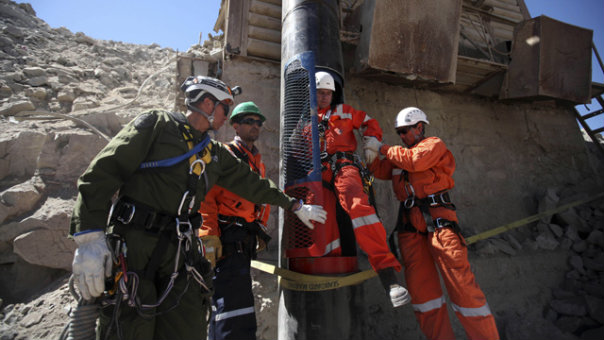
Just as Florencio Avalos walked out of the Fenix, a rescue cage that brought him up some 700 metres below the earth from the San José copper-gold mine in Chile, his eagerly waiting son hugged him hard. Not only Avalos and his family, but also the Chilean population and Courtesy: AP Photo/Government of Chile, Hugo Infantethe world at large heaved a big sigh of relief. Avalos  marked the end of a 69 day wait that started when there was a collapse in the mine in which they were working in, entrapping 33 men 2300 feet below the Earth.

Entrapped in a 50 square meter shelter, the miners lived through the ordeal and worked as a cohesive group. In fact for the first 17 days, they had no contact with the outside world, and no one knew whether there were any survivors at all. Yet, under the aegis of senior and experienced miner, the rest did not lose hope and started to ration the limited food they had on hand.

On August 22, when the miners stuck a note written in a red marker to a probe, the world came to know about the survivors. And subsequently, the heaven and earth were moved, quite literally, to rescue these miners. Mining accidents are quite common in Chile, but the gods were kind on these miners and the story ended on a good note. In a strange quirk of fate, the gods were kind once more in the past, some 38 odd years ago. In fact in some strange ways, the story of the Copiapó mine rescue has an unique parallels with an event that took place 38 years back. Popularly known as the Miracle in the Andes, the accident occurred in 1972, in the the world’s longest continental mountain range, the Andes.

Back then, a win turboprop Fairchild FH-227D flying under the Uruguayan Air Force insignia, crashed in the the Andes. The plane was ferrying Old Christians Club rugby union team from Montevideo, Uruguay, to play a match in Santiago, Chile. There were 45 people on-board including players, crew and their families. After a frantic search over the arduous terrain of Andes, the search was abandoned and the passengers given up for dead. But unbeknowst to them, the plane had crash-landed and while 12 of the 45 passengers died instantly, the rest survived. But the condition of the living was worser than that of the died. Continue reading

Interview: Dave Evans (Cisco)

Sitting across the table, some 13000 kms away in San Francisco, was the man of the future, Dave Evans, chief futurist, Cisco. Through the enclosing Telepresence screen, I could almost feel the glare of his peering eyes. But then, that’s the side-effects of dealing with a futurist, who’s job profile involves looking always over the horizon. Dave is just the man for it.

The best thing about him is that he does not confine himself, solely talking about networking and hardware (which could be expected since he draws his paycheck from Cisco), but he can shed light on a variety of topics. For instance, a good 15 minutes of our time in the interaction we spent discussing how the human society will evolve, will ever have a scenario like that poignantly imagined by HG Wells in the Time Machine, a division of the human society of lazy Eloi (the haves) and the wily Morlocks (the have-nots).  Well, he charted the division from the digital divide perspective and seemed wary of how it might widen in the future.

Nonetheless, we did speak much on technology and here is what he had to say on various things.

Just one thing, don’t forget to read Dave Evans 25 top tech predictions at the end of this interaction. In fact if possible, read it first before diving into the Q&A.

In one of your prognosis, you have spoken about data explosion. How critical is the issue?

Data explosion is one of the biggest issues that will hold sway in the days to come and that is simply because we are generating information at an exponential rate. To give you an idea, the Internet in the US at 2015 will be 50 times larger than in 2006 because of the huge volumes of data uploads. Even as we talk now, the Internet is growing fantastically, savour this, everyday some 10 billion email messages are sent, close to 20 hours of video is being uploaded on YouTube every single minute. So in a way, we are drowning in this sea of data that we ourselves are creating.

This explosion has led to the realisation that data is not knowledge, and we need to be careful and not err in believing the same. The difference is essential as today companies across the world are digging deeper into the vast loads of information they have to find nuggets of consumer insights and thereby build up business. Thus, it is very critical for an enterprise to chalk out a strategy on how to deal with data explosion.

You have also spoken about instantaneous communication in the future, how will that have an impact?

In the years to come, thanks to wonders like quantum computing, etc. instantaneous communication will indeed be a reality. But even today, the world has more or less flattened when it comes to communication as the Internet has enabled communication with everyone in a matter of few seconds. The impact is huge, for instance, a few centuries back if I had to share knowledge with you, I would have to go through the arduous old trade routes and it could take anything between a few weeks to months for us to get together and exchange words. And here we are today in different part of the globes, sitting across the table and conversing in real time. This ability to share knowledge instantaneously will have a huge impact in the days to come, business models, revenue models; everything will change under its wake.

You also used the term ‘flattening’, what are the implications of the same?

Huge and we are already witnessing the impacts of the same. You see, the flattening, so as to say, has not only resulted in an agile workforce, but has also turned the world into a sort of global marketplace. So any company located anywhere in the world can sell anything to anyone located elsewhere. That’s why countries like India and China are blossoming. They are becoming tour de force vis-a-vis the US. This is a huge challenge for enterprises and even bigger opportunity for them.

Do you think the networking and communication capabilities be able to cope up with this growth? Continue reading

Encounter with the Pee-lice

It was late evening and the little shrub shrugged disenchantedly under the warm shower, much like a kid does when rudely woken up for school. After being drenched incessantly by the Westerlies, the last thing that it desired was warm water to disturb the repose. And yet, for all my concern and respect, I had little recourse but to let nature have its way — out of me. So, after dutifully ‘watering the plants’ or rather a solitary shrub on a dark sidewalk, I felt much relieved and refreshed to continue my onward journey home.

But barely, had I zipped up, a hoarse cry disturbed my nirvana. On turning around, I found out that the person hollering out was none other than a Mumbai cop, and by the way he was looking, he seemed to be a sub-inspector (had a gun holster and no Pandu cap) and yes he seemed much irate and on the verge of fuming.

Hey kay kele” he said much loudly, even though a few quick paces had brought him much closer to me than before. On seeing my bewildered look, he quickly shifted from Marathi to Hindi (to help me or chastise me). The subsequent conversation ran something like this:

Mad cop (MC): Tum idhar su su kyun kia?
Bewildered me (BM): Saab, jor se aaya tha
MC: Aur koi jagah naheen dikha
BM: Saab kidhar karta poora to road hain
MC: To kya idhar karne ka, police ka gaadi naheen dekha kya

At that point, I did remember seeing the police vehicle — the kind that was bought to fight off the Kasab-types, a heavy built Scorpio with COMBAT etched boldly — parked on the side. But then since, there seemed to be no women in there, and considering that men are often considerate on such sensitive issues, I decided to let nature have its way. I tried explaining it as deferentially as possible.

BM: Saab, dekha tha, magar bahut zor se aaya tha, aur aage sab ladies wagarah khadha tha. To out of respect idhar kia
MC: Tumko police ka respect naheen hain?

The question seemed more like an accusation, and even though the answer was fairly obvious, I continued lying through my teeth.

BM: Saab, bahut respect hain, but aap samjho na

By this time, he was in angst not only that I had peed, but also the fact that since I wasn’t conversant in Marathi, it was obvious that I was an outsider or rather a migrant. Now, now, a migrant dirtying Mumbai, no self-respecting cop can bear. So, almost sounding like Gabbar from Sholay, he pronounced. Continue reading

Of Bun Maska and History

One of my biggest regrets in life is that I am ill equipped to be a food reviewer or a connoisseur. Over the years I have been an mute outsider to discussions of whether Karims in Jama Masjid, Delhi, is the best place for kebabs or is it Bade Miyaan in Mumbai, or whether the pork chops in Goa are sumptuous or is it the momos in North East.Menu at Ideal

At most I could look on with wonder at how passionate people become when comes to discussing cuisines, I would smirk and nod my head in disbelief. It was just that I never felt like arguing or debating so valiantly over a paneer kadhai or even an aloo paratha.

The reason is quite elementary, my dear Watsons, I happen to be a vegetarian. And not the ‘vegetarian type’ of vegetarian that abound these days. To my own misfortune, I was born in a family that always looked at a rabbit as cute, while others looked at the supple meat (like in the case of a waterhole in Bangalore, where I saw a rabbit merrily hopping around, oblivious of the fact that the menu card there promoted rabbit fry).

As a kid I loved chickens and was mortified to know that people make soups out of them and horrors of horrors even drank it! As those cute-furry chicks came out of that oval egg, I could never even bring myself to even eating it and because of it I had to forsake almost all pastries, cakes, chocolates (I used to love Mars till I came to know) and what not. I was happily living this life of deprivation, and then I was married.

My better-half had quite other ideas about how to deal with chicken, goat, fish and other forms of animal life. She preferred to devour them. I’m now used to watching the relish on her face, when she dug into a Goan Prawn Curry, or bit a piece of tandoori chicken. It was then that I came to know from close quarters how mutton tastes (like soyabeen) or how it does not. I also came to know that while it might not be harder for a veggie to turn non-veggie, the versa is hard to make. Continue reading

Paragliding @ Panchgani

“Remember keep your legs straight, run fast and when you reach the edge — look straight and jump,” was Sultan Bhai’s  terse command for me. I would have readily followed his instruction, but for one simple thing, he was asking me to jump of a cliff in Panchgani overlooking a valley, a straight drop of a few thousand metres, enough to make Protinex  out of your bones. But, then, I had willingly chosen to undertake the mission and could only nod meekly in agreement, leaving everything to his good sense.
All geared up and in the air
Paragliding is not for the faint-hearted. The human body, for all its evolutionary beauty, is still fairly brittle and can barely take a big knock. So, surviving a fall from a few hundred feet is dicey, forget about a few thousands. Not to mention, there are scores of videos that are available on Youtube,  that capture how things can go horrifically wrong in a matter of seconds. Unlike other sports, the risks are fairly high and you cannot bet on the outcome.

Yet, standing there on the cliff, I must have seen some 9-10 nervous people jumping of the cliff, soaring in the air and returning quite safely to reassure my worried heart. Also the fact that I would not be alone on the trip, there would an experienced hand with me on the sojourn to take care of all the technicalities and also to ensure that after some minutes on the sky, I land safely back on terra firma. Considering my over-healthy frame, my para-guide Babu, waited for the wind currents to increase a bit. His main worry was that once we jump, it should not be that my weight pulls us both down towards certain doom. Hence, I had to wait till early-evening before taking the plunge.

The price for a few minutes in the sky was not cheap. For low-flying 15 minutes, it was 1500 bucks and for high-flying 30 minutes it was 3000. I opted for the latter as I didn’t know when next I will be air-borne, so might as well as make the best of it right now. Before the flight, the guys make you sign a declaration bond, stating that in case of an accident there is none else to blame, etc. Believe me, at that moment the declaration form seemed ominous. Continue reading

Uddhav: The Reluctant Tiger

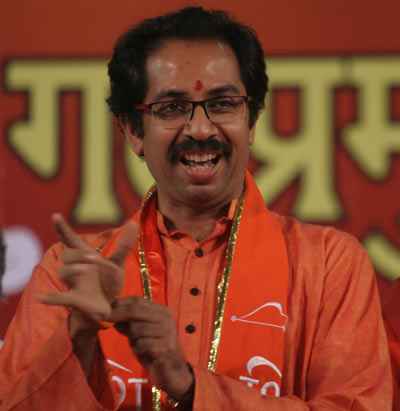
Right alongside the mirror in Matoshree’s bathroom, there must be a sticker of the party emblem — the tiger and a placard that would have the words ‘growwllll’ etched on them. The purpose of the two is simply to remind Uddhav Thackeray his lineage, and to imbibe the ‘killer instinct’ in him that the Thackerays are so much renowned for. Somehow Uddhav, the youngest of the Bal Keshav Thackeray clan, was a misfit in the family and hence he needs to be constantly reminded of who he is and what he must pose. The latest episode involving the mud-slinging with Rahul Gandhi and Shahrukh Khan is an illustration of the same fact, the display of false paws.

Some are born great and some have greatness thrust upon them, goes the adage and Uddhav is a living testament to that. Till about 2002, little was known about Uddhav except that he liked photography and yes that he was the youngest  son of the ‘remote control’ of one of the most vituperative Hindu leader. The bespectacled almost impish Uddhav preferred to do his bit, snap tigers in the wild, or shoot forts in Maharashtra from a helicopter.Uddhav, whose name means the brother of Krishna, was quiet happy to lead a non-descript life with his two sons. Since, he happened to be at the vortex of power, he could barely afford the privilege of a profession. So, he was content hosting his photo exhibitions now and then and living it out at his idyllic farm house in Karjat. Unlike his elder brothers, Jaidev and Binda, who were either spoilt by the allure of power or caught in a web of indulgences, Uddhav kept away from both politics and business. In a way, youngest Thackeray seemed to have inherited more from his mother Meena Thackeray, a warm and genile persona that shielded an iron will.

Yet, for all his desires to be away from the dust and grime of politics, he was destined for it. With the death of his brother Binda Thackeray in a car accident, his mother Meenatai in a cardiac arrest and relationship souring between Jaidev and senior Thackeray, his ageing father had no shoulder to lean on, except Uddhav’s. Though, there was indeed Uddhav’s cousin and Balasaheb’s nephew Raj, who had completely imbibed his uncle not only in the way he looked, but also the way he spoke, he thought and he reacted. Raj also had a keen business mind, and was not averse to using any means to achieve his ends. The Ramesh Kini murder case was an example, Raj was accused of threatening and subsequent murder of Ramesh Kini for a real estate deal. Raj over the years, under the aegis of Balasaheb had become the de-facto heir, whose anointment was just a matter of time. But destiny had other plans for him as well.

Once, the Shiv Sena (in conjunction with BJP) had tasted power, they were keen to hold on to it. In fact, before the saffron combine took over the Maharashtra state legislature in 1995, Shiv Sena were just a band of ruffians that were content to terrorise real-estate barons and business people and exhort money from them. But on ascending the CM’s chair, this band of ruffians suddenly realised that the real riches lay elsewhere and what they had been all the time dealing was merely a drop in front of the ocean of opportunity that lay in front. After 5 years in power they were badly itching to be back. Power was undeniably a great intoxicant and now that the ruffians had tasted it, they could not stay away from it.

Continue reading

Killed by Blackberry?

“Heard the latest? Ranjan Das is dead,” my friend Sudesh updated over GTalk. The bit of news numbed me, and for a moment I thought it must be some other Ranjan Das he might be referring to. Certaily not the Ranjan Das that I knew, the MD & CEO of SAP, who was young fighting-fit with a cherubic face. Amongst the many IT top guys that I knew, he was by far the fittest, Ranajajoy Punja (ex-cisco and now Vodafone) would come in second. I remember meeting Ranjan a few months back, the suave and genteel man seemed completely in control and excited to drive the German company’s revenues in India. In fact, SAP after many years had nominated an Indian for the top job (followed by Alan Sedghi) and Ranjan seemed to be the best man for it proved by the soaring revenues even as the economy took a dip. Hence, after a few anxious moments, I asked Sudesh “the SAP one?” To my dismay it was. And all that remained was a shock.

The reason for this profound effect was his age. At 42, Ranjan could be termed to be at his prime. He was physically fit, in fact he was returning from a session at the gym when the hands of fate stopped his Rajandasheart beat. Going by my own gait and girth, I for once would have been a more likely candidate for such an event in comparison to Ranjan. But then Ranjan is not the exception when it comes to a life snuffed out in the prime, in my own personal sphere I have come across numerous instances like Dewang & Sunil Mehta from Nasscom, Vivek Dayal from Mphasis, etc.

The one thing that is common to all these departed souls except for their relatively young age, is the fact that they all were involved in fairly high-profile work. All of these people including Ranjan were complete go-getters, always on the move, with set goals for the future and moving briskly towards them. The only thing a miss was that such work and lifestyle brings in tons and tons of stress with it. Somewhere their bodies could not keep pace with their ambitions and it gave up. Hard stress and not hard work killed them. Continue reading

Indian CIOs: A pampered lot?

Settling down for a cup of tea with a CIO friend of mine, the discussion veered about things in general and not so general. After touching topics like the elections in Maharashtra, water cuts in Mumbai, and Nobel for Prez Obama, the topic veered towards the various clubs et al. The clubbing bit was a trigger and my friend showed me an invitation that he (or another CIO friend of his) had received from reputed IT publishing group.
The proposed club had almost all the features like the other CIO clubs, but it went a bit ahead. Namely, there will be family outings, tuitions and career guidance for kids, cookery classes and kitty parties for wives, caretakers for old parents, etc. In addition, there will be all those ‘exclusive’ conferences invites, the offsite events, etc. etc. Yet one of the most distinguishing features of the proposed club was the annual fee, a whopping Rs. 1,00,000 per annum.
With a rather obtusely open mouth, I asked my friend what he thought of the initiative and the annual fee. He smiled at me obliquely and responded; “why pay when you can have all this and more for free”.
Indeed, over the years that I have spent in the IT industry, one observation that has been reaffirmed time over time that among all the other top executives within an organization, the Chief Information Officer or CIO stands tall and is treated differently  both within and outside the organization. It has been a long journey was the Indian CIO, often starting as an EDP manager in the days of yore and then going on to head a function that was at best considered to be a support one. Today, the IT department is critical glue that not only connects the disparate functions within the company but now is also a strategic one than can help in curtailing costs and gaining market share. As the weight age of the IT function zoomed over the years, so has the stock value of the CIO.

And the CIO stock value only increases depending on the vertical space he is in, thus say for instance a CIO at TCS, Infosys and Wipro might be at par with the rest of the chiefs, like CFO, CPO (chief people officer), etc. In other domains like manufacturing, banking and telecom, where IT could be the deciding factor between success and disaster, the CIO is next only to the CEO. No major decisions in these companies are taken without the CIO’s solicitation. The CEO is constantly checking out with the CIO, “Is this possible”, “how can we do it better”, “help!!”.
The change in the CIO’s stature can be gauged by the cosy cabins that they now occupy, till a decade or so back, CIOs used to take up space beside the data enter in case they are needed in a jiffy. But now, their cabins are next to CEOs and rest, reflecting a shift from a technological role to that of a strategic one.
So that proves how the CIO’s role has evolved over the year. Let me now tell you why they are a pampered lot as well.
India is a country in a hurry at the moment. After years of socialist stagnation, we embraced the liberalism with the enthusiasm and fanaticsm of a new convert. Suddenly the economy shifted gears from neutral to 4, and growth became the new mantra. The change in the market also brought about a massive change in the mindset as well. Also, with economy opening up suddenly there were a glut of options.
Since, IT is all pervasive, right from the desktops, mobile to the data center, the CIO’s opinion on what to buy and how much to buy became the last word on it. The vendors realised it first and smartly and subtly started to cajole the CIOs, with Diwali hampers, New Year gifts, branded freebies, etc. Next, they started to organize conferences and round-tables at fancy locales abroad, taking the CIOs with them on an all paid luxurious trip.
It is not only the vendors who court the CIOs, but the media, especially the B2B one, became an ardent admirer. For the few publication houses that run the magazine in the space, the CIO community is the most important one, simply because depending on the same will the vendors agree to splurge on full page or false cover adverts. In the past year or so, for these B2B publications, as the print revenues shrunk substantially, events became an important source of income. And now the CIO was no more an important factor, but the most important factor, as the sponsors would only agree to pay if you could ensure the presence of a set number of enterprise CIOs for the event. Any faltering on the number and the client would refuse to cough up as well. Little wonder, in the past one year, there were more enterprise events (from business intelligence to storage) than the past 5 years. Not only the B2B magazines, but also reputed mainstream publications and business news channels started organizing such events to quickly shore up their top line.
The Indian CIOs too realised this shift as now they were being repeatedly called as panellists, delegates, etc. for scores of events. Take the case of my CIO friend having a tea; in the past week he had attended 4 conferences, 1 in Bangalore, 1 in Delhi and 2 in Mumbai, flying business class to all places. And this was a lean week, since he could not attend (or wished not too) some 5 other events he was called to. He is a star and he knows it.
Another symbol of the power is the amount of clubs that have mushroomed over the past few years, one of the most successful ones is the CIO Club in Mumbai, set up by the CIOs themselves. The club activities take place in swanky 5-star hotels sponsored by different vendors. Recently, Network 18 had officially joined hands with the club, to what end, I am still not sure. Then there is a Gartner Club for CIOs, rumoured to be quite heavy on the pockets and also IMA has a club for the CIOs as well. Indeed, every publication worth its salt tries to engage the CIOs through these clubs, forms, community exercise and the CIOs are quite aware of this. There have been times when senior CIOs have refused to attend an event if they are called merely as a panellist and not as a speaker. On the other hand, there are a few CIOs who can be seen at all the events and even the vendors are not keen to court them.
Thus because of the power than the Indian CIOs wield, they are much respected, loved, feared and also pampered by alln sundry. Even, my CIO friend, when I shared with him these views appeared to agree. Finally, I posed him the Rs. 1,00,000 question; Would you be joining the club?
“Of course not,” he quipped, “my CEO will never agree to pay and I would not want to pay. If I did pay, would it not be better to pay for gymkhana membership that will help me get in shape. Rather than a publication that promises to provide me special pases for events; where I would be invited anyways,” he stated. Like many else Indian CIOs, he did seem to know his value and surely he won’t settle for anything less.

Settling down for a cup of tea with a CIO friend of mine, the discussion veered about things in general and not so general. After glossing over issues like the elections in Maharashtra, water cuts in Mumbai, and Nobel for Prez Obama, the topic veered towards the various clubs et al. The clubbing bit was a trigger and my friend showed me an invitation that he (or another CIO friend of his) had received from reputed IT publishing group.  The company was establishing a CIO club, and was soliciting advice on it.

The proposed club had almost all the features like the other CIO clubs, but it went a bit ahead. Namely, there will be family outings, tuitions and career guidance for kids, cookery classes and kitty parties for wives, caretakers for old parents, etc. In addition, there will be all those ‘exclusive’ conferences invites, the offsite events, etc. etc. Yet one of the most distinguishing features of the proposed club was the annual fee, a whopping Rs. 1,00,000 per annum.

With a rather obtusely open mouth, I asked my friend what he thought of the initiative and the annual fee. He smiled at me obliquely and responded; “why pay when you can have all this and more for free”.

Indeed, over the years that I have spent in the IT industry, one observation that has been reaffirmed time over time that among all the other top executives within an organization, the Chief Information Officer or CIO stands tall and is treated differently  both within and outside the organization. It has been a long journey for the Indian CIO, often starting as an EDP manager in the days of yore and then going on to head a function that was at bestpamperconsidered to be a support one. Today, the IT department is critical glue that not only connects the disparate functions within the company but now is also a strategic one than can help in curtailing costs and gaining market share. As the weight age of the IT function zoomed over the years, so has the stock value of the CIO.   Continue reading

A HOMO-sapienic ruling

People who belabour homosexuality in the society, terming it to be a disease (of the mind & soul) suffer themselves from an affliction: Homophobia. Homophobia, described as fear and contempt of gay and lesbians, is pretty much prevalent in our society. Through our literature, films and religious sermons, the caretakers of morality have repeatedly emphasised that homosexuals were different and dangerous; labelled as queer.
Indeed that stereotype built up over the ages still enshrouds our mind, so much so that if we were to know a friend or a colleague is a gay, snide comments will be passed and in all probability he or she would be socially segregated. Till sometime back it was believed that AIDs was borne out of same-sex relations. And the biggest opposition to same-sex relations came from organized religion be it Catholic, Hindu or Islamic.
The prejudice is so strong that if a man accidently brushes his hand against our crotch even in a crowded train; we immediately react with alacrity and would stare down at the man as if he is infested with worms and maggots. In fact, consider the terms that are used to refer to a gay or a lesbian; terms like faggots, queer, etc. In Mumbai we refer to them as ‘Gud’ (adding ‘Saala’ as an appendage) or Bombay Dost (based on the gay magazine published by Ashok Row Kavi).
Ironically, Homosexuality or the rather scientific term LGBT has been pretty common in the ancient times. Even the gods of yore frequently tipped the scale on both the ends, Zeus could not resist Ganymede or even rather strange inference by many of how Ganesha was born(e) by Parvati and Malini. I suggest that you do a Google on “god and homosexuality” and you will be surprised by the results thrown up.
And yet, for all the broadmindedness of the ancients like Greek pederasty, we the modern Homosapiens have been much intolerant of the sexual orientation of individuals. The worst instance of discrimination that I can think about was the incarceration of Oscar Wilde for his alleged affair with Lord Alfred Douglas. Wilde was made to suffer for “the love that dare not speak its name”.
Sadly, the same provisions that were applied and used against Wilde in 1895 continued to be used in India thanks to the colonial legacy. But thankfully, that changed today as the Delhi High Court came out with a landmark judgement by quashing the provisions of IPC 377 that applied to consensual sex between gays and lesbians. With one swipe, the court removed an unjust and unfair act that compelled individuals to hide behind curtains and be ashamed of their sexuality.
Nonetheless, the brouhaha around the issue as hyped up by the media is fairly disconcerting, since the term “legalizing homosexuality” is quite confusing, it almost seems like “legalizing rape” or “legalizing burglary”. Semantically speaking, it is more like “decriminalizing homosexuality” than anything else. The other day, my dad was watching all those gay parades on the news channels and the argument on “legalizing homosexuality”; and there was shock, anguish and anger writ on his face. As if now, we all will be forced by law to make out with gays and lesbians. The frown on his upper-story disappeared only when I explained to him the real picture, and what legalizing actually meant. I firmly believe that the media right now doing a grave disservice by improper usage of terminology and thus in a way promoting homophobia.
Meanwhile, let’s all hail the modern or as I termed Homo-sapienic ruling by the Delhi HC. And let’s hope that revulsion and fear associated with same sex love will vanish with time as more and more couples step out from the closet. Wonder, when will Shahrukh Khan (SRK) and Karan Johar admit it all over Koffee? Or are they really just ‘good buddies’?

People who belabour homosexuality in the society, terming it to be a disease (of the mind & soul) suffer themselves from a serious and dangerous affliction; namely, homophobia. By the way, homophobia described as fear and contempt of gay and lesbians, is pretty much prevalent in our society. Through our literature, films and religious sermons, the caretakers of morality have repeatedly emphasised that homosexuals were different and dangerous; labelled as queer.

Indeed that stereotype built up over the ages still enshrouds our mind, so much so that if we were to know a friend or a colleague is a gay, snide comments will be passed and in all probability he or she would be socially segregated. Till sometime back it was believed that AIDs was borne out of same-sex relations. And the biggest opposition to same-sex relations came from organized religion be it Catholic, Hindu or Islamic.

The prejudice is so strong that if a man accidently brushes his hand against our crotch even in a crowded train; we immediately react with alacrity and would stare down at the man as if he is infested with worms and maggots. In fact, consider the terms that are used to refer to a gay or a lesbian; terms like faggots, queer, etc. In Mumbai we refer to them as ‘Gud’ (adding ‘Saala’ as an appendage) or Bombay Dost (based on the gay magazine published by Ashok Row Kavi).

Ironically, Homosexuality or the rather scientific term LGBT has been pretty common in the ancient times. Even the gods of yore frequently tipped the scale on both the ends, Zeus could not resist Ganymede or even rather strange inference by many of how Ganesha was born(e) by Parvati and Malini. I suggest that you do a Google on “god and homosexuality” and you will be surprised by the results thrown up.

And yet, for all the broadmindedness of the ancients like Greek pederasty, we the modern Homosapiens have been much intolerant of the sexual orientation of individuals. The worst instance of discrimination that I can think about was the incarceration of Oscar Wilde for his alleged affair with Lord Alfred Douglas. Wilde was made to suffer for “the love that dare not speak its name”. Continue reading

Hail Hynkel….

“Democratia schtunk!! liberty schttunk !! free spracken schtunk!!,” thunders Adenoid Hynkel in front of the sons and daughters of the Double Cross. But even as the Hynkel bares open his dark soul and devious intentions, “strunken me de Europe, and strunken me de world,”; the personal translator on the radio station, Heinrich Stick goes about frostily reading from a prepared script and states that “in conclusion the Fuhrer remarks that for the rest of the world, he has nothing but peace in his heart.”

Burlesque is the one word that comes to mind as one is riveted watching the Great Dictator, a brilliant parody by one of the greatest comedians (and actor as well) this world has ever seen: Charles Chaplin. In fact, the opening speech by Herr Hynkel is one of my all time favourite scenes; the way Hynkel raves and rants about his greatest army and navy, the guttural noises he makes while talking about Jews and the times he breaks off remembering the struggles he had with Herring and Garbitsch (pronounced as Garbage) or the beauty of the Aryan maiden. The 5-minute long address is delivered in gibberish English, with smattering of German words.   

It is not merely Hynkel’s speech, in fact each and every scene in the movie is a masterpiece by itself and that is what makes the movie such a classic and Chaplin such a genius. I well remember about an incident the Satyajit Ray recalled about making Pather Panchali. Filming one of the sequences, he got so carried away by the visual that he continued shooting. It was only later on that he realised that while the sequence was very much visually appealing, it great-dicator-1did not really fit into the scheme of things and had to be discarded. The movie is more important than the sequences, was the implied message.

And yet, if one were to see Chaplin’s films they are all made of amazing sequences that are meant to tickle us. Chaplin’s antics stay with us, even if the movie does not. Many years back, when I was much younger and in school (apparently 2nd or 3rd standard), we were all taken to Chaplin movie being screened in one of the theatres. That was my first introduction to the tramp. I don’t really recall which that movie, but there are a couple of scenes that I still remember, apparently Chaplin and the villain are caught in a blizzard and in one sequence he cooks his shoe and sits down to eat it with a fork and knife. In fact he almost relishes the shoe, as if it is come delicacy. And in another scheme, the house they seem to be living in, slides down a mountain slope ostensibly because of Chaplin’s carelessness. This is all I remember from my first Chaplin movie. Nonetheless, it is a miracle that I remember anything from that movie considering the lapse of time (over 2 decades and more). That is the power of gag, that is where Chaplin’s genius: in creating gags that tickle. Continue reading

VFXing its Way…

Bollywood, the largest film industry in the world, has finally come to terms with computing power, as more and more filmmakers are jumping on the VFX bandwagon for cost or for glory.

Babubhai Mistry is a name not many are able to recall; even in Bollywood. The few that do, are completely oblivious to Babubhai’s (as he was fondly known) state of affairs; whether he alive or is no more. And yet, just a few decades back, he was a star in his own right, dubbed as the ‘trick scene director’, he was the person who made it possible for Hanuman to lift the Gandhamadan mountain or Hatimtai to fly on a magical carpet in Hindi films. For over 50 years, Babubhai was the man who gave wings to film maker’s and viewer’s fantasies, he was India’s premier special effects director with around 300 films to his credit as director or special effects cinematographer. Many dub his most active years, from 40s to 70s, as the age of the mythologicals (in another words, the age of special effects).

Till around 1970s, Indian and Hollywood films were more or less the same in terms of usage of technology and output. When Babubhai made Mahabharata in the 60s, around the same time Hollywood saw the release of The Ten Commandments, Benhur or the King of Kings. There wasn’t a major difference in the way action sequences were displayed in these movies.

All that changed with the emergence of George Lucas on the international scene. Lucas’ Star Wars in the 1970s opened the realm of possibilities with the use of robotics and computer effects. Meanwhile, Steven Spielberg brought to life aliens in E.T., dinosaurs in Jurassic Park, sharks in Jaws and alien machines in War of the Worlds. Hollywood had discovered the magic of computers and was eagerly trying to redefine the realm of possibilities.

Finally, Peter Jackson went a notch higher, the Lord of the Rings trilogy proved what modern high-end computing can achieve. And if that was not enough, he put life in the giant ape King Kong. Visual Special Effects or VFX in Hollywood is getting bigger and bigger by the day, every year big blockbuster movies are released that heavily rely on VFX to pull the audiences.
vfx-1
In sharp contrast, Indian films lagged as filmmakers persisted with the same old techniques. The reluctance to adopt computing platform resulted in a yawning gap between Indian films and the ones made in Hollywood. So, while the two were on the same level till the 70s, over the next 2-3 decades, Hollywood raised the level of moviemaking to such an extent that the comparison itself seemed laughable.

Continue reading

Who will be the 18th PM?

Look at any newspaper, magazine, news channel, online media, just about anything, the hot discussion or rather the only discussion that is taking place these days is as to what will happen to the 15th Loksabha, who will win, who will lose and who will stay put. The best brains of this nation are trying to come out with the answers, right from the grey-haired political analysts to the scores of psephologists who have made a well paid business out of predictions.

And yet, as in the past, all these opinion polls and surveys fail to reveal the story, election after election. The reason is simple, the inherent bias. All Indians are political, whether they agree or not. Hence, when they are asked to make the choices they do so based on their desires and hopes (which by the way are shaped by their biases). It is very hard for any analyst, reporter, or even a psephologist to get rid of that bias. And yet, they pretend valiantly to do so. Thus, before every election there are these predictions that are built upwards and then fall flat like a house of cards.

Being a political Indian myself, I strongly feel the urge to add to the cacophony of these predictions. I think can foretell the future based on my ‘gut feel’ and am quite sure how things will turn out. And since, I am aware of my limitations (rather my communal bias), I feel the best thing to do will be to find a few more political Indians like me who feel strongly on the issue and have biases that are not quite like mine. So, while I am tainted in the communal colour of Saffron, I have asked my friend or rather comrade Abhijit Deb who is dipped in Red to make his predictions, and finally to balance the 2nd and the 3rd front, we have a supporter of the Gandhian family Akhilesh Shukla pitching in for Congress I.

Among us, we are making predictions on how things will turn out in the days to come. And all this at a fraction of the cost of all those psephologists and analysts, just a couple of ‘cutting chai’. At the end of the political tamasha, we very much intend to return to this post, and am sure one of us would be grinning to himself patting his own back, while the rest will be terming this to be a rather childish and immature exercise or just that Indian politics is beyond the range of any rational analysis based prediction, it is game of tart, for the tart-headed.

So, mere pyaare desh vasiyon. Here are the 3 scenarios from three biased journalists, please take them with a pinch of salt and a tequila too (if you can afford one, that is). Here it goes:

Continue reading