HERE is an article of mine, recently published in the Dataquest Magazine, wherein I discuss about how technology can be employed to save big cats, especially the Royal Bengal Tiger, in India..A very special article for me…
(http://www.dqindia.com/content/egovernance/2007/107062701.asp)
——————————————————————————
The Last Roar?
Can technological innovations like GIS, GPS, Radio Telemetry save India’s national animal from certain extinction? The good news is that transformation is underway, the bad, it isn’t fast enough. Fortunately, technology might just rescue what humans have forsaken…
Wednesday, June 27, 2007
Tiger count tells a sorry tale’ screamed the headline of a leading newspaper on a sultry May morning. It was a page one lead story: a bolt from the blue for Indians who woke to the harsh reality that the National Animal had suffered a body blow. It was not the first time that such a thing had been reported. Over the past few years, there have been quite a few sting operations conducted by media houses to present the real picture. Experts have been crying hoarse over the catastrophic decimation of the species. Yet, f or the past many years, the country was lulled into a fall sense of security that all was well in the 30 odd wildlife reserves in India. The babus claimed time and again that not only were the tigers safe and sound, in fact they were thriving in the tranquility of the reserves. Nothing could be further from the truth!
The Wildlife Institute of India (WII) based in Dehradun, burst that bubble by presenting the truth to the nation last month. The preliminary report released talked of how tiger numbers had reduced quite drastically. According to WII estimates the tiger population in 16 of the country’s 28 tiger reserves in 2006-07 had fallen by over 50%. From 1,233 tigers in 2002, the reserves across Madhya Pradesh, Rajasthan, Maharashtra and Chattisgarh currently house only 490 or so tigers.
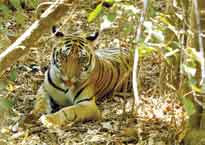 The story was picked and splashed across the media, some papers even terming it as the worst decline in tiger population since 1973. There were numerous articles, features in papers, debates and discussions on TV channels. Everyone wondered what had gone wrong, and that too so suddenly. How in the world was that possible? What had happened to all those tigers? Had they been killed for skin or bones, or had they just vanished? These were questions that were troubling every mind.
The answer was fairly simple: technology had ‘happened’ to the tigers. Or, more appropriately, to the art of counting tigers. Indeed for over two decades the science of census had been turned into an art by the officials manning the 28 tiger reserves in India. Using pugmark methodology, the census artists arrived at numbers that were vastly exaggerated and no way matched the numbers on the ground. That was the very case in Sariska.
—————————————————————-
Number of Sanctuaries and Parks for Wildlife in India
Number of national parks: 80
Total area of national parks sq km (5% of forest area): 36,882
Number of sanctuaries: 501
Total area of sanctuaries (17% of forest area): 120,052 sq km
Total protected area (22% of forest area): 156,934 sq km
*************
Source: Project Tiger
Going, Going, Gone
In December 2004, a news report highlighted the fact that there were no more tigers left in the Sariska Tiger Reserve, Rajasthan. It came as a rude shock, as till then the official record showed a healthy population of around 25-30 tigers in the reserve that is spread over an area of about 880 sq km, with three core areas (areas where no human are supposed to be present) and buffer zone (forested area with tribals).
In the wake of the uproar that followed, Prime Minister Manmohan Singh announced a CBI inquiry into the matter and even set a Tiger Task Force to study the issue and suggest remedial measures (the report was submitted and yet no action was taken, as usual).
“Sariska was simply a case of inaction. The poachers dealt a fatalistic blow to the few tigers that existed there. While all the time officials were talking about 25 tigers in Sariska. Every researcher knew it was a farce, because no one had sighted a tiger for quite many years. Those were just paper tigers, that existed solely on paper,” says Valmik Thapar, a renowned tiger conservation activist and author of quite a few books on the tiger, the latest being, The Last Tiger. He was also on the Tiger Task Force set up by the Prime Minister.
A Tale of Tall Numbers
At the turn of the twentieth century, there were an estimated 40,000 tigers in India. Indiscriminate hunting and loss of habitat resulted in a drastic dip in numbers, and by the ’70s, not more than a few thousand remained. There was international uproar as India houses close to 50% of all tigers, and if they disappear here it would effectively mean the end of the species. The future of the tiger looked dreary. The Prime Minister, at the time, Indira Gandhi, deciding to take matters in her hands set up a team to study the issue and come up with a plan to save the tigers. The team was headed by erstwhile ruler of Jammu & Kashmir, Dr Karan Singh. Based on the report submitted by the team, Project Tiger was launched amidst much fanfare in 1973.
Initially, Project Tiger was conceived for six years, from 1973-79, and was launched by setting up eight tiger reserves across the country (Sunderban was added at the launch, taking the number to nine). Over the years, the project received much success and was even termed as the ‘most successful wildlife conservation program’ in the world, by reputed international agencies. Gradually, the number of tiger reserves increased to 30 and by 2005, India had 90 national parks and 501 wildlife sanctuaries.
Thus, going by official figures, there were over 3,600 tigers in India by 2002. But the real story was something else. The figures had been arrived using pugmarks, which according to many is a faulty procedure. As it was solely based on human discretion, the figures could be easily inflated to reflect an increase in numbers while there was none.
“Pug mark census methodology was turned into an art by the officials. It was used to fabricate numbers. By the 90s, we all knew that the tiger population was declining, yet the reports would show that the numbers had actually increased,” says India’s premier tiger scientist and conservation activist Raghu Chundawat
Arriving at the Right Numbers
In the latest survey conducted by WII, the institute used advanced technology like DNA sampling and camera trap techniques to arrive at the current figure. The WII estimates showed that tiger numbers had fallen in Madhya Pradesh by 61%, Maharashtra by 57%, and Rajasthan by 40%. Compare this with the government’s first tiger census; conducted under the Project Tiger initiative, begun in 1973, it counted 1,827 tigers in the country that year. Since then the tiger population saw a steady rise to reach 3,700 tigers in 2002. Use of technology has effectively curtailed the numbers by half.
“Tiger count is a wrong terminology being used by everyone. We are not counting tigers; we are estimating the density of the tigers in a given area using scientific methodologies to arrive at the figure. Numbers by itself can be quite an erroneous game,” says BC Choudhary, senior scientist, WII.
Camera trapping is one of the technologically advanced ways of estimating the population of tigers. In this, cameras are placed across the jungle and whenever a tiger crosses a beam, the camera captures an image. As every tiger has a unique stripe coat, there is no question of the numbers being duplicated.
“Fortunately, after 40 years of wasting public money and effort, the pugmark census total count methods have been abandoned. I have been saying for 22 years that it did not work but the bureaucratic lethargy carried it so far…at great cost to tigers and to tax payers. Now even the government appears to be switching over to sampling-based methods I have used since early 1990’s,” says renowned Indian scientist, K Ulhas Karanth, director, India Program & technical director, Tigers Forever, Wildlife Conservation Society.
“Camera trapping is useful and cost effective for getting good estimates of tiger numbers in critically important reserves and populations. It is not meant for recording tiger presence across large areas or states or the country. It is a powerful and specific tool for a specific purpose,” adds Karanth.
The Poaching Menace
Without an iota of doubt, the biggest threat to the tiger is from the two-legged animal that violates the park rules and comes armed with sophisticated guns. Poaching and illegal trafficking of tiger body parts is big business. Data available at Project Tiger Directorate indicate that out of 173 deaths of tigers during 1999-2004, 83 were due to poaching. Out of the remaining, 60 deaths were due to natural causes, 13 due to electrocution, 7 due to poisoning, and 10 due to infighting. Thus, loss of tiger life due to poaching, poisoning, and electrocution works out to 103, which accounts for more than 60% of tiger deaths, reveals a CAG report for the year ended titled, “Conservation and Protection of Tigers in Tiger Reserves.”
Selling tiger skin and body parts is a highly lucrative proposition in foreign and domestic markets. Apart from tiger skin, nails, bones, tooth, fat, male genital, etc fetch anything from $300-500 per item. Tiger parts are high in demand in China, where they are used in traditional medicines. Other countries like Taiwan, Vietnam, Thailand, Singapore, are also known to be destinations for tiger parts. Not only those, sheikhs and the emirs in the Middle East are known to pay high price for tiger skin.
There are no two ways about it. If you want to save the tiger, you need to stop the poaching. Technology can be employed in the battle against poaching in a variety of ways, right from investigation to prosecution.
Sujoy Banerjee, director (Species Conservation), World Wildlife Fund (India) talks of how in the UK, the government has used a high-tech application to dissuade people who were stealing rare birds’ eggs from the nests: “The authorities identified these poachers and noted the registration number of their vehicle. Now, whenever these vehicles are found moving in such protected areas or towards Scotland (as these poachers also shifted activities to Scotland), the movement is tracked using cameras fitted by the roadside. This has helped in curbing their activities largely.”
A Black-book of Poachers
If catching a poacher was tough in India, getting him prosecuted is infinitely more tough. The big problem is that poachers are always on the move and strike at different reserves each time. This creates a problem for the police, as they are unable to corroborate the past history of the poacher in front of the magistrate, resulting in the poacher being let off easily. If there could be a central repository of all these crimes against wildlife it would be so much easier to prove cases against poachers.
“Analyzing the records in our database allows us to monitor trends in wildlife crime, which, in turn, allows us to advise enforcement officials. Secondly, we often find that poachers and traders linked to organized wildlife crime networks tend to stay in the business all their lives, and work in close knit cliques of relatives and family friends. Our database allows us to track these criminal networks as well,” she adds.Thus, if the WPSI team finds that a recently arrested individual has been arrested/convicted before for a wildlife crime, they pass the information to the public prosecutor so that the criminal’s bail application can be opposed more strongly. This database is regularly updated at WPSI and is a big asset in the fight against poaching.
Roger…Roger
Effective communication is the key to protection from forest fires, poaching, timber felling, grazing, encroachments and other illegal activities. While the poachers have been known to use sophisticated communication devices like wireless sets, UHB Radio, and even ham radio, the state of the forest guard is abysmal. “As many as nine tiger reserves- Manas, Valmiki, Indravati, Melghat, Pench (Maharashtra), Tadoba-Andhari, Periyar, Sariska, and Ranthambore were not equipped with adequate means of communication to counter illegal activities. In the Manas Tiger Reserve, four ranges, fourteen beats and two check posts were functioning without wireless network,” the CAG audit states.Not only that, even in sanctuaries where the communication network did exist, in most the devices were damaged. The Nagarjunsagar Tiger Reserve could not utilize the available communication/wireless network as per the advice of police authorities due to extremist activities in the area, and no persuasive action was taken by the forest authorities as of March 2006.
It is obvious that the Project Tiger officials do not pay much attention to communication among the guards. The consequences of such laxity are quite disastrous, and in the end it is the tiger population that takes the hit.
On the Tiger’s Trail
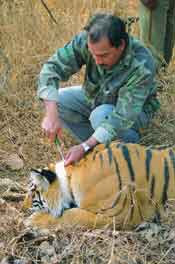
One of the best known methods to trail a tiger or a lion is through radio telemetry. In this, a tiger is tranquilized and a collar containing a radio antenna is put on the tiger. A researcher armed with a receiver can easily track a tiger with the aid of radio telemetry.
“Radio telemetry is a very good example of how technology can help. The tiger, as a species, is difficult to see. By nature tigers are very elusive and the quite hard to spot in the tall elephant grass. Also, it is a fact that they travel quite long distances. A male tiger often lords over an area of around 250 sq km, thus, without radio telemetry it would be hard for a researcher to track him down,” says Chundawat. In the past Chundawat has had immense success in discerning tiger behavioral patterns using radio telemetry and satellite collars. But then the red-tape stalled all Chundawat’s research efforts.”The biggest issue in use of technology, say radio telemetry or chemical immobilization, is the problems of getting research permissions. The officials managing wildlife are usually rather ignorant of science and technology and the utility of sound research. As a result, despite tremendous support to technology in other fields like medicine, ICT, agriculture etc, the field of conservation is held back by archaic mindsets. Sadly, our science policy leaders are ignoring this problem,” says Karanth.
Mapping the Forest
Another ambitious project launched by the government was digital mapping of all the wildlife sanctuaries and tiger reserves in India. It is important as an understanding of spatial factors such as connectivity between forest patches can help managers plan where and how to assign resources and efforts in general. Geographical Information Systems (GIS) are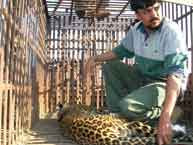 an essential tool to both wildlife managers and researchers alike.”With the development of technology, use of Geographical Positioning System (GPS) is also coming into vogue. It has been used to track the movement of Siberian cranes and sea turtles. Some tigers radio collared recently have a small GPS attachment which puts itself on at a certain time of the day as programmed, and then searches for satellites for fixing the location of the animal. The unit switches off by itself. It also transmits data to handheld devices which can be transferred onto a GIS,” says Banerjee.
Yet the signs have not been quite encouraging on the mapping front. For instance, in March 2004, the Ministry of Environment and Forests sanctioned a project at the cost of Rs 1.39 crore for mapping wildlife sanctuaries and parks by the WII.
The project was to be completed in 36 months with the aim to generate accurate, reliable and latest base line spatial information on forest types and density (using satellite imagery) and topographic features (supplemented by latest satellite imagery), On the completion of the pilot, WII was to take up the complete mapping and monitoring of wildlife sanctuaries in coordination with the Indian Institute of Remote Sensing (IIRS), National Remote Sensing Agency (NRSA) and Aligarh Muslim University. But according to the facts in the CAG report, “out of the five sites selected for this pilot project, three were tiger reserves, namely Corbett, Tadoba-Andhari and Dudhwa. The identified targets included generation of satellite data by July 2004 and securing the Survey of India (SoI) topographic maps by September 2004. However, both activities were not completed even as of March 2006. As against the projected expenditure of Rs 1.20 crore in the first two years, Rs 0.73 crore was released of which only Rs 0.30 crore was spent till the end of February 2006, indicating poor progress of the project.”
“Project tiger creates much hype about use of technology, but the performance on ground has been rather poor. They claimed to provide web-based access to their survey data three years ago. I see no sign of it at all even today. A lot of hype really,” says Karanth.
George Schaller, a globally renowned field biologist, and known as the greatest naturalist of the 20th century, sums up the issue beautifully. “Field biologists, such as Karanth and Chundawat, can use technology in the form of satellite radio-collars, camera-traps, DNA analysis of scats and other techniques to determine population size, movement patterns, and other aspects. That provides extremely valuable information. Such knowledge is essential for conservation-but it is not conservation. Conservation, in the final analysis, is culture, economics-and politics,” he mentions.
Baghbahadur and More
Indeed what Schaller says is quite true. In the end, conservation is also politics and the only way (read the right way) to influence politicians is through public opinion. If there is a huge rabble raised, usually the politician will have to back down. Internet can play a big role in influencing the opinion by projecting the true state of affairs to millions of individuals across the globe. Quite many tiger activist have woken up to the potential of the net.Ajay Sartape is one such individual. He has recently launched a tiger portal, http://www.baghbahadur.com/, in conjunction with a friend. He aims to consolidate all the disparate information on the internet on a single site. “Not only do we intend to provide information but also attempt to promote conservation. The problem with tiger conservation is that the common person is unable to associate him or herself with the cause. By providing different means and channels, we hope to spread the word on tiger all across India. The success of Baghbahadur will be in influencing policy decisions through public opinion,” says Sartape. Tall aim, but Internet has been known to connect individuals like no other medium did so in the past. Thus it could play a big role in conservation. “Internet has revolutionized how information on conservation issues is disseminated. It also improves fund raising opportunities for conservation groups and the dissemination of knowledge about the species in question,” opines Banerjee.
Any Silver Lining?
The complete report by WII will be out by December 2007. In such a gloomy scenario, one wonders if there is really any hope left for the lord of the jungle. “Technology can enable informed decision in a timely fashion and more  importantly make the whole process transparent, making people accountable for their decisions and actions. This is what has been missing in Project Tiger,” says Chundawat.Thapar sounds skeptical. “The real fact of life is that tiger protection is not a priority for the government. So all it does is provide lip service. In many ways, it was only under the Gandhi family’s direct rule that the tiger was safe. After Rajiv Gandhi’s death, the numbers have been fast declining. Even the current government does not seem keen. There was the talk of setting up a state-of-the-art Wildlife Crime Bureau, but it exists only on paper,” says Thapar, ending with a note of caution, “There will not be any recovery. Damage done is damage permanent.”Meanwhile, Rajesh Gopal, director, Project Tiger was away in Europe and Ganga Singh, additional director, India Ecodevelopment Project, Ministry of Environment and Forests, would not comment, “as we need clearance from the ministry,” he said.
But can technology come up with a solution that will solve the issue, something like what was shown in Jurassic Park. Adam Barlow from the Sunderbans Tiger Project in Bangladesh dismisses the thought. “Blind faith; this is generated with respect to the idea that technological advances can combat large scale long term environmental damage-not with current knowledge, which has been proven insufficient, but with the hope that ‘well we’re bound to think of something!’ The reliance on advancement in technology to solve social and environmental problems is a fallacy, made dangerous by growing acceptance,” he says.As Schaller says, with characteristic brevity and clarity, “India has to decide whether it wants to keep the tiger or not. It has to decide if it is worthwhile to keep its National Symbol, its icon, representing wildlife. It has to decide if it wants to keep its natural heritage for future generations, a heritage more important than the cultural one, whether we speak of its temples, the Taj Mahal, or others, because once destroyed it cannot be replaced. If the answer is yes, then plans can be made and implemented.”
Jim Corbett, the famous hunter and conservationist, had sounded a warning more than half a century back in his famous book, the Man-eaters of Kumaon. “I am convinced that all sportsmen, no matter whether their viewpoint has been a platform on a tree, the back of an elephant or their own feet, will agree with me, and that is, that a tiger is a large-hearted gentleman with boundless courage and that when he is exterminated, as exterminated he will be unless public opinion rallies to his support, India will be the poorer by having lost the finest of her fauna.” So let us not bat an eyelid and rally to the tiger’s support, there might just be a chance, a rather slim one.
***x***
Chip Inside
In 2002, the leopards in Maharashtra had turned into public enemy number one. There were numerous cases of leopard attacks. Wildlife biologist and vet, Aniruddha Belsare, decided to study the human-animal conflict. He tagged a few leopards that were caught in the proximity of human settlements, and later released in the wild. The chips implanted were passive alphanumeric tags. “The study threw up some very interesting clues. As these leopards were released in the wild, in certain cases close to 400 km from their home territory, they were disturbed. Because of that they started attacking cattle, animals and even humans. They became aggressive due to habitat displacement,” he said. Belasare also talks how leopards try and hone into their home territory, in one case a leopard that was chipped was found over a 100 kms away from the location he was released, he was trying to return to his original base. “Technology can be used greatly to study conflict in animals with radio telemetry and embedded chip,” says Belasare.
DNA Profiling
As it is hard to identify a tiger due to its elusive nature, researchers are all the time trying to find a solution. Non-invasive DNA-based techniques, which identify individual species and animals with the molecular analysis of collected hair and scat samples. With the profiling in place, trends in tiger behavior will be easier to discern. There are two institutes in India that are currently working on DNA profiling, WII and the Centre for Cellular and Molecular Biology in Hyderabad. “DNA analysis on wild population can also help monitor poaching trends. For instance, if we had a DNA profile of all the tigers, and if we caught a tiger skin, we could compare it to the database and find out where this tiger had been killed. If there are more cases from a certain forest reserve or reserves, you know where these poachers are active,” says Chundawat.
Tracking Elephants with GPS
WWF in India is using GPS to track elephants in Assam. “We are tracking the movement of elephants in Assam (by following elephant herds, or using secondary indicators of elephant movement such as dung, footprints, etc) by using GPS. The data is transferred on to a GIS, which gives us critical corridors”. says Banerjee.The study has thrown up a lot of data on animal behavior and helped understand human-animal conflict better. 
By using this technology, we also come to know more about their “errant” behavior, for eg, the very recent storming of Hojai town in Assam due to which a curfew had to be imposed for two days,” he adds.The Wildlife Protection Society of India (WPSI) has created one such database, a veritable of who’s who of Indian poachers. “At WPSI, we work extensively with enforcement agencies such as the Forest Department and the police. We have found that one of our most effective tools is our wildlife crime database which has over 15,000 records of wildlife crime from in and around India,” shares Onkuri Majumdar, senior project officer and the legal program, WPSI.
Electronic surveillance in the jungle
Wildland Security, a U.S. based company, has designed electronic surveillance technology for monitoring of protected forests. Labeled as TrailGuard, the remote electronic surveillance technology increases the effectiveness of protection efforts both in terms of the cost effectiveness of monitoring as well as by increasing apprehension before poaching occurs. TrailGuards work by detecting human intruders as distinct from other animals that may be in the forest. The principle discriminate that we use are magnetometers (metal detectors) buried near the principle trails poachers are likely to use. Humans would be the only ones carrying iron objects-machettes and guns, for example. The detection events are then transmitted by a radio data link to a low-cost satellite internet gateway located in the canopy. And hence to the internet and a web server where the event is recorded and then emails, GSM SMS text messages and satellite pages are sent to a designated list of parties such as the chief ranger and, possibly, funding agencies. So within a matter of a few minutes after an intrusion is detected, patrols can be dispatched to where the event occurred, says Steve Gullick from Wildland Security.Is it costly? “The system is in a prototype stage so I can not give exact figures as to the cost once it is in full production. I think it would be in the order of $1,000 per trail site protected. I also think that in many areas there may be only 6-10 principle established trails into an area so a large number of TrailGuards would not be required to provide a greatly increased 24/7 surveillance,” says Gullick.He has been approached by Biswajit Mohanty of Wildlife Society of Orissa for elephant protection and Ulhas Karanth as well. Probably TrailGuards can solve the issue of monitoring the parks, a big issue in India.
—EOM